
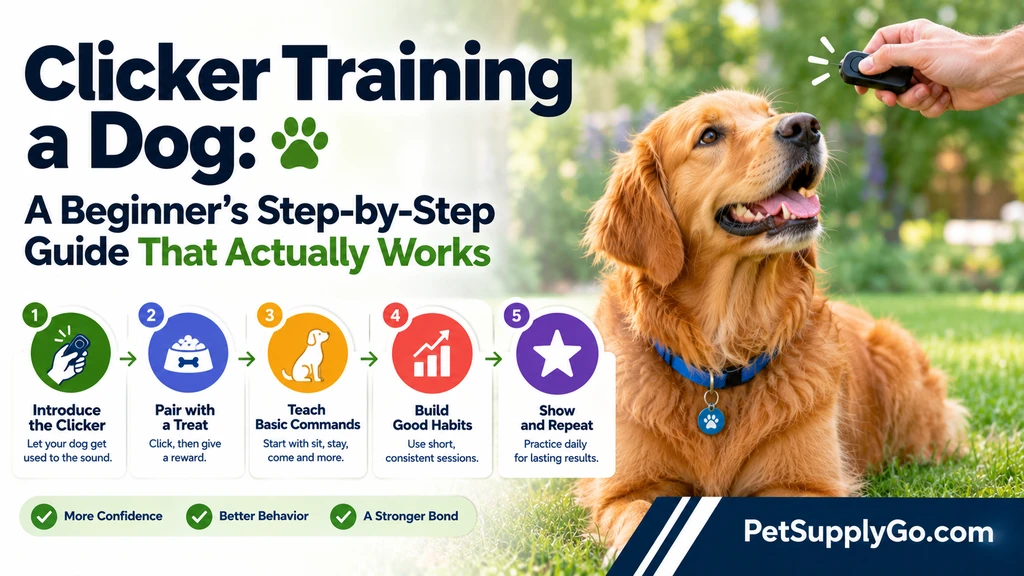
If you have ever tried to teach a dog something and felt like you were speaking a different language, you are not alone. You say “sit,” your dog stares at you, and you say it again, louder. Nothing changes except your patience.
Clicker training fixes that problem in a surprisingly simple way. Instead of relying on words your dog does not yet understand, you use one short, clear sound to tell her exactly what she got right, the instant she does it. Then you follow it with a treat. Within a few sessions, most dogs figure out that the click means “yes, that, and a reward is coming,” and they start offering behaviors on purpose to make it happen.
It is a friendly, low-stress way to teach nearly anything, from basic manners to tricks, and it works for puppies, adult dogs, rescues, and even seniors. You do not need special talent, a big budget, or a lot of time. A clicker costs a few dollars, and a handful of small treats is all the rest you need.
Keyword data from Google Keyword Planner shows that “clicker training” draws roughly 5,000 average monthly searches in the US, with low advertiser competition. People searching it want practical help: what a clicker actually does, how to start, what to do when the dog is scared of the sound, and how to teach real skills such as sit, come, and loose-leash walking.
This guide covers all of it, in plain language. You will learn how clicker training works, how to choose a clicker and treats, how to “charge” the clicker, how to teach your first behaviors step by step, how to add cues, how to fix common problems, and how to build a four-week plan. There are also 30 frequently asked questions at the end.
The short answer: clicker training is a form of positive reinforcement in which a click marks the exact moment your dog does something right, and a treat follows every click. Charge the clicker first, keep sessions short, reward often, and add the cue word only after the behavior is reliable. If your dog is sound-sensitive, use a softer clicker or a marker word such as “yes.”
Affiliate disclosure: PetSupplyGo may earn a small commission if you buy through links on this page. It never changes our recommendations or what you pay.
Important Note
This article is general information about training, not veterinary or professional behavior advice. If your dog shows fear, aggression, severe anxiety, or sudden behavior changes, talk to your vet to rule out medical causes, and consider working with a qualified, positive-reinforcement trainer or a veterinary behaviorist. Do not use a clicker or treats as a substitute for professional help with serious behavior problems.
Quick Answer: How Does Clicker Training Work?
Here is the fast version before we go deeper.
| Step | What to do | Why it matters |
| 1 | Get a clicker and tiny, soft treats | Simple tools, pea-sized rewards |
| 2 | Charge the clicker | Click, then treat, 10 to 20 times, so the sound means “treat” |
| 3 | Mark the behavior | Click the instant your dog does the right thing |
| 4 | Treat after every click | Always pay for the click |
| 5 | Shape small steps | Reward tiny improvements toward the goal |
| 6 | Add the cue | Say the word only once the behavior is happening reliably |
| 7 | Keep it short | Three to five minutes, a few times a day |
| 8 | Raise the difficulty slowly | Add time, distance, and distractions gradually |
| 9 | Fade the clicker and food | Once the behavior is solid, use clicks and treats less often |
| 10 | End on a win | Finish while your dog is still keen |
Key Takeaways
- A clicker is a small device that makes a short, distinct sound. It tells your dog exactly which behavior earned a reward.
- The click is a promise: every click is followed by a treat, every time.
- Timing matters more than the tool. Click the moment the right behavior happens, not afterward.
- Charge the clicker before you start teaching anything.
- Use tiny, soft, high-value treats, and count them in your dog’s daily calories.
- Keep sessions short, upbeat, and easy to win. Three to five minutes is plenty.
- Add a verbal cue only after your dog offers the behavior reliably.
- If your dog is sensitive to sound, use a quieter clicker, muffle the click, or use a marker word.
- Clicker training works for puppies, adult dogs, rescues, and seniors.
- You do not have to use a clicker forever. It is a teaching tool, and you can fade it once the behavior is learned.
What Is Clicker Training?
Clicker training is a way of teaching animals using a small handheld device that makes a short click. The click is a marker. It tells the animal, “that exact behavior is what earned the reward.”
The method grew out of the science of learning, and it was used for years by trainers of marine mammals, who needed to mark a behavior from a distance before they could hand over a fish. It became popular with dog owners in the 1990s, when trainer Karen Pryor and others brought it to the pet world. Today it is used by pet owners, service dog organizations, and professional trainers around the world.
It works because of how dogs learn. When something pleasant follows a behavior, a dog is more likely to repeat that behavior. The tricky part is timing. A treat handed over two seconds late may reward the wrong thing, such as the moment after your dog sat down and stood back up. The click solves that problem. It is short and consistent, so it can mark the exact instant your dog does the right thing, even before you can reach for a treat.
Think of the click as a camera shutter. It takes a snapshot of the behavior you like, and the treat is the payment that follows.
Why Clicker Training Works So Well
It is clear. The click is the same every time. Unlike your voice, it does not carry frustration, excitement, or tone changes that confuse your dog.
It is precise. You can mark tiny movements, such as a head turn, a paw lift, or a step in the right direction, so your dog understands exactly what to repeat.
It builds a thinking dog. Dogs learn that they can make the click happen by trying things. Many start offering behaviors, which makes them confident, curious, and eager to work.
It is gentle. There are no leash corrections, no scolding, and no fear. Dogs stay relaxed, and learning feels like a game.
It strengthens the bond. Training becomes a shared activity. Your dog learns that paying attention to you is rewarding.
It works at a distance. You can mark a behavior from across the room, which is handy for recall, stays, and tricks.
It works for many ages and breeds. Puppies, adults, and seniors can all learn. Shy dogs often blossom, and busy dogs get a useful job.
It is easy to learn. Most owners can start within minutes.
Clicker Training Versus Other Methods
You may hear terms such as positive reinforcement, marker training, lure-reward, and balanced training. Here is how clicker training fits in.
Clicker training is a form of positive reinforcement and marker training. It focuses on rewarding wanted behavior.
Lure-reward training uses a treat to guide the dog into position. It can be combined with a clicker, which then marks the moment the dog reaches the position.
Verbal marker training uses a word, such as “yes,” instead of a click. It works the same way, and is handy when you do not have a clicker.
Traditional or correction-based training relies on leash corrections or other aversive tools. Many modern trainers and veterinary behavior groups prefer reward-based methods, since they are less likely to cause fear or stress.
You do not have to choose one forever. Many owners use a clicker to teach new skills, then rely on a word and occasional treats afterward.
What You Need to Get Started
You can begin with very little.
A clicker. Any small clicker will do. Box clickers, button clickers, and wrist-coil styles all work. Pick one that is comfortable and easy to press. If your dog is sound-sensitive, look for a quieter version, or muffle the sound, and see the section on noise-sensitive dogs below.
Small, soft treats. Pea-sized pieces that your dog can swallow quickly. Soft treats are better than crunchy ones, since there is less chewing and crumbling. For single-ingredient options that work well for training and picky eaters, see our guide to freeze dried dog treats.
A treat pouch. Keeps treats within reach and your hands free.
A quiet space. Start in a calm room with few distractions.
A leash and a well-fitted harness. For outdoor work, a secure harness keeps your dog safe and comfortable. Our guide to dog harnesses for large dogs explains what to look for in fit and security.
A mat or bed. Useful for teaching settle and “go to your place.”
Patience and good humor. Mistakes are information, not failures.
That is the entire starter kit.
Choosing the Right Clicker
Clickers are not all the same. A few things to think about.
Sound level. Standard clickers can be sharp and loud. Quieter models exist, and some dogs do much better with them.
Style. Box clickers have a metal tongue that clicks, button clickers have a soft button, and wrist-coil models keep the clicker on your wrist. Try one that suits your hand.
Ease of use. You need to click quickly and with one hand, so choose something that is easy to press without looking.
Durability. A basic plastic clicker is fine, but cheap ones can break. Buy a spare.
Alternatives. A clicker is helpful, but it is not magic. A word like “yes,” a tongue click, or a distinct, short sound can work equally well, as long as it is consistent.
If you use a clicker, keep it simple and consistent. Do not use it as a toy or as an attention-getter, and do not click for fun.
Choosing the Right Training Treats
Treats are the paycheck. Better pay means better work.
Small. About pea-sized, or even smaller for small dogs. Big treats slow the session down and fill your dog up.
Soft. Easy to swallow quickly, with little crumbling.
Tasty. Use something your dog really loves for harder skills and distractions. Many trainers keep a few levels of treats, from “good” to “amazing.”
Safe. Choose dog-safe foods, and check ingredient labels, especially for xylitol, which is toxic to dogs. If your dog has allergies or a sensitive stomach, ask your vet before choosing treats.
Easy to handle. Treats that are greasy or crumbly are hard to carry in a pouch.
Part of the daily diet. A common guideline is that treats should be about 10 percent or less of daily calories. On heavy training days, reduce meal portions, or use part of your dog’s regular kibble as the reward. If you are unsure about your dog’s weight or diet, ask your vet. You can also browse our dog food category to compare options.
Other rewards. Some dogs love a toy, a game of tug, or praise as much as food. Mix and match, and see our dog toys category for ideas.
Step 1: Charge the Clicker
Before you can teach anything, your dog has to learn what the click means. This is called “charging” or “loading” the clicker, and it takes only a few minutes.
- Get ready. Sit in a quiet room with your dog and a handful of small treats. Your dog does not need to do anything.
- Click, then treat. Press the clicker once, then immediately give your dog a treat.
- Repeat. Do this about 10 to 20 times, with short pauses of a few seconds between clicks. Vary the timing a little, so your dog cannot predict it.
- Watch for the “aha.” After a few rounds, most dogs perk up at the click, and look toward you or the treat. That means the link is forming.
- Test it. Wait until your dog is looking elsewhere, then click. If she turns toward you with interest, the clicker is charged.
- Repeat it later. Do another short session a few hours later, or the next day.
Tips for charging:
- Do not ask your dog to do anything yet. Just click and treat.
- Click first, then reach for the treat. The click must come before the treat appears.
- Keep your clicker hand still, and click at the same speed each time.
- If your dog is startled by the sound, muffle it by clicking in your pocket, wrapping the clicker in a towel, or holding it behind your back. Then gradually increase the volume.
- If your dog is very scared, switch to a soft marker word such as “yes.”
The Golden Rules of Clicker Training
The click means “yes, that, and a treat is coming.” It does not mean “come here” or “pay attention.”
Click once. One click per behavior. Do not click repeatedly.
Always treat after a click. Even if you clicked by mistake. This keeps the click meaningful.
Click at the right moment. The click should mark the exact behavior you want, not the moment afterward.
Treat quickly. Deliver the treat within a couple of seconds, ideally in the position you want your dog to hold.
Keep sessions short. Three to five minutes is plenty, with a few sessions a day.
Make it easy. Aim for your dog to succeed about 80 percent of the time. If she keeps failing, make the task easier.
Do not use the clicker to call your dog. It is a marker, not a recall signal.
Do not use the clicker as a pointer. Do not point at things with it, or click to get attention.
End on a win. Finish with something easy, and a little extra reward.
How to Use the Clicker: Timing and Technique
Good timing is the key to good clicker training. Here are some tips for building it.
Click at the instant of the behavior. If you want to mark a sit, click as her bottom touches the ground, not when she stands up again.
Practice without your dog. Try clicking when a ball bounces, or when a friend raises a hand, to sharpen your reaction.
Hold the clicker in your non-treat hand. Keep the other hand free to deliver treats.
Keep it near your body. Hold it close to your chest, so your dog does not become distracted by it.
Treat in position. Give the treat where you want the behavior to happen, such as by her paws for a down, or by your leg for heel position.
Use a single, sharp click. Avoid the rapid-fire “double click” habit.
Do not worry about perfection. Early on, a late click is better than none. Your timing will improve quickly.
Mark the behavior, not the end of it. Marking at the end can reward the wrong thing.
The Three Ways to Teach With a Clicker
There are three main ways to get a behavior to happen, so you can click it.
Capturing
You wait for your dog to do something on her own, such as sit, lie down, shake, or yawn, and click it. Over time, she learns to repeat it for a reward. This is great for natural behaviors, and for dogs who like to offer things.
Luring
You use a treat to guide your dog into position, then click when she gets there. Lures are quick and easy, but fade them as soon as possible, so your dog does not rely on the treat as a prompt.
Shaping
You reward small steps that move toward a final behavior. For example, to teach a dog to touch a target with her nose, you first click for looking at it, then for moving toward it, then for sniffing it, then for touching it. Shaping builds creative, confident dogs, and it is the heart of clicker training.
Most trainers mix all three. For a new skill, pick the method that gets you the quickest first click.
Your First Behaviors: Step-by-Step
Start with simple, useful behaviors. Keep sessions short, and always end on a success.
Teaching “touch” (hand target)
Touch is one of the most useful skills in clicker training. It helps with recall, heeling, moving, and shyness.
- Hold your open hand a few inches from your dog’s nose.
- When she sniffs or touches it, click and treat.
- Repeat a few times.
- Move your hand to different positions, such as low, high, and to either side, and click for touches.
- Add the cue “touch” as she touches.
- Gradually increase the distance, so she has to move to your hand.
Teaching “sit”
- Hold a treat near her nose.
- Move it slowly up and back over her head, so her bottom lowers.
- The moment her bottom touches the floor, click, then treat.
- Repeat several times.
- Fade the lure by using an empty hand with the same motion, then clicking and treating from the other hand.
- When she sits reliably, add the cue “sit” just before she does it.
You can also capture a sit. Wait until she sits on her own, click, and treat.
Teaching “down”
- Ask for a sit.
- Hold a treat at her nose, and slowly lower it to the floor between her paws.
- When her elbows touch down, click and treat.
- If she stands, reset and try again. Reward even partial lowering at first.
- Fade the lure, then add the cue “down.”
Teaching “come” (recall)
- Start in a quiet room. Say your dog’s name in a happy voice.
- When she turns toward you, click and treat.
- Take a step back, and when she moves toward you, click and treat.
- Practice at short distances, then increase gradually.
- Add the cue “come” just before she moves toward you.
- Always make coming to you the best thing that happens. Never call her to scold her or end the fun.
- Practice on a long line outdoors before trusting off-leash recall, and only in safe, enclosed areas.
Teaching “leave it”
- Hold a treat in a closed fist, and let your dog sniff and lick it.
- The moment she backs off or looks away, click, and give a different treat from your other hand.
- Repeat until she moves away quickly.
- Add the cue “leave it” as she backs off.
- Progress to an open hand with a covered treat, then a treat on the floor, and then real-world items.
Teaching “settle” or “go to your mat”
- Place a mat on the floor.
- Click and treat any interest in the mat, such as looking, stepping near, or putting a paw on it.
- Reward four paws on the mat.
- Reward sitting, then lying down on the mat.
- Add duration slowly, rewarding calm behavior.
- Add the cue “mat” or “place.”
A mat is also a handy way to build calm in busy homes. If you want to teach her to relax in a crate, see our guide to crate training a puppy, which explains how positive habits and routine make crates comfortable at any age.
Teaching “spin” (a fun first trick)
- Lure your dog’s nose in a small circle with a treat.
- Click when she completes a turn, then treat.
- Fade the lure, and use a hand signal.
- Add the cue “spin.”
Tricks are great for building confidence and focus. Many dogs enjoy them as much as the treats.
Adding Cues the Right Way
A cue is the word or signal that asks for the behavior. In clicker training, you add it late, not early.
Wait until the behavior is reliable. Your dog should be offering it consistently before you name it.
Say the cue just before the behavior. For example, say “sit” as she begins to sit, then click and treat.
Say it once. Repeating “sit, sit, sit” teaches your dog that the first cue does not matter.
Use a calm, clear voice. A short word, said in a normal tone, is enough.
Use hand signals, too. Many dogs learn visual cues faster. Pair a gesture with the word.
Test the cue. If you say “sit” and she does not sit, do not repeat it. Wait a moment, then reset and try again.
Keep the cue connected to the behavior. Do not use the cue for something else.
Practice in new places. Dogs do not generalize well. A “sit” that works in the kitchen may not work at the park. Rebuild it gradually.
Raising the Bar: The Three Ds
Once your dog knows a behavior, you can make it stronger by increasing the three Ds, one at a time.
Duration. How long she holds the behavior, such as a stay or a down.
Distance. How far you are from her.
Distraction. How much is happening around her.
Change only one at a time. If you increase the distance, keep the duration short and the distractions low. If your dog fails, go back to the last easy level, and rebuild.
A simple rule: if you raise one “D,” make the others easier.
Fading the Clicker and the Treats
You do not need a clicker forever. Once a behavior is learned and responds to the cue, you can slowly fade the equipment.
Fade the lure. Switch from a treat in your hand to an empty hand, and reward from your pouch.
Fade the click. Once the behavior is solid, use the clicker for new skills and harder moments. A verbal “yes” can replace it.
Vary the rewards. Move from a treat every time, to treats now and then, mixed with praise, play, and life rewards, such as a walk or a toy.
Keep a surprise factor. Dogs work harder when they do not know exactly when the jackpot will come.
Keep paying sometimes. Behaviors that are never rewarded fade away.
Use real-life rewards. Sitting before a door opens, or waiting for a bowl to be put down, are natural rewards for good manners.
Clicker Training for Puppies
Puppies are sponges, and clicker training is a gentle way to start. Most puppies can begin charging the clicker right after they settle in at home, usually from about eight weeks.
Keep sessions very short. Two to three minutes, a few times a day. Puppies tire quickly.
Use tiny treats. A puppy’s tummy is small. Use pieces smaller than a pea, or part of her kibble.
Start with easy skills. Name response, touch, sit, down, come, and settle on a mat.
Teach manners early. Reward calm behavior, four paws on the floor, and chewing the right toys.
Combine with socialization. Click and treat when she calmly meets new sights, sounds, and surfaces. Your vet can advise on safe socialization before vaccines are complete.
Make crate time positive. Click and treat for stepping into the crate, and for relaxing there. If you need supplies, our puppy starter kit essentials guide covers what new owners typically need, and our crate training guide walks through the routine.
Use clicker training for potty habits. Take her out regularly, and click and treat right after she goes in the right spot.
Watch the biting phase. If your puppy mouths a lot, redirect to a chew toy and click and treat when she takes it. Our dog toys category is a good place to compare toys, and always supervise chewing.
Be patient. Puppies are distractible. Short, joyful sessions beat long, serious ones.
Clicker Training for Adult Dogs and Rescues
It is never too late to start. Adult dogs often learn quickly, since they can focus longer than puppies. Rescue dogs may need extra time.
Start slowly. A dog with an unknown history may be nervous about new sounds or hands. Use a quiet clicker, and go at her speed.
Build trust first. Hand-feeding treats and calm, gentle sessions help her relax.
Do not assume past training. Even a dog who knows “sit” may not know it with a clicker. Start with the basics.
Reward calm behavior. Click and treat for relaxed body language, eye contact, and settling.
Be patient with fear. If your dog is frightened of people, noises, or handling, work with a trainer or behavior professional, and use clicker work as a gentle addition.
Let her choose. Allowing a dog to offer behaviors gives her a sense of control, which often boosts confidence.
Mind the weight. Adjust meals so training treats do not cause weight gain.
Clicker Training for Senior Dogs
Older dogs can learn new things, and mental work keeps them engaged.
- Use easy, low-impact behaviors such as touch, nose games, and settle on a mat.
- Keep sessions short, and watch for fatigue.
- Use soft treats that are easy to chew.
- If your dog has hearing loss, use a hand signal or a light, vibration, or touch marker, and talk to your vet.
- Be mindful of sore joints, and avoid long downs on hard floors.
- Celebrate small wins.
Clicker Training and Noise-Sensitive Dogs
Some dogs are startled by the click. It does not mean clicker training will not work, but you will need to adjust.
Muffle the sound. Hold the clicker in your pocket, under a towel, or behind your back. Some owners wrap it in tape.
Choose a softer clicker. Quiet models and button-style clickers make a gentler sound.
Start far away. Click at a distance, or in another room, and treat. Move closer gradually.
Use a marker word. A short word such as “yes” can replace the click entirely.
Use a different marker. A tongue click, a thumbs-up, or a light flash can work for dogs with hearing loss.
Watch body language. Signs of stress include flinching, lip licking, avoiding you, or refusing treats.
Go slow. If your dog stays frightened, stop and ask a trainer for help.
Teaching More Skills With a Clicker
Once you have the basics, the possibilities open up. Here is how clicker training can help with everyday life.
Loose-leash walking
- Start in a quiet area with your dog on a leash and a secure harness.
- Click and treat when she is beside you with a loose leash.
- Reward frequently, at your side, in the position you want.
- Stop when she pulls, and wait. When the leash loosens, click and treat.
- Change direction often, so she follows you.
- Increase distance and distractions gradually.
A well-fitted harness makes walking more comfortable, and our guide to harnesses for large dogs explains what to look for.
Door manners
Click and treat for waiting at an open door, and release with a cue such as “okay.”
Stay
- Ask for a sit or down.
- Click and treat after one second of staying.
- Add time slowly.
- Add distance after duration is solid.
- Always release with a word, such as “okay,” and reward.
Targeting objects
Use touch to teach your dog to press a button, close a door, or touch a cone. It is the base for many tricks and for agility.
Calm greetings
Click and treat for four paws on the floor when guests arrive. Ask guests to wait until she is calm before greeting.
Cooperative care
Clicker training can make vet visits, nail trims, and grooming easier.
- Touch a paw gently, click, and treat.
- Touch longer, click, and treat.
- Introduce the clippers or brush, click, and treat.
- Move step by step, never forcing.
Dogs who learn to enjoy handling are safer and easier to care for.
Settling and relaxation
Click and treat calm, relaxed behavior on a mat. Over time, add duration. This is a valuable skill for dogs who struggle to settle. A lick mat can add a calming activity, and always use dog-safe spreads and check labels for xylitol.
Tricks
Roll over, shake, bow, spin, play dead, and “find it” are all fun. Tricks are not just for show. They build focus, body awareness, and confidence.
Real-world skills
Clicker training also supports service and therapy dog work, scent games, and dog sports. If you are curious about sports, many owners find agility a natural next step.
Shaping: The Secret Weapon
Shaping is where clicker training shines. Instead of luring or forcing, you let your dog figure out what earns the click.
Pick a goal. For example, teach your dog to close a cabinet door with her nose.
Break it into steps. Looking at the door, moving toward it, sniffing it, touching it with her nose, pushing it slightly, pushing it closed.
Click and treat each small step. Once she is doing one step reliably, ask for slightly more.
Raise criteria gradually. Only click for the next level. If she gets stuck, go back one step.
Keep sessions short. Three to five minutes. Stop on a success.
Stay neutral. Do not talk, lure, or prompt. Let her think.
Be patient. Shaping can feel slow at first, but dogs get faster at it as they learn to learn.
Watch her mood. If she is frustrated, lower the criteria and give an easy win.
Many trainers say shaping is like a game of “hot and cold,” where the click says “warmer.”
Reward Strategies: Making the Most of Treats
Jackpot. For a big breakthrough, give a handful of treats, one after another. It tells your dog, “that was amazing.”
Variable rewards. Once a behavior is solid, vary the pattern, so your dog keeps trying.
Reward placement. Deliver treats where you want your dog to be. Placement can build speed and position.
Throw the treat. For recall games or to reset your dog, toss a treat away, and let her run back.
Use life rewards. Access to the park, a sniff, or a toy is also a reward.
Match reward to difficulty. Easy tasks get ordinary treats, hard ones get premium treats.
Stay hungry-friendly. Many dogs work best before meals, but never withhold food unfairly. Use your dog’s regular food as treats if needed.
Keep it healthy. Choose healthy treats, and keep portions small. If you notice loose stool or tummy trouble after changing treats, talk to your vet.
Slow down fast eaters. If your dog gobbles treats, use a slow feeder or a lick mat at mealtime. Our guide to slow feeder bowls explains how they work.
A Four-Week Clicker Training Plan
This plan suits a healthy dog of any age. Adjust the pace to your dog, and always keep sessions short.
Week 1: Foundations
- Charge the clicker in two or three short sessions.
- Practice name response: say her name, click when she looks, and treat.
- Teach hand touch.
- Teach sit using a lure or capturing.
- Practice three sessions a day, each three to five minutes.
Week 2: Core skills
- Fade the lure for sit, and add the cue word.
- Teach down.
- Start recall in a quiet room.
- Begin “settle on a mat.”
- Add short distractions, such as a toy on the floor.
Week 3: Manners and duration
- Teach “leave it” with a closed fist.
- Add a short stay, one to five seconds.
- Practice door manners.
- Begin loose-leash walking in a quiet area.
- Add a simple trick, such as spin.
Week 4: Real-world practice
- Practice sit, down, touch, and come in the yard.
- Increase the three Ds, one at a time.
- Practice around mild distractions, such as a quiet street.
- Start fading treats, rewarding every second or third success.
- Review what is going well, and what needs more work.
After four weeks, keep a few minutes of practice in your daily routine, and add new skills as your dog is ready.
Sample Training Session
Here is how a typical three-minute session might look.
- Gather. Treat pouch, clicker, and your dog in a quiet room.
- Warm up. Two or three easy “touch” repetitions, clicking and treating each success.
- Main skill. Ten repetitions of the new skill, such as down, clicking and treating each success.
- Check the rate of reinforcement. If she succeeds most of the time, keep going. If not, make it easier.
- Jackpot. Finish with one big success and a handful of treats.
- Release. Say “okay,” and let her sniff and relax.
- Note. Jot down what worked, so you can plan the next session.
Troubleshooting: Common Problems and Fixes
My dog is scared of the click. Muffle the sound, use a quieter clicker, or switch to a marker word. Click at a distance, and treat. Go slowly.
My dog ignores the clicker. Make sure it is charged, and use a higher-value treat. Train when she is a bit hungry, in a quiet space.
My dog is not interested in treats. Try softer, smellier treats, a toy, or praise. Check her health and appetite, and ask your vet if she suddenly stops eating.
My dog gets too excited. Practice calm behaviors, such as settle on a mat. Use quieter treats, and reward when she is calm, not wild.
My dog gets frustrated. The task may be too hard. Go back to an easier step, and reward more often. End the session with a win.
My dog stops offering behaviors. She may be confused. Make criteria easier, and give a jackpot for any effort.
My dog only works when I have treats. Fade the lure gradually, vary rewards, and keep some treats hidden. Reward with life rewards, and keep a few random rewards going.
My timing is bad. Practice clicking with a ball, or ask a friend to help. Your timing improves quickly.
My dog does the behavior, but not on cue. Make sure the cue is added only once the behavior is reliable, and practice the cue in several places.
My dog forgets everything outside. Dogs do not generalize well. Practice in new places, starting with easy ones, and raise distractions slowly.
My dog is barking for the treat. Do not click barking. Wait for a quiet moment, click, and treat, so you reward quiet.
My dog mouths my fingers. Hold the treat in a closed fist, and open it when she is calm, or toss treats on the floor. Try a treat tube or a spoon.
My dog gets too full. Use pieces of her regular meal, or smaller treats.
I click by mistake. Treat anyway. It does not matter much.
My dog seems bored. Mix up the skills, shorten the session, and switch rewards.
My dog’s training is not progressing. Review your timing, rate of reward, and the size of the steps. Break the goal into smaller pieces.
Common Mistakes Owners Make
- Clicking after the behavior. Late clicks reward the wrong thing.
- Skipping the treat after a click. It weakens the click’s meaning.
- Using the clicker to get attention. It is a marker, not a doorbell.
- Adding the cue too early. Teach the behavior first.
- Repeating the cue. Say it once.
- Asking for too much, too fast. Small steps work better.
- Training for too long. Short sessions keep dogs keen.
- Using treats that are too big. Big treats slow the session down.
- Ignoring the daily calories. Treats add up.
- Training only in one place. Practice in new settings.
- Becoming frustrated. If you are annoyed, take a break.
- Using punishment. It undermines trust, and it can create fear.
- Forgetting to end on a win. Finish with success.
- Expecting perfection. Progress is not a straight line.
- Skipping the vet. If your dog suddenly refuses to work, check her health.
Myths About Clicker Training
Myth: Clicker training is only for tricks. It teaches basic manners, real-life behaviors, and sport skills, too.
Myth: You need a clicker forever. The clicker is a teaching tool. You can fade it once the behavior is solid.
Myth: Dogs only work for treats. Many dogs also work for toys, play, and praise, and you can fade food over time.
Myth: It spoils the dog. Rewarding good behavior builds good habits.
Myth: It is too complicated. The basics are simple, and most owners start in minutes.
Myth: It does not work for older dogs. Dogs of any age can learn.
Myth: It will make my dog bossy. Clicker training teaches dogs to think, and many become calmer and more cooperative.
Myth: The click is a command. It is a marker, not a cue.
Myth: You must use a clicker. A marker word works the same way.
Myth: Aggressive or fearful dogs cannot be clicker trained. Gentle clicker work can help many dogs, but serious behavior issues need a qualified professional.
Clicker Training Versus a Marker Word
If you cannot use a clicker, or you want hands-free training, a marker word is an excellent alternative.
| Feature | Clicker | Marker word |
| Sound | Distinct, consistent | Depends on your voice |
| Hands | Needs one hand | Hands-free |
| Consistency | Very high | Can vary with tone |
| Noise-sensitive dogs | Can be too sharp | Softer |
| Always on you | Only if you carry it | Always available |
| Best for | Precision, new skills | Everyday use |
Many trainers use both. They teach with a clicker, then switch to a word such as “yes” for daily life. If you use a word, say it in the same short, sharp tone each time, and follow it with a treat, just as with a click.
Clicker Training Gear Checklist
You can keep things simple, but here is a list of tools that make training easier.
- A clicker, plus a spare
- A treat pouch
- Small, soft treats in two or three levels of value
- A secure harness and a leash
- A long line for outdoor recall practice
- A mat or bed for settle work
- A few toys for rewards
- A target stick, which is optional
- A notebook or app to track progress
- A lick mat or slow feeder for calm time afterward
- Water for your dog
For more ideas, browse our dog care category for tools and guides that support everyday training.
Safety and Common Sense
Clicker training is gentle, but a few safety points matter.
Check treats for ingredients. Avoid xylitol, chocolate, grapes, raisins, onions, and anything your vet has said your dog should not eat.
Watch for choking. Use treats that are small enough for your dog’s size, and supervise.
Mind the calories. Weigh your dog regularly, and adjust meals.
Ask your vet before changing diets. Sudden diet changes can upset the stomach.
Be careful outdoors. Use a secure harness and leash, and train in safe, enclosed areas. Do not trust off-leash recall until it is rock solid.
Protect against heat and cold. Avoid training in extreme weather, and keep water handy.
Respect your dog’s stress signals. If she yawns, licks her lips, turns away, or shuts down, take a break.
Call a professional when needed. For fear, aggression, or severe anxiety, work with a qualified trainer or veterinary behaviorist.
Pre-Training Checklist
Use this list before each session.
- My clicker is charged, and my dog knows what it means.
- I have small, soft treats ready.
- My dog is healthy, and not too full or too tired.
- The space is quiet and safe.
- I have a clear, simple goal for this session.
- I plan to keep it to three to five minutes.
- I will click at the exact moment of the behavior.
- I will treat after every click.
- I will end on a success.
Quick Glossary
Clicker: A small device that makes a short sound to mark a behavior.
Marker: A signal, such as a click or the word “yes,” that tells your dog she did the right thing.
Charging the clicker: Pairing the click with a treat so the sound means a reward is coming.
Positive reinforcement: Adding something your dog likes to make a behavior more likely.
Capturing: Clicking a behavior your dog offers on her own.
Luring: Using a treat to guide your dog into position.
Shaping: Rewarding small steps toward a final behavior.
Cue: A word or signal that asks for a behavior.
Criteria: The standard your dog must meet to earn a click.
Jackpot: A big reward for an outstanding effort.
Generalization: Teaching a behavior in many places and situations.
Duration, distance, distraction: The three Ds used to make a behavior stronger.
Using Clicker Training for Everyday Problems
A clicker is not just for tricks. Many common frustrations get easier when you reward the behavior you want, instead of focusing on the one you do not. The idea is always the same: decide what you want your dog to do instead, and teach that.
Jumping on people
The goal is four paws on the floor.
- Stand still, and turn your body away when she jumps. Do not talk or push.
- The moment all four paws are on the ground, click and treat low, by her feet.
- Practice with family members first, then with visitors.
- Add a cue, such as “sit,” for greetings, and reward her for sitting when people approach.
- Keep a leash on her during early practice with guests, so you can guide her gently.
Barking at the door or window
The goal is quiet, or going to a mat.
- Teach a mat or “go to your place” behavior first.
- When the bell rings or a sound occurs, ask her to go to her mat, click, and treat.
- Reward calm behavior while she stays on it.
- Click and treat any moment of quiet, then extend the time between clicks.
- If she barks for attention or because of fear or anxiety, ask a professional for guidance, since the cause matters.
Pulling on the leash
The goal is a loose leash at your side.
- Click and treat frequently when she is in the right spot, to build the habit.
- Stop moving when the leash goes tight, and wait for it to slacken, then click and walk on.
- Use turns and changes of speed to keep her attention.
- Practice in quiet places first.
- Choose a comfortable, well-fitted harness. See our guide to harnesses for large dogs for a good fit.
Counter surfing and begging
The goal is a dog who stays on the floor, or on a mat, while you cook or eat.
- Teach “go to your mat” and reward duration.
- Reward her whenever she chooses to lie down on her own near the kitchen.
- Keep food out of reach, so she is not rewarded for stealing.
- Give her a puzzle or lick mat while you prepare meals.
Chewing the wrong things
The goal is chewing the right things.
- Provide safe chew toys and rotate them often.
- Click and treat when she picks up and chews an appropriate toy.
- Redirect to a toy when she grabs a shoe or a sock, and reward the swap.
- Keep tempting items out of reach, and supervise.
- Browse our guide to indestructible dog toys for aggressive chewers if your dog destroys regular toys, and always supervise chewing.
Fast eating and mealtime manners
The goal is calm waiting and slower eating.
- Ask her to sit and wait before you put the bowl down, and click and treat for patience.
- Use a slow feeder or a lick mat to slow her down. Our guide to slow feeder bowls explains how they work.
- Reward her for waiting until you say “okay.”
Handling, grooming, and vet visits
The goal is a dog who is relaxed when touched.
- Pair gentle touches on the paws, ears, mouth, and belly with a click and a treat.
- Increase the touch gradually, and stop if she shows stress.
- Practice with the brush, nail clippers, and towel, clicking and treating for calm acceptance.
- After muddy walks, a calm paw routine saves time. See our guide on how to clean dog paws.
Car rides
The goal is a calm, comfortable traveler.
- Click and treat for approaching the car, then for hopping in, then for settling.
- Practice short trips, ending somewhere fun.
- Use a secure harness, crate, or safety-tested seat. Our guide to dog car seats and car beds explains how to choose one.
Separation and alone time
Clicker training can help your dog feel more confident about being alone, for example by rewarding calm behavior on a mat while you move around. But true separation anxiety is a medical and behavioral problem that needs professional guidance.
Building Training Into Your Daily Routine
You do not need a special block of time. Short, frequent moments fit easily into daily life.
Morning. Practice a few sits or touches while the coffee brews.
Before meals. Use part of her dinner as rewards for a few easy skills.
On walks. Click and treat for checking in with you, and for walking nicely at your side.
At the door. Reward waiting before going out.
During TV time. Practice calm settling on a mat, with an occasional treat.
Before bed. A quick trick, such as spin or touch, ends the day on a happy note.
Keep treats in several places. A small container near the door, one in your coat, and one in the kitchen make it easy to reward good behavior when you see it.
Catch her being good. Click and treat when she lies quietly, ignores a distraction, or chooses a toy over your shoe. These small moments add up.
Fun Clicker Games to Keep Things Fresh
Games keep training lively, and they build skills without feeling like work.
101 Things to Do With a Box. Put a cardboard box on the floor, and click and treat any interaction, such as sniffing, touching, stepping in, or climbing on. It teaches dogs to be creative.
Targeting games. Ask her to touch your hand, a cone, a sticky note, or a lid. Move the target around, and click each touch.
Hide and seek. Ask her to stay while you hide, then call her, and click and treat when she finds you.
Find it. Toss a treat on the floor, say “find it,” and click and treat her for sniffing it out. Move on to hiding treats around a room.
Mat games. Click and treat for different positions on the mat, such as sit, down, and chin on the mat.
Name that toy. Teach her the names of her toys, and ask her to fetch each one.
Follow the leader. Walk in different directions, and click and treat for staying close.
Trick chains. Link two or three tricks together, such as spin, sit, and touch.
Freeze game. Have her run or walk, then freeze on cue, and click and treat the stop. It is a fun way to practice impulse control.
Obstacle play. Walk over low poles, through a hoop, or around cones. This is a gentle first step toward sports such as agility.
Keeping a Training Log
A simple record helps you see progress, and plan the next step.
For each session, write down:
- The date and length of the session
- The skill you practiced
- The treats you used
- How many successes and misses you had
- Where you practiced, and any distractions
- What went well, and what to change
After a week or two, you will see patterns. Maybe she learns best in the morning, or works harder for a particular treat. A short video of a session can also show you where your timing slips, and help you improve.
Teaching Kids to Clicker Train
Clicker training is a great family activity, since it is gentle and clear.
- Start with an adult demonstration, then let children try with supervision.
- Keep sessions short, and let kids take turns.
- Teach them to click once, treat promptly, and stay calm.
- Show them how to hold treats flat on the palm, so small fingers are safe.
- Remind them never to tease the dog with treats or the clicker.
- Let kids choose a fun trick to teach, and celebrate small wins.
- Stay close, and step in if the dog seems stressed.
Children learn patience, timing, and empathy, and the dog learns that kids are a source of good things.
Tips for Group Classes and Trainers
If you would like feedback, a class can help.
Look for positive reinforcement. Ask how the trainer handles mistakes, and avoid classes that use harsh corrections.
Watch a class first. See how dogs and owners seem to feel.
Check class size. Smaller groups mean more attention.
Ask about the clicker. Many positive trainers use clickers, but some use markers or other tools.
Bring plenty of treats. The distractions of a class call for high-value rewards.
Go at your dog’s pace. If she is overwhelmed, move away, take a break, and try again.
Practice at home. Classes work best when you practice between sessions.
Share your goals. Tell the trainer what you want to achieve, and any concerns about your dog.
When Progress Feels Slow
Every dog hits a plateau, and every owner has days when nothing seems to click, literally. A few reminders can help you get through them.
Dogs learn in bursts. A skill can seem stuck for days, then suddenly come together overnight. Rest is part of learning, so a day off is not a setback.
Look at your own part. Are you clicking late, asking for too much, or training when your dog is tired? Filming a session often reveals the answer in seconds.
Make it easier. If she keeps failing, go back to a step she can do, reward it generously, and build up again in smaller steps.
Change the setting. A different room or a new treat can bring back her interest.
Check her health. A dog who suddenly refuses to work, move, or eat may be uncomfortable. Mention it to your vet.
Take a break. A few days of play and walks, with no formal training, can reset both of you.
Celebrate small wins. A dog who looks at you in a busy place has done something remarkable. Reward it.
Compare her only to herself. Every dog learns at her own speed, and the goal is steady progress, not a race.
If you are stuck for weeks, or worried about your dog’s behavior, a session with a qualified, positive-reinforcement trainer can get things moving again.
Frequently Asked Questions (30 FAQs)
1. What is clicker training for dogs?
Clicker training is a positive-reinforcement method in which a small device makes a short click to mark the exact moment your dog does something right. A treat follows every click. Dogs quickly learn that the click means a reward is coming, so they start repeating the behavior that earned it. It works for basic manners, tricks, and even real-life skills.
2. How does a dog clicker work?
The click is a precise marker. When your dog sits, for example, you click at the moment her bottom touches the floor, then give a treat. The sound is the same every time, so it tells your dog exactly what earned the reward. Because it is short and consistent, it is clearer than a spoken word, especially when you are teaching something new.
3. How do I start clicker training my dog?
Get a clicker and a handful of tiny, soft treats, then charge the clicker. Sit in a quiet room, click once, and give a treat right away. Repeat 10 to 20 times, with short pauses. When your dog perks up at the click, you can start teaching simple behaviors such as touch and sit. Keep sessions to three to five minutes.
4. What does it mean to charge the clicker?
Charging the clicker means teaching your dog that the click predicts a treat. You do not ask your dog to do anything. You just click, then treat, over and over, so the sound becomes meaningful. Once she looks for the treat when she hears the click, the clicker is charged, and you can use it to mark behaviors.
5. How long should a clicker training session be?
Three to five minutes is plenty, especially for beginners and puppies. Short, upbeat sessions, a few times a day, work better than one long one. Stop while your dog is still keen, and always end on a success. Seniors and very young puppies may do even better with two to three minutes.
6. At what age can I start clicker training a puppy?
Many puppies can start charging the clicker from about eight weeks old, when they settle into their new home. Keep sessions very short, use tiny treats, and start with simple skills such as name response, touch, sit, and settle. Your vet can advise on safe socialization before vaccines are complete.
7. Can you clicker train an older dog?
Yes. Adult dogs and seniors can learn with a clicker, and many enjoy the mental work. Use soft treats that are easy to chew, keep sessions short, and choose low-impact behaviors if your dog has sore joints. If your dog has hearing loss, use a hand signal or another marker, and ask your vet for advice.
8. What treats are best for clicker training?
Small, soft, tasty treats that your dog can swallow quickly, about pea-sized or smaller. Keep a few levels of value, so you can use something amazing for hard tasks. Check labels for xylitol and other unsafe ingredients, and count treats toward her daily calories. For single-ingredient options, see our guide to freeze dried dog treats.
9. How many treats can I give during training?
A common guideline is that treats should be about 10 percent or less of your dog’s daily calories. On heavy training days, reduce her meals, or use part of her regular food as rewards. If you are unsure about her weight or diet, ask your vet.
10. Do I need a clicker, or can I use a word?
A word works just as well. Many trainers use “yes” as a marker. The key is to be consistent, and to follow it with a treat every time. A clicker has a few advantages, since it is the same sound every time and does not change with your mood, but a word is always with you and works hands-free.
11. My dog is scared of the clicker. What should I do?
Muffle the sound by clicking inside your pocket, under a towel, or behind your back, or use a quieter clicker. Start far from your dog, and click and treat, moving closer slowly. If she is still frightened, switch to a marker word. Watch for stress signs such as flinching, lip licking, and avoiding you, and ask a trainer for help if fear continues.
12. When should I add the verbal cue?
Add the cue only after your dog performs the behavior reliably. Say the word just before she does it, then click and treat. Say it once, in a calm voice. Adding the cue too early teaches your dog to ignore it, and repeating the cue teaches her that the first one does not matter.
13. How do I teach my dog to sit with a clicker?
Hold a treat near her nose, and move it slowly up and back over her head, so her bottom lowers. When it touches the floor, click and treat. Repeat several times, then fade the lure by using an empty hand. Once she sits reliably, add the word “sit” just before she does it. You can also capture the behavior by clicking when she sits on her own.
14. How do I teach recall with a clicker?
Start in a quiet room. Say her name, and when she turns toward you, click and treat. Step back, and click as she moves toward you. Add the cue “come” once she is moving to you reliably. Always make coming to you rewarding, never call her to scold her, and practice outdoors on a long line until it is solid.
15. What is shaping in clicker training?
Shaping means rewarding small steps toward a final behavior. If you want your dog to touch a target with her nose, you click first for looking at it, then for moving toward it, then for sniffing it, then for touching it. Shaping lets your dog figure out the behavior herself, which builds confidence and thinking skills.
16. What is the difference between luring and capturing?
Luring uses a treat to guide your dog into position, and you click when she gets there. Capturing means waiting for her to do the behavior on her own and clicking it. Luring is quick, but should be faded. Capturing works well for natural behaviors such as sitting, lying down, or shaking.
17. Should I click and treat every time?
Always treat after a click. In the early stages of a new behavior, click every success. Once the behavior is solid, you can vary the pattern, clicking and treating some successes, and rewarding others with praise or play. Never click without following up, since it weakens the meaning of the click.
18. How do I stop using the clicker?
Gradually fade it. Once a behavior is reliable and responds to the cue, use the clicker only for new skills or hard moments. Replace it with a marker word, vary the rewards, and use life rewards such as sniffing time, toys, and play. Keep a few random rewards going, so the behavior stays strong.
19. Can clicker training fix barking, pulling, or jumping?
It can help. You can click and treat for quiet, for a loose leash, or for four paws on the floor, and teach alternative behaviors such as sit or settle. For serious or long-standing problems, work with a qualified trainer. Clicker training works best when you reward the behavior you want, rather than trying to stop the unwanted one.
20. Is clicker training good for puppies?
Yes. Puppies learn quickly, and clicker training is gentle and fun. Keep sessions to two or three minutes, use tiny treats, and start with easy skills such as touch, sit, and settle. It also helps with crate comfort, potty habits, and redirecting mouthing to chew toys. Our puppy starter kit essentials guide lists the basics new owners need.
21. Does clicker training work for anxious or reactive dogs?
It can help, as a gentle addition, because it rewards calm behavior and builds confidence. But dogs with serious fear, anxiety, or reactivity need guidance from a qualified, positive-reinforcement trainer or a veterinary behaviorist, and sometimes a vet visit to rule out medical causes. Do not use the clicker as a substitute for professional help.
22. How long does it take to clicker train a dog?
It depends on the dog and the skill. Many dogs understand the clicker after a few short sessions. Simple behaviors such as touch or sit can be learned in days, while reliable recall, stays, and loose-leash walking can take weeks or months of practice. Short daily sessions and patience matter more than speed.
23. Why does my dog stop working after a while?
She may be tired, full, bored, or frustrated. Check the difficulty, shorten the session, and use higher-value treats. Make sure you are rewarding often enough, about 80 percent success is a good target, and end on a win. If your dog suddenly stops working or loses interest in food, ask your vet to check for health problems.
24. Can I clicker train more than one dog at a time?
It is better to train each dog separately at first, so the click is clear. Once each dog understands the clicker, you can practice together, using a different marker word for each dog, or working with one dog while the other rests on a mat. A second person can help.
25. Can I use a clicker for crate training?
Yes. Click and treat for approaching the crate, stepping in, and relaxing inside, and slowly build up the time. Never force her in, and never use the crate as punishment. Our guide to crate training a puppy explains how routine and positive habits make crates comfortable.
26. Can a clicker help with loose-leash walking?
Yes. Click and treat when your dog is beside you with a loose leash, and stop when she pulls, waiting for the leash to slacken. Change direction often, and reward in the position you want. A secure, comfortable harness helps. Our guide to harnesses for large dogs explains what to look for.
27. What is a jackpot reward?
A jackpot is a large reward for an outstanding effort, such as a breakthrough or a very hard success. Instead of one treat, you give several in a row, or a favorite toy. It tells your dog, “that was amazing.” Use jackpots sparingly, so they stay special.
28. Can I use toys or play instead of treats?
Yes. Many dogs love a tug game or a favorite toy as much as food. Click, then give the toy or a short game. Mix and match rewards, and use food for precise skills and play for energy. Our dog toys category has ideas, and always supervise play.
29. Is clicker training safe?
Yes, when done with care. Avoid unsafe treats, choose pea-sized pieces to prevent choking, watch calories, and respect your dog’s stress signals. Train in safe areas, with a secure harness and leash outdoors. If your dog shows fear or aggression, stop and consult a qualified trainer or your vet.
30. When should I get help from a professional trainer?
Seek help if your dog shows aggression, severe fear, intense anxiety, or sudden behavior changes, or if training is not progressing despite your best efforts. A qualified, positive-reinforcement trainer can watch your timing and technique, and a vet can rule out medical causes. Group classes are also a great way to learn and practice with distractions.
The Bottom Line
Clicker training is simple, kind, and effective. A click marks the exact moment your dog gets it right, and a treat tells her it was worth the effort. Charge the clicker, keep sessions short, reward often, and add cues only when the behavior is solid. Make it easy for her to win, and go slowly when you raise the difficulty.
Most of all, have fun. Training is time you spend together, and a dog who loves to learn is a joy to live with. If you hit a snag, break the task into smaller steps, check your timing, and ask a good trainer for help. Your dog will let you know how it is going.
This article is for general information and is not a substitute for veterinary or professional training advice. If your dog shows fear, aggression, or sudden behavior changes, contact your veterinarian or a qualified trainer.
AFFILIATE DISCLOSURE
Petsupplygo.com is a participant in the Amazon Services LLC As an Amazon associate program, I earn from qualifying purchases.This costs you nothing extra and help us keep our guide free.
Add a Comment