
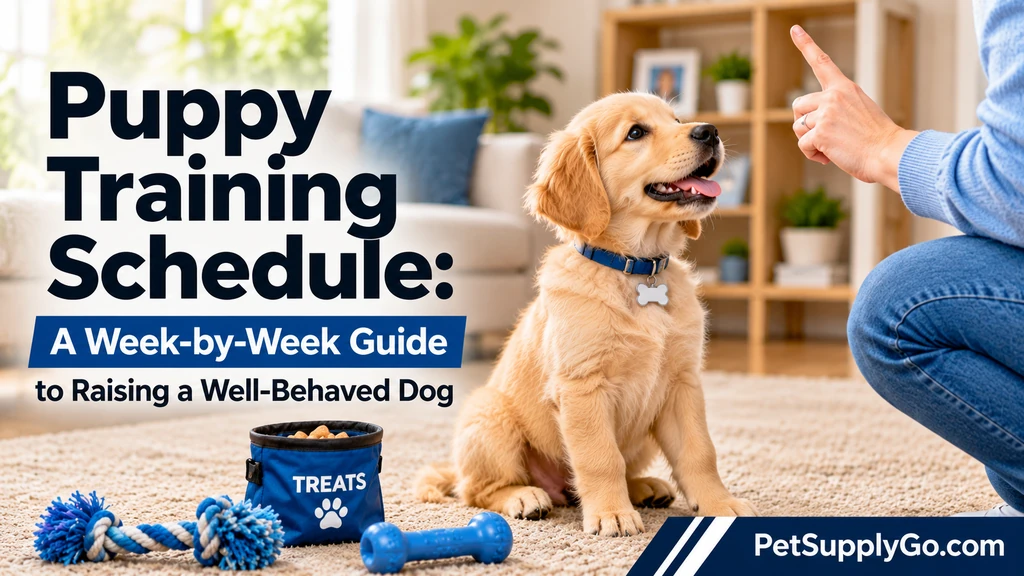
Bringing home a puppy is one of the happiest days of your life, and, about an hour later, one of the most overwhelming. There are puddles on the floor. Tiny teeth in your sleeves. A tiny, adorable creature who cries at midnight, chews your favorite shoe, and has absolutely no idea what “no” means. Everyone tells you to “start training right away,” but nobody tells you where to start, what to teach first, or how long it should take.
The good news is that puppy training is not magic, and it is not a secret. It is a handful of simple skills, taught gently and consistently, in the right order. A puppy who learns where to potty, how to settle, how to meet the world calmly, and how to listen to you, has a head start on a lifetime of good behavior.
This guide gives you exactly that. It is organized as a week-by-week schedule, from the first days at home through the first year, with what to teach, how to teach it, how long it takes, and what to expect. You will learn potty training, crate and sleep routines, socialization, bite inhibition, basic cues such as sit, down, come, and leave it, leash manners, alone time, how to handle the teenage phase, the gear you need, a sample daily schedule, common mistakes, and 30 frequently asked questions.
The short answer: puppy training works best when it is positive, consistent, and short. Start with routine, potty training, and gentle socialization in the first weeks, add simple cues in short sessions, reward what you like, manage the environment so your puppy cannot practice bad habits, and be patient with setbacks. Keep your vet in the loop, especially about vaccines, safe socialization, and health.
Affiliate disclosure: PetSupplyGo may earn a small commission if you buy through links on this page. It never changes our recommendations or what you pay.
Important Note
This article is general information, not veterinary or professional training advice. Every puppy is different, and timelines vary by breed, age, and personality. Talk to your vet about your puppy’s vaccine schedule, deworming, diet, and when and where it is safe to socialize. If your puppy shows fear, aggression, or sudden behavior changes, talk to your vet and a qualified, positive-reinforcement trainer.
Quick Answer: How Do You Train a Puppy?
Here is the fast version before we go deeper.
| Stage | Age (rough guide) | Main goals |
| Settling in | 8 to 10 weeks | Routine, potty basics, crate comfort, name, gentle handling |
| Foundation | 10 to 12 weeks | Sit, down, come, safe socialization, bite inhibition |
| Building skills | 3 to 4 months | Leave it, drop it, loose-leash walking, alone time |
| Teething and testing | 4 to 6 months | Chew management, impulse control, reliable cues |
| Teen phase | 6 to 12 months | Practice in distractions, recall, manners, consistency |
| Young adult | 12 months and up | Maintain, advance, and enjoy |
Key Takeaways
- Puppies learn from the day they come home. Early, gentle, consistent training is more effective than late, harsh correction.
- Reward-based training builds trust and gets reliable results. Avoid yelling, hitting, or intimidation.
- Potty training depends on routine and supervision more than on any trick. Take your puppy out often, and reward success.
- Puppies have short attention spans. Several sessions of three to five minutes beat one long session.
- Socialization matters most in the early months. Aim for positive, safe experiences, and talk to your vet about vaccines and safe places.
- Manage the environment. Crates, pens, gates, and chew toys prevent mistakes while she learns.
- Biting, chewing, and accidents are normal puppy behavior, not signs of a bad dog.
- Teach calm and settling as skills, not just sit and stay.
- Expect setbacks, especially in the teenage months. Consistency pays off.
- Get help from a qualified trainer early if you feel stuck.
Before You Start: The Training Mindset
A few principles make everything easier.
Puppies are babies. They have small bladders, short attention spans, and endless curiosity. They are not being naughty. They are learning how the world works.
Training is communication. You are teaching your puppy a new language. Be clear, consistent, and kind.
Reward what you like. When your puppy does something right, mark it with a word like “yes” and give a small treat, a game, or praise. Dogs repeat what pays.
Prevent what you do not like. If your puppy cannot reach the shoe, she cannot chew the shoe. Management is as important as training.
Keep it short and fun. Three to five minutes, a few times a day, is plenty. End on a success.
Be consistent. Everyone in the home should use the same words, rules, and routines.
Be patient. Progress is not a straight line. Good days and bad days are normal.
Stay safe. Never leave a puppy unsupervised with something dangerous, and always check with your vet about health and safety.
Where Do Puppies Learn Best? The Early Learning Window
Puppies go through important developmental stages, and the early weeks and months are a special time for learning.
Birth to about 8 weeks. Puppies learn from their mother and littermates, including bite inhibition, play, and basic social skills. A good breeder or rescue starts gentle handling and exposure to everyday sounds.
About 8 to 12 weeks. Puppies are very receptive to new experiences, and many are curious and bold. This is a key time for gentle introductions to people, sounds, surfaces, and routines. It can also include a first “fear period,” where a bad scare can leave a lasting impression, so keep experiences positive and low pressure.
About 3 to 6 months. Puppies learn quickly, test boundaries, and begin teething. Training and routine become increasingly important.
About 6 to 12 months or longer. The teenage phase brings more independence, distraction, and sometimes a second fear period. Many dogs seem to “forget” training. Keep going, and stay consistent.
Experts in veterinary behavior generally agree that positive early socialization is one of the most important things you can do for a puppy, and that it needs to be balanced with protection from disease. Ask your vet how to socialize safely until vaccines are complete.
Gear You Need for Puppy Training
You do not need much to begin, but a few key items make training smoother.
A crate or pen. A safe, comfortable space for naps, nights, and times you cannot supervise. Our crate training guide explains how to make it a happy place, and our dog crates category can help you compare sizes and styles.
Small, soft treats. Pea-sized pieces that she can swallow quickly. For single-ingredient options, see our guide to freeze dried dog treats. Count treats toward her daily calories.
A treat pouch. Keeps rewards handy.
A well-fitted harness and a light leash. A harness avoids pressure on her neck while she learns to walk. Our guide to dog harnesses for large dogs explains what to look for in fit and security.
Chew toys. Safe, appropriate toys for teething. Browse our dog toys category, and see our guide to indestructible dog toys for aggressive chewers if your puppy is a determined chewer.
A lick mat or puzzle toy. For calm, independent play. See our guide to lick mats for dogs, and always check labels for xylitol.
A slow feeder or puzzle bowl. For puppies who gulp. See our guide to slow feeder bowls.
A comfortable bed. A cozy resting place. Our dog beds category is a good place to compare options.
Enzymatic cleaner. For accidents, since it breaks down odors that encourage repeat spots.
Baby gates. To block off areas while she learns the rules.
A car restraint. A crate, harness, or car seat, for safe travel. Our guide to dog car seats and car beds explains how to choose one.
For a fuller shopping list, see our puppy starter kit essentials guide, and browse our dog care category for more tools.
Week 1: The First Days at Home (About 8 to 9 Weeks)
Your first week is about helping her settle, and building routine.
Goals
- A predictable daily routine
- A first vet visit
- Potty basics
- A comfortable sleeping spot and crate introduction
- Learning her name
- Gentle handling
- Starting socialization at home
What to do
Set a routine. Puppies thrive on predictability. Feed at consistent times, take her out after meals, naps, and play, and keep a regular bedtime.
Visit your vet. Schedule a check-up in the first few days. Ask about vaccines, parasite prevention, diet, and safe socialization.
Start potty training. Take her out every one to two hours, and right after waking, eating, and playing. Pick a spot, say a cue word such as “go potty,” and reward her immediately when she goes. More on this below.
Introduce the crate. Make it a happy place with treats and a comfy bed. Keep early sessions short, and never use it as punishment.
Plan the first nights. Put the crate or bed near you, so she feels secure, and expect a few wake-ups for potty trips. A calm, boring potty break, with no play, teaches her that night is for sleep.
Teach her name. Say it in a happy voice, and reward when she looks at you.
Handle her gently. Touch her paws, ears, mouth, and tail, with treats. Handling prepares her for vet visits and grooming.
Let her rest. Young puppies need a lot of sleep. Do not overtire her.
Keep visitors calm. Introduce one or two people at a time, gently.
What to expect
Accidents, whining, a lot of sleeping, and a few late nights. That is all normal. Your job is to be calm and consistent.
Week 2: Building Routine and Simple Cues (About 9 to 10 Weeks)
Goals
- Consistent potty progress
- Sit and hand targeting
- Gentle introductions to household sounds
- Crate comfort
- Bite inhibition basics
What to do
Keep the potty routine going. Reward every success, and clean accidents with an enzymatic cleaner. Do not punish accidents. If you catch her in the act, interrupt calmly, and take her outside.
Teach sit. Hold a treat near her nose, and move it slowly back over her head. When her bottom touches the floor, say “yes” and treat. Practice in short sessions.
Teach hand targeting. Present your open hand, and reward when she touches it with her nose. It is a handy skill for recall and moving her around.
Expose her to everyday sounds. The vacuum, doorbell, blender, and TV, at low volume, paired with treats. Keep it gentle.
Work on crate time. Build up the duration slowly, and reward calm behavior.
Start bite inhibition. Puppies mouth and nip as they play, and learn from your reactions. When she bites too hard, calmly stop play, or redirect to a toy. See our guide on how to stop a puppy from biting for more.
Give her chew toys. Offer several textures, and rotate them.
Keep sessions short. Two to three minutes at a time.
What to expect
She may begin to understand the potty routine, but accidents will still happen. Nipping is normal, and she may have bursts of wild energy, often in the evening, called the “zoomies.”
Weeks 3 and 4: Adding Skills and Safe Socialization (About 10 to 12 Weeks)
Goals
- A solid potty routine
- Down, come, and “wait”
- Safe, positive socialization
- Settling on a mat
- Car rides and handling practice
What to do
Teach down. From a sit, lower a treat to the floor between her paws. Reward when her elbows touch the ground.
Teach come. Start in a quiet room. Say her name and “come” in a happy voice, and reward when she reaches you. Never call her to scold her.
Teach “wait.” Ask for a sit, take a step back, and reward. Add time and distance slowly.
Teach “go to your mat.” Reward her for stepping on a mat, then lying down. A mat gives her a place to settle, and is useful for visitors and meals.
Socialize safely. Introduce her to new people, gentle dogs who are healthy and vaccinated, sounds, surfaces, and places, always at her pace. Carry her in busy places, if your vet advises avoiding ground contact until vaccines are complete. Ask your vet what is safe where you live.
Practice handling. Brush her gently, touch her paws, check her ears and mouth, and reward.
Start car rides. Short, calm trips with a secure restraint, ending somewhere fun.
Introduce the harness and leash. Let her wear the harness for a few minutes at a time with treats, and drag a light leash indoors under supervision.
What to expect
Her attention span may be a bit longer, and she will learn quickly. She may also be distractible, and test the rules. Keep sessions short and rewarding.
Month 3 to 4: Foundations Become Habits (About 12 to 16 Weeks)
Goals
- Reliable potty habits
- Leave it and drop it
- Loose-leash basics
- Longer crate and alone times
- Continued socialization
What to do
Teach “leave it.” Hold a treat in a closed fist. When she backs off, reward with a different treat. Build up to a treat on the floor, and then real-life items.
Teach “drop it” and “trade.” Offer a treat for a toy, and give the toy back when she lets go. It prevents guarding, and keeps her safe.
Start loose-leash walking. Reward her for staying near you with a loose leash. Stop when she pulls, and move on when it relaxes. Keep walks short and sniffy.
Build alone time. Practice short separations, rewarding calm. Give her a chew or lick mat, and leave for a few minutes, then return calmly. Increase gradually. See the alone-time section below.
Continue socialization. Meet more people, ages, and environments, always positively. Watch for signs of fear, and go slowly.
Practice impulse control. Wait at doors, wait for her food bowl, and wait before jumping out of the car.
Attend a puppy class, if possible. A good, positive class offers safe socialization and expert guidance, with vaccinated puppies. Ask your vet for recommendations.
Review your schedule. As she grows, her potty intervals lengthen. Adjust your routine.
What to expect
Teething begins around now, and chewing, drooling, and sore gums are common. Offer chilled, safe chew toys, and keep valuables out of reach. Some puppies hit a second wave of fearfulness, and a sudden startle at something familiar is normal. Stay calm and supportive.
Months 4 to 6: Teething, Testing, and Practice
Goals
- Reliable cues in more places
- Chew management
- Longer walks and outings
- Recall practice
- Calm manners
What to do
Practice in new places. Dogs do not generalize well, so a “sit” that works in the kitchen may fail at the park. Practice in the yard, on the sidewalk, and in new settings, starting easy.
Add distractions slowly. A toy on the floor, a person walking by, and a quiet park. Use higher-value treats as difficulty rises.
Work on recall. Use a long line outdoors in safe areas, and reward every return generously. Never call her for something she dislikes.
Manage teething. Provide plenty of safe chews, rotate toys, and redirect biting. See our dog toys category for options.
Keep up with socialization. Positive exposure continues to matter.
Teach settle. Reward calm behavior on a mat, in the crate, or in a bed. Calm is a skill.
Practice handling. Nail trims, brushing, tooth brushing, and wiping paws. See our guide on how to clean dog paws for easy methods.
Stay consistent with house rules. If the couch is off limits, it should be off limits for everyone.
Talk to your vet about timing. Spay or neuter decisions, and adult diet changes, are best made with your vet’s input.
What to expect
She may seem to “forget” cues, bark more, and test limits. She may also have a growth spurt, and be clumsy. Keep training fun, and go back a step when she struggles.
Months 6 to 12: The Teenage Phase
Adolescence can be a shock. The sweet puppy who listened is suddenly distractible, independent, and sometimes stubborn. Many dogs are surrendered to shelters during this stage, so it helps to know it is normal and temporary.
Goals
- Maintain and strengthen cues
- Build reliability around distractions
- Keep exercise and mental work high
- Manage rising energy
- Stay consistent
What to do
Keep training. Short, frequent sessions still work. Do not stop because she “knows it.”
Increase exercise and enrichment. Teenagers have lots of energy. Provide walks, play, sniffing, puzzle toys, and training games.
Be consistent with rules. Adolescents test boundaries, so stay calm and steady.
Keep recall safe. Use a long line in open areas, and avoid off-leash freedom until recall is rock solid.
Manage leash manners. Reinforce loose-leash walking, and use a secure harness.
Continue socialization. Keep exposing her to positive new experiences, and watch for fear or reactivity. If you see growling, lunging, or fear of people or dogs, ask a qualified trainer for help.
Give her a job. Training games, trick training, scent games, and sports provide a purpose.
Keep patience. If she seems to regress, go back to basics, and reward generously.
Plan for second fear periods. Some dogs go through a stage where they are suddenly afraid of things they used to ignore. Stay positive, and do not force.
What to expect
Distractibility, selective hearing, and more energy. It is normal. With consistency, most dogs come through this stage as wonderful adults.
Potty Training: The Heart of Early Training
Potty training is usually the first priority for new owners. It takes time, but a good system makes it much easier.
The basic system
- Take her out often. Young puppies need to go every one to two hours, and right after waking, eating, drinking, playing, and chewing.
- Pick a spot. Take her to the same area each time, on a leash if needed.
- Use a cue. Say “go potty” or another phrase as she begins.
- Reward immediately. Praise and a treat right after she finishes, outside, not when you get back indoors.
- Stay calm during accidents. Clean them with an enzymatic cleaner, and do not scold. Scolding can teach her to hide when she needs to go.
- Supervise indoors. Keep her in sight, or use a crate, pen, or leash, so you can catch the signs.
- Learn her signals. Sniffing, circling, whining, or heading to the door.
- Use a schedule. Feed at set times, and take her out regularly.
- Be patient. Most puppies need months to be fully reliable, and some take longer.
How long can a puppy hold it?
A very rough guide is that a puppy can hold her bladder for about one hour for each month of age, plus one, during the day. At night, she may manage a little longer once she is older. These numbers are not rules. Small breeds often need more frequent trips, and every puppy is different. Ask your vet if you are concerned.
Crate and potty training together
A properly sized crate helps, since most puppies do not like to soil their sleeping space. But it is not a cure-all. Do not leave a puppy in a crate longer than she can hold it, and never use it as punishment. Our crate training guide explains the routine in detail.
Accidents
Accidents are a normal part of learning. If your puppy has one:
- Interrupt calmly if you see it, and take her outside.
- Clean the spot well with an enzymatic cleaner.
- Do not rub her nose, yell, or punish.
- Review your schedule. You may be waiting too long between trips.
- Check with your vet if she is having frequent accidents, straining, or has changes in thirst or stool.
Overnight
Young puppies often need a potty trip overnight. Set an alarm, take her out calmly, and return her to bed. As she grows, the need decreases.
Weather and routine
Rain, snow, and cold can make potty trips hard. Keep a consistent routine, and use a coat if she is small or short-haired. Our guide to dog winter coats can help you choose one.
Pads and indoor options
Some owners in apartments use pads or a patch of turf. They can help, but they may delay learning to go outside, so use them thoughtfully, and plan for the long term.
Crate and Sleep Training
A crate gives your puppy a safe, cozy den, and helps with potty training, travel, and rest.
Choosing a crate
Choose a crate large enough for her to stand up, turn around, and lie down comfortably, but not so big that she can use one end as a bathroom. Many crates come with dividers that adjust as she grows. Browse our dog crates category to compare sizes and styles.
Introducing the crate
- Make it inviting. Add a comfy bed and a safe chew.
- Toss in treats. Let her walk in and out freely.
- Feed meals inside. She will associate it with good things.
- Close the door briefly. Stay close, and reward calm behavior.
- Build time slowly. Increase gradually.
- Never use it as punishment.
- Exercise first. A tired puppy settles more easily.
For a step-by-step approach, see our crate training guide.
Nights
- Place the crate in your bedroom at first, so she feels secure.
- Offer a final potty trip before bed.
- Expect a wake-up or two in the first weeks.
- Keep night potty breaks calm and quiet.
- Do not let her out while she is crying, if you know she does not need to go. Wait for a pause.
- Provide a comfortable bed. See our dog beds category for options.
If she cries a lot
Check the basics: bathroom, hunger, thirst, temperature. If she is panicked, drooling, or injuring herself, stop, and ask a vet or qualified trainer. Some puppies need more gradual training.
Socialization: Helping Your Puppy Meet the World
Socialization means gently introducing your puppy to a wide range of people, animals, places, sounds, and experiences, so she grows into a confident adult.
Why it matters
Puppies who have positive early experiences are generally more relaxed and adaptable, and less likely to develop fear-based problems later. Poor or missing socialization is linked to fear, anxiety, and sometimes aggression.
How to do it safely
Talk to your vet. Puppies are vulnerable to infectious diseases until their vaccines are complete, so ask what is safe in your area, such as controlled playdates with healthy, vaccinated dogs, and which places to avoid.
Go at her pace. Let her approach new things on her own, and do not force her.
Keep it positive. Pair new experiences with treats and calm praise.
Keep it short. A few minutes at a time is enough.
Watch her body language. Signs of stress include lip licking, yawning, tucked tail, hiding, and refusing treats. If you see them, move away, and try an easier version.
Carry her if needed. In busy places where ground contact is risky, carrying her lets her see and hear the world safely.
A socialization checklist
Aim for gentle, positive exposure to:
People. Men, women, children, people in hats, glasses, uniforms, and with beards, people using wheelchairs, canes, and strollers.
Dogs. Calm, healthy, vaccinated dogs of different sizes and ages.
Other animals. If relevant to your household.
Sounds. Traffic, vacuum cleaners, doorbells, sirens, thunder recordings, kitchen noises, and music, at low levels.
Surfaces. Grass, gravel, tile, carpet, wood, metal grates, and wet floors.
Places. Vet clinic visits, car rides, friends’ homes, quiet parks, and pet-friendly stores.
Handling. Brushing, nail trims, ear checks, tooth brushing, and being held.
Objects. Umbrellas, bikes, skateboards, hats, boxes, and balloons.
Weather. Rain, wind, and different temperatures, with safe protection.
Puppy classes
A well-run puppy class gives safe, supervised play, basic training, and expert guidance. Look for a positive trainer, small groups, and vaccination requirements. Visit before you sign up, and ask your vet for recommendations.
If your puppy seems fearful
Do not push. Increase distance, use higher-value treats, and keep exposures short and calm. If fear is strong or does not improve, ask a qualified trainer or veterinary behaviorist for help.
Bite Inhibition and Mouthing
Puppies explore with their mouths, and they play by biting. It is normal, but needs guidance.
What to do
- Redirect to a toy. When she mouths your hands, offer a chew toy, and praise her when she takes it.
- Stop play when it gets too rough. Say a calm “ouch,” or “too bad,” and pause the game for a few seconds. She learns that biting ends the fun.
- Reward gentle play. Praise and continue when her mouth is soft.
- Provide plenty of chew options. Different textures, and rotate them.
- Exercise and rest. Overtired and overstimulated puppies bite more.
- Avoid rough games. Wrestling with hands encourages biting.
- Manage visitors. Ask children and guests to follow the same rules.
- Be consistent and patient. Biting usually improves as she matures and her adult teeth come in.
For detailed steps, see our guide on how to stop a puppy from biting.
Teaching the Basic Cues
Here are the core skills, with simple steps. Use small, soft treats, and keep sessions short.
Name and attention
- Say her name in a happy voice.
- When she looks at you, say “yes” and treat.
- Practice in different rooms, then outside.
Sit
- Hold a treat near her nose.
- Move it slowly up and back over her head.
- When her bottom touches the floor, say “yes” and treat.
- Add the word “sit” once she does it reliably.
Down
- From a sit, lower a treat to the floor between her paws.
- When her elbows touch the ground, say “yes” and treat.
- Add the cue “down” later.
Come
- Start close, in a quiet room.
- Say “come” in a happy voice, and back away.
- When she reaches you, give a treat and praise.
- Practice at longer distances, then outside on a long line.
- Make it the best thing that happens, and never call her to scold her.
Wait and stay
- Ask for a sit.
- Say “wait,” and take one step back.
- Return, and reward.
- Gradually increase time and distance.
- Teach a release word, such as “okay.”
Leave it
- Hold a treat in a closed fist.
- When she stops sniffing and backs away, reward with a different treat.
- Progress to a treat on the floor, covered by your hand.
- Add the cue “leave it.”
Drop it and trade
- Offer a treat as she holds a toy.
- When she lets go, say “drop it,” and give the treat.
- Return the toy sometimes, so she learns that giving it up is safe.
Loose-leash walking
- Let her get used to the harness and leash indoors.
- Reward her for walking beside you.
- Stop when she pulls, and move on when the leash relaxes.
- Change direction often.
- Keep walks short and sniffy.
Settle on a mat
- Place a mat on the floor.
- Reward any step toward it, then four paws on it.
- Reward lying down.
- Add duration, and a cue such as “mat.”
Hand touch
- Present your open hand.
- When she touches it with her nose, say “yes” and treat.
- Move your hand to different positions.
Alone Time and Separation
Learning to be alone calmly is an important skill. Puppies are social, and they can easily become anxious when left.
Build it slowly
- Start with seconds. Leave the room for a moment, and return calmly.
- Increase gradually. Add time, but only when she stays relaxed.
- Keep departures boring. No long goodbyes.
- Offer a safe activity. A lick mat, a chew, or a puzzle toy, while you supervise at first.
- Exercise first. A tired puppy rests more easily.
- Use a crate or pen. If she is comfortable there.
- Reward calm. Quietly praise her when she settles.
Signs of trouble
Constant crying, panting, drooling, or destruction can signal separation anxiety, which needs patient, gradual work and sometimes professional help. Ask your vet and a qualified trainer if your puppy is very distressed.
Chewing and Teething
Puppies chew to explore and to relieve sore gums. Teething usually begins around three to four months and continues for several months.
- Provide safe chews. Choose puppy-appropriate toys and chews. Avoid very hard items that can hurt developing teeth.
- Offer cold relief. A chilled, soft chew toy can soothe gums.
- Redirect. Swap forbidden items for a toy, and praise.
- Puppy-proof. Pick up shoes, cords, and valuables.
- Supervise. Many problems occur when puppies are unsupervised.
- Use a pen or gates. To limit access.
- Exercise and enrich. A bored puppy chews more.
- Ask your vet. If you notice bleeding gums, retained baby teeth, or trouble eating.
Feeding and Training
Mealtimes are a great chance to train.
- Feed on a schedule. Regular meals help with potty timing.
- Use part of her meal for training. Kibble works well as treats.
- Teach “wait” at the bowl. Ask for a sit before you put down the food.
- Use slow feeders or puzzles. They calm gulpers, and add enrichment.
- Handle the bowl. Gently add a treat while she eats, so she learns that hands near her food are good.
- Ask your vet about food and portions. Puppies need balanced nutrition for growth. Our dog food category can help you compare options, but your vet should guide the choice.
- Count treats. A common guideline is that treats should be about 10 percent or less of daily calories.
Exercise and Play for Puppies
Puppies need activity, but not too much.
- Short, frequent play. Several brief sessions, not long runs.
- Avoid hard, repetitive exercise. Growing joints need protection. Skip long runs and high jumps until your vet says she is ready.
- Mix physical and mental play. Sniffing, simple games, and gentle fetch.
- Rest matters. Puppies need lots of sleep, so build in naps.
- Watch for overtiredness. A cranky, mouthy puppy may need a nap.
- Offer safe toys. Rotate them to keep play interesting.
A Sample Daily Schedule for a Young Puppy
Every household is different, but a predictable rhythm helps. Here is an example for a puppy of around 10 to 12 weeks. Adjust it for your puppy and your day.
| Time | Activity |
| 6:30 a.m. | Wake up, straight outside to potty, reward |
| 6:45 a.m. | Breakfast, then potty |
| 7:15 a.m. | Short play and a training session, then potty |
| 7:45 a.m. | Nap in the crate or pen |
| 9:30 a.m. | Potty, play, a short walk or sniff in the yard |
| 10:00 a.m. | Nap |
| 11:30 a.m. | Potty, lunch, then potty |
| 12:00 p.m. | Training session, socialization at home |
| 12:30 p.m. | Nap |
| 2:30 p.m. | Potty, play, chew time |
| 3:30 p.m. | Nap |
| 5:00 p.m. | Potty, dinner, then potty |
| 5:45 p.m. | Family time, gentle play, practice cues |
| 7:00 p.m. | Potty, calm time with a chew or lick mat |
| 8:00 p.m. | Final play, then potty |
| 9:30 p.m. | Last potty trip, then bedtime in the crate |
| Overnight | One potty trip if needed |
Puppies need a lot of sleep, so make sure she gets quiet time between activities. Overtired puppies are cranky and mouthy.
Troubleshooting: Common Puppy Problems
She keeps having accidents. Take her out more often, watch for signals, clean with an enzymatic cleaner, and reward outside successes. Check with your vet if there are sudden changes, or she is straining or drinking a lot.
She bites and nips constantly. Redirect to toys, end play when it gets rough, and make sure she gets enough sleep and exercise. See our guide on how to stop a puppy from biting.
She chews everything. Puppy-proof, provide plenty of chews, supervise, and redirect. Teething will pass.
She cries in the crate. Check the basics, exercise her first, build crate time slowly, and avoid letting her out when she is panicking. Our crate training guide can help.
She barks a lot. Make sure she gets enough exercise and rest, reward quiet, and avoid yelling. Some barking is normal, and training helps.
She pulls on the leash. Reward her for walking near you, stop when she pulls, and use a comfortable harness.
She will not come when called. Practice with high-value treats, on a long line, and never call her for something unpleasant.
She jumps on people. Ignore jumping, reward four paws on the floor, and teach sit for greetings.
She is afraid of new things. Go slowly, use treats, keep distance, and never force. Ask a trainer if fear is strong.
She will not eat treats. She may be nervous, tired, or full. Try softer, tastier treats, and train before meals.
She seems to forget everything. Puppies learn in bursts, and regress during growth spurts and adolescence. Go back to easy steps, and keep rewarding.
She growls over toys or food. Do not punish. Trade from a distance, and ask a qualified trainer for help with resource guarding.
She eats poop or garbage. Keep the yard clean, supervise, teach “leave it,” and ask your vet if it continues.
She gets carsick. Short trips, a secure restraint, and a calm start can help. Our guide to dog car seats and car beds explains how to choose a comfortable setup. Ask your vet if it continues.
Common Mistakes New Owners Make
- Waiting too long to start. Training begins the day she comes home.
- Using punishment. Yelling, hitting, and rubbing noses in accidents damage trust.
- Expecting too much, too soon. Puppies are babies.
- Skipping socialization. Early positive experiences matter.
- Not supervising. Accidents and chewing happen when she is left to roam.
- Inconsistent rules. Everyone in the home needs to follow the same plan.
- Long training sessions. Short and fun works better.
- Overfeeding treats. Count calories.
- Forgetting about rest. Overtired puppies behave worse.
- Skipping exercise. Too little, or too much, causes problems.
- Not using management tools. Crates, pens, and gates prevent mistakes.
- Letting bad habits slide because she is cute. Habits stick.
- Calling her for punishment. It ruins recall.
- Ignoring fear. Pushing a frightened puppy can create lasting problems.
- Not asking for help. A good trainer or your vet can save time and stress.
Myths About Puppy Training
Myth: You have to wait until she is six months old to start. Training starts as soon as she is home, with age-appropriate lessons.
Myth: Puppies should be corrected harshly. Reward-based methods are effective, and avoid fear and stress.
Myth: Rubbing her nose in an accident teaches her. It only teaches her to fear you, and to hide.
Myth: Dominance training is necessary. Modern behavior science favors cooperation, clarity, and rewards over “dominance.”
Myth: Puppies need to play with every dog they meet. Quality matters more than quantity, and some meetings can do harm.
Myth: A tired puppy is a trained puppy. Exercise helps, but training and structure are still essential.
Myth: Crates are cruel. When introduced well, a crate is a comfortable den.
Myth: Puppies grow out of everything. Some behaviors fade, but many need training.
Myth: If she misbehaves, she is stubborn. Usually she is confused, tired, excited, or has not been taught.
Myth: Training is only about obedience. It is about communication, safety, and a good relationship.
When to Get Professional Help
Many puppy problems can be solved at home, but some need extra support. Ask your vet or a qualified, positive-reinforcement trainer if:
- Your puppy shows aggression, such as growling, snapping, or biting hard with intent
- She is very fearful, shaking, hiding, or panicking
- She has intense separation distress
- She cannot settle, or is frantic much of the day
- She has frequent accidents despite a good routine
- She seems to be in pain, or has sudden behavior changes
- You feel overwhelmed, or are not seeing progress after several weeks
Look for professionals who use reward-based methods, are transparent about their approach, and welcome questions. Group puppy classes are a great way to learn and socialize, and private lessons can help with specific problems.
A 12-Week Puppy Training Checklist
Use this as a rough guide, not a strict test. Every puppy learns at her own pace.
By the end of week 2:
- Knows her name
- Has a routine for meals, potty, and sleep
- Is comfortable in the crate for short periods
- Accepts gentle handling
By the end of week 4:
- Is making progress with potty training
- Sits on cue, with a treat lure
- Walks calmly on a harness indoors
- Has met several new people and surfaces, safely
By the end of week 8:
- Sits and downs reliably in quiet places
- Comes when called at short distances
- Understands “leave it” and “drop it” in simple settings
- Settles on a mat, or in the crate
- Is tolerating short alone times
By the end of week 12:
- Has fewer accidents, and a predictable schedule
- Responds to cues with some distractions
- Walks on a loose leash for short stretches
- Has positive experiences with many people, places, and sounds
- Has learned basic bite inhibition
Puppy Training Gear Checklist
- A crate or pen, plus a comfy bed
- Small, soft treats
- A treat pouch
- A harness and a light leash
- Chew toys, and a lick mat
- A slow feeder or puzzle bowl
- Enzymatic cleaner
- Baby gates
- A car restraint
- A towel for muddy paws
- Poop bags
- A notebook or app for tracking progress
Quick Glossary
Positive reinforcement: Rewarding behavior you want, so it is repeated.
Marker word: A short word, such as “yes,” that tells a puppy she did the right thing.
Lure: Using a treat to guide a puppy into position.
Cue: A word or signal that asks for a behavior.
Socialization: Positive exposure to people, animals, places, and sounds.
Bite inhibition: Learning to control the force of her bite.
Management: Using tools such as crates, pens, and gates to prevent mistakes.
Fear period: A stage when a puppy may be more sensitive to scary experiences.
Generalization: Practicing a behavior in many places and situations.
Impulse control: Learning to wait, and not act on every urge.
Zoomies: Sudden bursts of wild running and play.
Puppy-Proofing Your Home, Room by Room
Management is half of training. If your puppy cannot get into trouble, she cannot practice bad habits. Walk through your home at puppy level, and look for anything she could chew, swallow, or knock over.
Kitchen
- Keep trash in a closed cabinet or a bin with a secure lid.
- Store cleaning products and chemicals on high shelves or behind child-proof latches.
- Put away foods that are toxic to dogs, including chocolate, grapes and raisins, onions, and anything sweetened with xylitol.
- Use a baby gate if you do not want her underfoot while you cook.
Living room
- Tuck away electrical cords, or cover them with cord protectors.
- Move small objects, remote controls, and shoes out of reach.
- Check houseplants, since some are toxic to dogs.
- Block access to spaces under furniture where she could get stuck.
Bedroom and bathroom
- Close closet doors, and keep socks, underwear, and shoes out of reach.
- Keep medications, vitamins, and personal care products in closed cabinets.
- Keep the toilet lid down, and the bathroom door closed.
Yard and garage
- Check fences for gaps.
- Store fertilizers, pesticides, antifreeze, and tools safely. Antifreeze is extremely toxic, and clean up any spills right away.
- Remove poisonous plants, and keep an eye out for sharp objects.
- Supervise her any time she is outside. If your yard is not fully fenced, read our guide to a GPS dog fence for a virtual option, and remember that supervision is still needed.
Everywhere
- Use baby gates and pens to limit her space while she learns.
- Keep a few toys in each room, so she always has something to chew.
- Supervise, or confine her safely when you cannot watch.
Training in an Apartment or Small Space
You do not need a big yard to raise a well-behaved puppy. A few adjustments make city living work.
Plan your potty routine. Without a private yard, you will need frequent, quick trips outside. Learn where the nearest grass is, and keep her on a leash. Some owners use a patch of turf or pads on a balcony as a backup, especially for tiny puppies and bad weather.
Be a good neighbor. Teach her to settle, and to be calm in hallways and elevators. Practice sit and wait at the door.
Manage noise. Reward quiet, and give her a chew or lick mat when you are busy. Soft white noise can mask hallway sounds.
Use indoor exercise. Short games of fetch in a hallway, hide-and-seek, and tricks work well, along with regular walks.
Socialize in small steps. Elevators, stairs, and busy sidewalks are great practice, when your vet says it is safe.
Keep things tidy. A small apartment fills with puppy mess quickly, so keep enzymatic cleaner and towels handy.
Use your space wisely. A crate, a pen, and a bed give her clear places to be.
Training Different Types of Puppies
Every puppy is an individual, but size and breed tendencies can shape how you train.
Small and toy breeds
Small puppies are easy to pick up and carry, which can tempt owners to skip training. But tiny dogs need manners too. They may take longer to potty train, since their bladders are small, and they can be more sensitive to cold and rain. Handle them gently, use tiny treats, and teach them to walk on a leash, not just be carried.
Medium breeds
Medium puppies are often a good fit for many training styles. Keep them active, mentally challenged, and consistently guided.
Large and giant breeds
Big puppies grow fast, and bad habits such as jumping and pulling become hard to manage when they are fully grown. Start loose-leash walking and calm greetings early. Avoid hard, repetitive exercise while their joints develop, and ask your vet about growth and diet. Choose sturdy gear. Our guide to dog harnesses for large dogs explains what to look for, and our guide to the best dog beds for large dogs covers supportive bedding.
Herding and high-energy breeds
These puppies need a lot of mental and physical work, or they invent their own jobs. Give them training games, puzzle toys, and structured exercise. Teach settling as an important skill.
Hounds and independent breeds
Scent hounds and independent breeds may be less focused on pleasing you, and more interested in smells. Use high-value rewards, keep training fun, and use a long line for safety outdoors.
Retrievers and sporting breeds
Many are eager and mouthy. Give them plenty of appropriate things to carry and chew, and teach impulse control early.
Guardian breeds
Some guardian breeds may be reserved with strangers. Early, positive socialization and calm, consistent training matter. Ask a qualified trainer for guidance, especially with large guardian breeds.
Mixed breeds and rescues
Without a clear breed profile, watch the individual. Learn her strengths, quirks, and fears, and tailor your training. A rescue puppy may need extra time to settle, and a gentler pace.
Puppy Training and Your Family
A puppy is a household project, and everyone has a role.
Agree on the rules. Decide where she sleeps, which furniture is off limits, which words you will use, and who does what. Write it down if it helps.
Use the same cues. If one person says “down,” and another says “off,” she will be confused.
Share the routine. Take turns on potty trips, meals, and walks.
Teach everyone to reward calm behavior. Giving attention to a jumping puppy teaches her to jump.
Include children carefully. Kids can help with simple tasks, such as filling the water bowl, and practicing sit with treats, with adult supervision. Teach them to be gentle, to avoid chasing the puppy, and never to take food or toys from her mouth.
Plan for guests. Put her on a leash or in a pen at first, and ask visitors to wait until she is calm before they greet her.
Protect her rest. Puppies need a lot of sleep. Make sure she gets quiet time, away from busy activity.
Hold a family check-in. After a week or two, talk about what is working and what needs to change.
Puppies and Other Pets
Introducing a puppy to resident pets takes patience.
Other dogs
- Introduce them in a neutral space, on leashes, and let them sniff at their own pace.
- Keep first meetings short and calm.
- Give each dog her own bed, bowls, and toys.
- Watch for signs of stress or tension, and separate if needed.
- Give your older dog breaks from the puppy’s energy.
- Supervise all interactions at first, and reward calm behavior.
Cats
- Keep the puppy on a leash or behind a gate at first.
- Give the cat escape routes and high places.
- Reward the puppy for calm behavior around the cat.
- Never let the puppy chase the cat.
- Feed them separately.
Small pets
Birds, rabbits, and rodents can trigger a puppy’s chase instinct, and are at risk. Keep them safely separated, and supervise any interaction.
If things are tense, ask a qualified trainer for help.
Rainy-Day and Indoor Training Games
Bad weather does not have to mean skipping training. These simple games build skills, and burn mental energy.
Find it. Toss a treat on the floor, and say “find it.” Hide treats around the room as she gets better.
Name game. Say her name, and reward when she looks at you. Do it from different places.
Hand touch parade. Ask her to touch your hand in different spots, and reward each touch.
Hide and seek. Ask her to wait, hide, and call her. Reward when she finds you.
Mat training. Reward her for stepping on a mat, lying down, and staying calm.
Tunnel of blankets. Drape a blanket over chairs, and invite her to walk through. It builds confidence.
Muffin tin puzzle. Hide treats in a muffin tin, and cover some with tennis balls, or toys, so she has to figure out where the treats are.
Trick time. Teach spin, shake, or bow. Tricks are fun, and build focus.
Calm time. Offer a lick mat or a chew in her bed, and reward her for settling.
Veterinary Care and Training: How They Fit Together
A healthy puppy learns best, so keep your vet in the loop.
Vaccines and parasite prevention. Follow your vet’s schedule. It protects her health, and determines when and where you can socialize her.
Diet and growth. Ask your vet about the right food, portions, and treat allowance for her age and breed. Our dog food category can help you compare options, but your vet should guide the decision.
Teething and dental care. Start gentle tooth brushing early, and ask your vet about chews.
Spay and neuter timing. Recommendations vary by breed, size, and individual health. Talk to your vet about what is best for your puppy.
Behavior concerns. If your puppy shows sudden changes, aggression, extreme fear, or other worries, your vet can check for medical causes, and refer you to a behaviorist.
Vet visit practice. Practice handling at home, and make vet visits fun, with treats and short, happy trips to the clinic for a weigh-in and a greeting.
Microchip and ID. Make sure she has an ID tag and a microchip, and keep your contact details up to date.
Training Notes: Keeping a Puppy Log
A simple log helps you see progress, spot patterns, and share information with your vet or trainer.
Each day, you can jot down:
- Meals, treats, and water
- Potty trips, and any accidents, with times
- Naps and nighttime sleep
- Training sessions, and what you practiced
- New experiences, and how she reacted
- Any health or behavior concerns
After a couple of weeks, you will see patterns. Maybe accidents cluster after playtime, or she is cranky when she skips a nap. Patterns point to easy fixes.
Positive Reinforcement in Action: A Quick Example
Here is how positive training plays out in a real moment.
Your puppy grabs a shoe from the hallway. A harsh scolding might make her drop it and run away, but it does not teach her what to do instead. A positive approach looks different.
- Stay calm. Do not chase, since chasing turns it into a game.
- Offer a trade. Show a tasty treat or an appropriate toy.
- Reward the drop. When she lets go of the shoe, say “yes,” and give the treat.
- Remove the shoe. Put it away, out of reach.
- Offer a chew. Give her an appropriate toy, and praise her for chewing it.
- Prevent a repeat. Keep shoes in a closet, or use a gate.
Over time, she learns that giving things up leads to good things, and that her own toys are the right place for chewing. That is the power of reward-based training.
Staying Patient: What Progress Really Looks Like
Puppy training does not move in a straight line. Some days she will nail every cue, and the next day she will act like she has never heard the word “sit.” That is completely normal, and it does not mean you are doing it wrong.
Learning comes in bursts. Puppies often seem to plateau, then suddenly jump ahead. Growth spurts, teething, and big developmental changes can all cause temporary dips.
Setbacks are part of the process. If she regresses, go back to an easier step, reward generously, and build up again. A few days of simple practice usually gets things back on track.
Compare her only to herself. Every puppy learns at her own pace. A puppy who takes longer to potty train may be quicker at tricks, and a nervous puppy may need more time to meet the world.
Celebrate small wins. The first time she sits without a lure, the first night she sleeps through, the first calm greeting at the door. These are big moments, and worth noticing.
Take care of yourself. Raising a puppy is tiring. Share the workload, nap when she naps, and ask for help from family, friends, a trainer, or your vet when you need it.
Keep the long view. The habits you build now shape her adult behavior. A few months of patient, consistent work pay off in years of a calm, confident, well-mannered dog.
If you ever feel overwhelmed, take a breath, go back to the basics of routine, rewards, and rest, and remember that every owner of a well-behaved dog started exactly where you are now.
Frequently Asked Questions (30 FAQs)
1. When should I start training my puppy?
The day she comes home. Early training can begin as soon as 8 weeks, with gentle, age-appropriate lessons such as potty routines, crate comfort, her name, handling, and a first sit. Keep sessions short and fun, reward what you like, and prevent mistakes with management. Ask your vet about vaccines and safe socialization.
2. How long does it take to train a puppy?
It depends on the puppy and the skill. Many puppies learn basic cues such as sit and come within a few weeks, but reliable behavior in real life takes months of practice. Potty training often takes several months, and some puppies need longer. Training continues through adolescence, so think of it as an ongoing process.
3. How do I potty train a puppy?
Take her out often, every one to two hours at first, and after waking, eating, drinking, and playing. Use the same spot, say a cue word, and reward immediately when she goes outside. Supervise indoors, clean accidents with an enzymatic cleaner, and do not punish. A crate or pen can help. Our crate training guide explains the routine.
4. How often should a puppy go outside?
Young puppies often need to go every one to two hours, and right after waking, eating, and playing. A rough guide is that a puppy can hold her bladder about one hour per month of age, plus one, but small breeds and very young puppies may need more frequent trips. Every puppy is different, so watch her signals.
5. How long can I leave my puppy in a crate?
Only as long as she can comfortably hold her bladder, and she should not be left for long stretches during the day. Young puppies need frequent breaks. Build crate time gradually, never use it as punishment, and make sure she gets exercise and attention. Ask your vet or a trainer if you work long hours.
6. How do I stop my puppy from biting?
Redirect mouthing to a chew toy, and stop play for a few seconds when she bites too hard. Reward gentle play, provide plenty of chews, and make sure she gets enough sleep and exercise. Avoid rough hand games. Biting usually improves as she matures. See our guide on how to stop a puppy from biting.
7. What should I teach my puppy first?
Start with routine and potty training, crate comfort, her name, gentle handling, and a simple sit. Next come down, come, wait, leave it, drop it, settle on a mat, and loose-leash walking. Keep sessions short, and reward often. Foundation skills make everything else easier.
8. How long should puppy training sessions be?
Three to five minutes is plenty for young puppies, repeated a few times a day. Their attention spans are short, and short sessions keep training fun. End on a success, and stop sooner if she is tired or frustrated. As she grows, you can lengthen sessions a little.
9. What are the best treats for puppy training?
Small, soft, tasty treats that she can swallow quickly, about pea-sized or smaller. Use part of her regular meal for easy tasks, and special treats for harder ones. Check labels, avoid xylitol, and count treats toward daily calories. For single-ingredient options, see our guide to freeze dried dog treats.
10. When can I take my puppy out in public?
Ask your vet. Puppies are vulnerable to infectious diseases until their vaccines are complete, but socialization is also important. Many vets suggest safe, controlled experiences, such as visits with healthy, vaccinated dogs, and avoiding high-risk places such as dog parks until your vet says it is safe. Carrying her in busy places can help.
11. What is puppy socialization, and why is it important?
Socialization means introducing your puppy gently and positively to people, animals, sounds, surfaces, and places. Puppies with good early experiences tend to be more confident, and less likely to develop fear-based behavior problems. Go at her pace, keep it positive, and talk to your vet about safe ways to do it before vaccines are complete.
12. Should I take my puppy to puppy class?
A good puppy class offers safe, supervised socialization, basic training, and expert guidance. Look for positive, reward-based trainers, small groups, and vaccination requirements, and visit before you sign up. Ask your vet for recommendations. Classes are also helpful for owners, who learn timing and handling.
13. How do I teach my puppy to come when called?
Start in a quiet room. Say her name and “come” in a happy voice, and reward when she reaches you. Practice at short distances, then longer, and use a long line outdoors. Make coming to you the best thing that happens, and never call her to scold her or end the fun.
14. How do I teach my puppy to walk on a leash?
Introduce the harness and leash indoors with treats. Reward her for walking beside you, stop when she pulls, and move on when the leash relaxes. Change direction often, and keep walks short and sniffy. A secure, comfortable harness helps. Our guide to harnesses for large dogs explains what to look for.
15. Why does my puppy cry in the crate?
She may be lonely, need a bathroom break, be uncomfortable, or simply not used to it. Check the basics, exercise her first, make the crate a happy place with treats and a comfy bed, and build time slowly. Do not let her out when she is panicking. If she is frantic or hurting herself, ask a trainer or your vet.
16. How do I stop my puppy from chewing everything?
Chewing is normal, especially while teething. Puppy-proof your home, supervise, and provide plenty of safe chew toys. Redirect to a toy when she chews the wrong thing, and praise her. Exercise and mental work reduce boredom chewing. See our dog toys category for options.
17. When do puppies start teething, and how long does it last?
Teething often starts around three to four months, and continues for several months while adult teeth come in. Chewing, drooling, and sore gums are common. Offer safe, puppy-appropriate chews, including chilled soft toys. Ask your vet if you notice bleeding gums, retained baby teeth, or trouble eating.
18. How do I teach my puppy to be alone?
Start with very short absences, and return calmly. Build time gradually, and offer a lick mat or a chew. Exercise her first, keep departures boring, and reward calm behavior. If she panics, drools, or destroys things, she may have separation anxiety, so ask your vet and a qualified trainer for help.
19. How much exercise does a puppy need?
Short, frequent play and walks suit most puppies better than long runs. Avoid hard, repetitive exercise and high jumps while her joints are growing, and make sure she gets plenty of rest. Mix physical activity with mental games such as sniffing and training. Ask your vet what is right for your puppy’s breed and age.
20. What are the best toys for puppy training?
Look for safe, puppy-sized chew toys, soft toys for cuddling, and a lick mat or puzzle toy for calm, independent time. Rotate toys to keep them interesting. For heavy chewers, see our guide to indestructible dog toys for aggressive chewers, and always supervise.
21. Why does my puppy seem to forget her training?
Puppies learn in bursts, and regress during growth spurts, teething, and adolescence. Dogs also do not generalize well, so a behavior that works at home may fail in a new place. Go back to an easy step, practice in different settings, and reward generously. Consistency pays off.
22. How do I handle my puppy’s teenage phase?
Keep training, and stay consistent. Increase exercise and mental work, use a long line for recall, and reinforce loose-leash manners. Give her a job, such as trick training or scent games. Do not punish regressions, since they are normal. If you see fear, reactivity, or aggression, ask a qualified trainer for help.
23. Should I use a crate or a pen for training?
Both can help. A crate is a cozy den for naps and nights, and a pen gives more space when you cannot supervise, such as during meal prep. Choose a size that fits her, introduce them positively, and never use them as punishment. Browse our dog crates category to compare options.
24. Can I train my puppy myself, or do I need a trainer?
Many owners successfully train their puppies at home with reliable information, patience, and consistency. A trainer or puppy class can help with timing, socialization, and specific problems, and is a good idea if you feel stuck. Seek help early if you see fear, aggression, or severe separation distress.
25. Is it okay to use punishment or harsh corrections?
Reward-based training is generally more effective, and avoids the fear and stress that harsh methods can cause. Yelling, hitting, and rubbing noses in accidents can damage trust, and make problems worse. Instead, prevent mistakes, reward what you like, redirect, and stay calm and consistent.
26. How do I stop my puppy from jumping on people?
Ignore jumping, turn away, and reward four paws on the floor. Teach sit for greetings, and ask guests to wait until she is calm. Keep her on a leash during early practice, if needed. Consistency from everyone is key, and giving attention only for calm behavior teaches her what works.
27. How do I stop my puppy from barking?
Make sure she gets enough exercise, sleep, and attention, and reward quiet moments. Do not yell, since it can sound like barking along. Teach a calm cue such as “quiet,” and manage triggers such as windows. If barking is constant, or tied to fear or separation, ask a trainer or your vet.
28. What if my puppy is afraid of new things?
Go slowly, and never force her. Keep a comfortable distance from what scares her, use high-value treats, and reward calm curiosity. Keep exposures short and positive. If fear is strong, or does not improve, ask a qualified, positive-reinforcement trainer or a veterinary behaviorist for help.
29. How much does puppy training cost?
Costs vary by region and format. Group classes and private lessons are common options, and many owners also use books, videos, and online resources. Basic gear, such as a crate, harness, treats, and toys, adds up too. Ask local trainers, shelters, and your vet about prices and options.
30. When should I call my vet about my puppy’s behavior or health?
Call if she has sudden behavior changes, signs of illness such as vomiting, diarrhea, lethargy, or loss of appetite, frequent accidents with straining or increased thirst, or if you are unsure about vaccines or safe socialization. Also ask about aggression, intense fear, or severe separation distress, since a vet can rule out medical causes and refer you to a behaviorist.
The Bottom Line
Puppy training does not have to be complicated. Start with routine, potty training, and a safe, cozy place to rest. Add short, fun lessons in basic cues, and give her gentle, positive experiences with the world. Reward what you like, prevent what you do not, and keep sessions short. Be patient with accidents, chewing, and the teenage months, since they are all part of growing up.
You do not need to be perfect. You need to be consistent, kind, and willing to ask for help when you need it. Keep your vet in the loop, celebrate small wins, and enjoy the ride. The habits you build in these early months shape the dog you will live with for years, and the bond you build while you teach her is the best reward of all.
This article is for general information and is not a substitute for veterinary or professional training advice. If your puppy shows fear, aggression, or sudden behavior or health changes, contact your veterinarian or a qualified trainer.
AFFILIATE DISCLOSURE
Petsupplygo.com is a participant in the Amazon Services LLC As an Amazon associate program, I earn from qualifying purchases.This costs you nothing extra and help us keep our guide free.
Add a Comment