
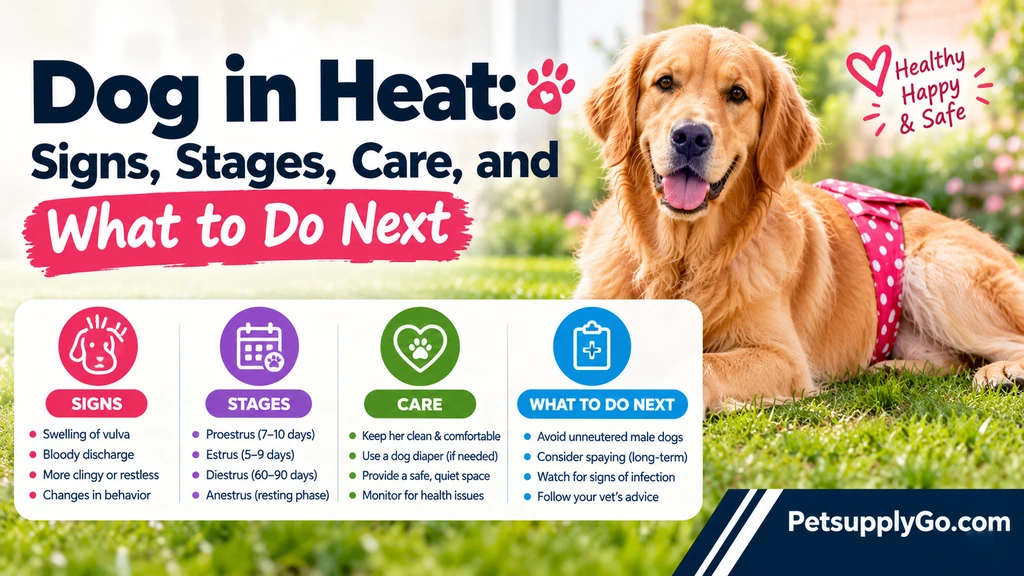
You notice it on a Tuesday morning. A few small spots on the floor, a lot of licking, and a dog who suddenly seems a little distracted. Or maybe your normally easygoing girl is clingier than usual, and the neighbor’s dog has started showing up at the fence. If your female dog has not been spayed, there is a good chance she is going into heat.
For a first-time owner, it can feel confusing, a little messy, and a bit stressful. How long will it last? What should you do about the blood? Is it safe to walk her? Can she get pregnant even though she does not seem interested in males? And what if something goes wrong?
This guide answers all of that in plain language. It covers the signs of a dog in heat, the four stages of the heat cycle, how long each one lasts, how to keep your dog clean, comfortable, and safe, how to handle the mess, how to protect her from unwanted pregnancy, and the warning signs that mean you should call your vet. There are also 30 frequently asked questions at the end.
Keyword data from Google Keyword Planner shows that “dog in heat” draws roughly 5,000 average monthly searches in the US, with very low advertiser competition, which tells us that a lot of owners go looking for answers at exactly this moment. Most of them want the same few things: to know what is normal, how to manage it, and when to worry.
The short answer: a female dog in heat is in the fertile part of her reproductive cycle. Most unspayed females go into heat about every six months, and the whole cycle runs roughly two to four weeks, though dogs vary. The main signs are a swollen vulva, bloody or pink discharge, more frequent urination, licking, and behavior changes. She can become pregnant during this time, so she needs close supervision, a secure space, and leashed walks. Call your vet if you see heavy bleeding, a foul-smelling discharge, lethargy, vomiting, a lot of drinking, or any sign that something is off.
Affiliate disclosure: PetSupplyGo may earn a small commission if you buy through links on this page. It never changes our recommendations or what you pay.
Important Note
This article is general information, not veterinary advice, and it cannot diagnose your dog. Heat cycles vary a great deal between individual dogs and between breeds. If you are unsure whether what you are seeing is normal, if your dog seems unwell, or if she may have mated, call your vet. Do not give your dog any medication, supplement, or hormone product without veterinary advice.
Quick Answer: What Does It Mean When a Dog Is in Heat?
Here is the fast version before we go deeper.
| Question | Short answer |
| What is a heat cycle? | The fertile stage of an unspayed female dog’s reproductive cycle, also called estrus or “season” |
| When is the first heat? | Often between 6 and 24 months, earlier in small breeds and later in large and giant breeds |
| How often does it happen? | Typically about every 6 months, but it ranges from every 4 to 12 months depending on the dog |
| How long does it last? | The visible heat is usually about 2 to 4 weeks |
| Main signs | Swollen vulva, bloody or pink discharge, frequent urination, licking, restlessness, behavior changes |
| Can she get pregnant? | Yes, mainly in the middle of the cycle, but supervise her the entire time |
| Can she go for walks? | Yes, on a leash and with care, away from other dogs |
| Should I use a heat diaper? | Many owners find them very helpful for keeping floors and furniture clean |
| When should I call the vet? | Heavy bleeding, foul-smelling discharge, lethargy, vomiting, excessive thirst, or a swollen belly |
| Does spaying stop it? | Yes, spaying ends heat cycles. Ask your vet about the best timing |
Key Takeaways
- A dog in heat is fertile and can get pregnant. Supervise her closely for the entire cycle.
- Common signs include a swollen vulva, bloody or straw-colored discharge, frequent urination, licking, and mood changes.
- The heat cycle has four stages: proestrus, estrus, diestrus, and anestrus. Only the first two involve visible heat.
- Most dogs are in visible heat for about two to four weeks, about twice a year.
- Heat diapers, washable bedding, and a calm, secure space make life much easier.
- Walk her on a leash, avoid dog parks, and do not leave her alone in a yard.
- Male dogs do not go into heat, but they react strongly to a female who is.
- A serious uterine infection called pyometra can occur in the weeks after a heat. Know the warning signs.
- Spaying prevents heat cycles and unwanted litters. Timing is a decision to make with your vet.
What Does “In Heat” Actually Mean?
When people say a dog is “in heat,” they mean she is in estrus, the part of her reproductive cycle when she is receptive to mating and able to become pregnant. You may also hear the terms “in season” or “coming into season.” They all mean the same thing.
Female dogs that have not been spayed go through this cycle repeatedly throughout their lives. Unlike humans, dogs do not go through menopause, so heat cycles generally continue, although they can become less regular in older dogs.
Heat is driven by hormones. Rising estrogen causes the visible changes, such as vulvar swelling and bloody discharge. A rise in another hormone, progesterone, follows. Together they prepare her body for possible pregnancy, and they also shape her behavior and scent, which is why male dogs become so interested.
It is worth understanding this properly, because many owners think the bleeding means the cycle is the same as a human period. It is not. In dogs, the bleeding happens as the body prepares to be fertile, not after a missed pregnancy. A bleeding dog is not “done,” and she may well be fertile when the bleeding slows.
When Does a Dog First Go Into Heat?
The age at first heat varies quite a bit.
Small and toy breeds often have a first heat at around 6 months, sometimes a little earlier.
Medium breeds usually go into heat somewhere between 6 and 12 months.
Large and giant breeds may not have a first heat until 12 to 24 months, occasionally even later.
Some dogs are early, some are late, and the first cycle is often irregular, shorter, or lighter. If your dog is much older than two and has never had a heat, mention it to your vet.
If you have a young female dog, our puppy starter kit essentials guide is a helpful read to prepare for the growing-up stage in general.
How Often Do Dogs Go Into Heat?
Most unspayed dogs have a heat cycle about every six months, or twice a year. But the range is wide.
- Many small breeds cycle every four to six months.
- Many large and giant breeds cycle every eight to twelve months, or even longer.
- Some breeds, such as the Basenji, typically have just one cycle a year.
- Cycles can be irregular in the first year or two.
- The timing may shift as a dog ages.
A helpful habit is to mark the dates of each heat on a calendar. Once you know your dog’s pattern, you can plan ahead for travel, boarding, training classes, and events, and your vet will want to know the dates in any case.
The Four Stages of the Dog Heat Cycle
The full reproductive cycle has four stages. Only the first two are what most owners call “being in heat,” but the whole cycle matters for your dog’s health.
Stage 1: Proestrus (the beginning)
How long: Usually about 9 days on average, though it can be shorter or considerably longer.
What you will see:
- A swollen vulva
- Bloody or dark red discharge, often light at first
- More frequent urination, sometimes with small amounts, as she leaves scent marks
- Frequent licking of the area
- More attention from male dogs
- She is usually not yet willing to mate and may snap at, sit down on, or move away from males
- Mood changes: some dogs become clingy, others grumpy or restless
- A slightly lower appetite in some dogs
This is the stage where owners often first notice something is happening. Pregnancy is generally not possible yet, but do not relax your guard, since the exact timing is hard to know.
Stage 2: Estrus (the fertile stage)
How long: Often around 9 days, but it ranges from a few days to about three weeks.
What you will see:
- The discharge often becomes lighter, pink, or straw-colored
- The vulva may soften or stay swollen
- She becomes receptive and may stand still for a male
- She may lift her tail to the side, a behavior called flagging
- She may be restless, affectionate, or distracted
- She may try to escape to find a mate
This is when she is most likely to become pregnant, usually around the time she ovulates. Because timing varies, treat the entire cycle as risky.
Stage 3: Diestrus (the aftermath)
How long: Around two months, sometimes a bit more.
What happens:
- She is no longer receptive to males
- Her vulva returns to normal size
- Her body behaves as if she might be pregnant, even if she is not
- Some dogs show signs of a false pregnancy, such as nesting, mothering toys, milk production, and weight changes
- This is also when serious uterine infections can develop, so any sudden illness in the weeks after a heat should be taken seriously
Stage 4: Anestrus (the rest)
How long: Typically two to several months, depending on the dog.
What happens:
- Hormones settle
- She returns to normal
- Her body rests before the next cycle
You will not see obvious signs in this stage. It is a good time to book a check-up, discuss spay timing, and review vaccinations and parasite prevention.
How Long Does a Dog Stay in Heat?
The visible part of the heat cycle, proestrus and estrus together, usually runs about two to four weeks. Some dogs have a shorter heat of about 10 to 14 days. Others, especially in their first cycle, may take longer.
A few points to keep in mind.
Bleeding does not mean the whole heat. Bleeding may stop or lighten while she is still fertile.
Discharge varies. Some dogs bleed heavily, others barely at all. Some are very tidy and lick themselves clean, so owners miss it.
Follow her signs, not the calendar. Keep her supervised until her vulva has returned to its normal size and the discharge has stopped, and then give it a bit of extra time to be safe.
Treat three weeks as a minimum. Many vets suggest planning for about three weeks of careful management, and extending it if she still seems to be in heat.
Signs Your Dog Is in Heat
Some signs are obvious, others are subtle. Here is a full checklist.
Physical signs
Swollen vulva. This is usually the first sign. The vulva looks larger, puffier, and may feel firm.
Bloody or pink discharge. It may start as a few drops and then become heavier, or it may stay light. The color often fades from red to pinkish or straw-colored as the cycle progresses.
Frequent licking. Dogs clean themselves more often than usual.
Frequent urination. She may ask to go out more, or squat in small amounts as she marks.
A slightly different scent. Male dogs can detect it from a distance.
Mild changes in appetite. Some dogs eat a little less, others the same.
Slight weight or bloating changes. These usually are small.
Behavior signs
Clinginess. She may follow you from room to room.
Restlessness. She may pace, whine, or have trouble settling.
Irritability. Some dogs become short-tempered with other pets, especially other females.
Flagging. She holds her tail to one side when touched near the rear.
Mounting or being mounted. Some females mount other dogs or objects.
Escape attempts. Heat can make even calm dogs try to wander. Check fences and gates, and never leave her alone outside.
Increased interest in males. Or in some cases, the opposite, with disinterest in anything except finding a mate.
Marking. Some dogs spray small amounts of urine to leave scent messages.
Lower tolerance for training. She may be easily distracted, so be patient.
How male dogs react
Male dogs do not go into heat, but they can respond strongly to a female who is. They may:
- Howl, whine, or pace
- Try to escape and reach her
- Lose interest in food
- Mark more
- Become aggressive with other males
- Hang around your fence or door
If you have both a male and a female in the house, you will need a plan to keep them apart for the entire cycle. We cover that below.
Signs that something is wrong
Not every discharge is normal heat. Call your vet if you see:
- Heavy bleeding that soaks through diapers or pads quickly
- Bleeding that lasts well beyond a typical heat
- Discharge that is green, yellow, or foul-smelling
- Vomiting
- Fever, lethargy, or weakness
- Excessive drinking and urination
- Loss of appetite lasting more than a day or two
- A swollen or painful belly
- Straining, or signs of pain when she urinates
- Any sudden illness in the weeks after a heat
Is It Really Heat? Look-Alikes to Know About
Not every bloody spot means a heat cycle. A few other conditions can look similar.
Urinary tract infection. Frequent urination, straining, or blood in the urine can be confused with heat. A vet can test a urine sample.
Vaginitis. Inflammation of the vagina can cause discharge, licking, and discomfort, especially in puppies and older dogs.
Pyometra. A serious uterine infection that can cause discharge, lethargy, and thirst. It is an emergency.
Injury or foreign object. A scratch, a grass seed, or another irritant can cause bleeding or licking.
Tumors or other growths. Rare, but possible, especially in older dogs.
Hormonal imbalance or ovarian problems. Dogs that have been spayed, but still show heat signs, should be examined.
If you are unsure, take a photo of any discharge, note how long it has gone on, and call your vet.
Can a Spayed Dog Go Into Heat?
Normally no. When a dog is properly spayed, the ovaries are removed, and she should not cycle. Rarely, a small piece of ovarian tissue is left behind, a condition called ovarian remnant syndrome, and signs of heat can appear months or years later. If your spayed dog shows heat signs, see your vet.
How to Take Care of a Dog in Heat
Caring for a dog in heat comes down to four things: hygiene, comfort, safety, and calm. A little planning goes a long way.
Keep her clean
Use heat diapers or britches. These are washable or disposable garments designed for dogs in heat. They contain discharge and protect your floors and furniture. Look for a soft, breathable fabric, a snug but not tight fit, a tail hole that suits your dog, and an absorbent pad. Choose the right size by measuring her waist as directed by the maker. Change or wash the diaper often, and remove it for bathroom breaks.
Change pads regularly. Leaving a wet pad on can irritate the skin, so change it every few hours or when it is damp.
Clean gently. Use a soft cloth with warm water, or unscented dog-safe wipes, to wipe the area. Avoid harsh soaps, scented products, and human intimate wipes unless your vet says they are fine.
Watch for skin irritation. Redness, rash, or a sore, itchy area means the diaper may be too tight, or needs changing more often. Ask your vet if it continues.
Wash bedding. Use a washable bed or lay old towels on her bed, and wash them regularly in hot water. A bed with a removable, washable cover is helpful, and our dog beds category is a good place to compare options.
Do not bathe too often. A bath is fine if she needs one, but avoid frequent baths that dry the skin. Dry her well afterward.
Wash your hands. After cleaning her or handling soiled items.
Protect your home
- Keep her in an easy-to-clean room, such as a kitchen or a room with hard floors
- Lay washable throws or waterproof covers on furniture and the car seat
- Use washable mats, and avoid carpet where possible
- Keep a stack of old towels handy
- Vacuum and mop often
For car trips, our guide to dog car seats and car beds explains how to choose a protected, comfortable setup that is easy to wipe down.
Keep her comfortable
Give her a quiet place. A calm, comfortable space helps her relax. A crate or a cozy corner with her bed works well. If she is already crate trained, it can be a lifesaver, and our guide to crate training a puppy explains how to build a positive crate routine at any age. Never use a crate as punishment.
Offer extra attention. Cuddles, gentle brushing, and quiet time together can help.
Keep her cool and relaxed. Provide fresh water and avoid hot, stressful environments.
Maintain a routine. Regular meals and walks reassure her.
Offer calm enrichment. Heat can make dogs restless, and mental work helps. A lick mat spread with a dog-safe treat gives her a soothing, slow activity, and you should always check labels for xylitol. Safe chew toys can also help, and our guide to indestructible dog toys for aggressive chewers covers tougher options for dogs who destroy toys. Always supervise.
Be patient. If she is moody, give her space. Some dogs feel crampy or uncomfortable, and cuddles or quiet time can help. Do not give human pain medication, since many are dangerous for dogs. Ask your vet if you are concerned about discomfort.
Keep her well fed and hydrated
Most dogs eat normally, though some have a smaller appetite. Offer her usual food, keep fresh water available, and avoid big diet changes in this time. If you want to explore options for her regular diet, browse our dog food category, and ask your vet before making changes.
Keeping Her Safe: Preventing Unwanted Pregnancy
This is the most important part. A dog in heat can become pregnant, and she may try very hard to find a mate. Males can also be remarkably determined. Safety depends on supervision and secure boundaries.
Never leave her alone outside
Even a short break in a yard can be enough. A male dog who is drawn by her scent may jump or dig under a fence, and she may try to escape to meet him. Stay with her every time she goes out, even in a fenced yard.
Check fences and gates
Look for gaps, loose boards, and weak spots, and fix them before her heat starts. If your yard is not fully fenced, consider reading our guide to a GPS dog fence, though remember that a virtual fence will not stop a determined male from coming in, so close supervision is still needed.
Walk her on a leash
Walk her at quiet times, on a short leash, and keep a firm grip. Avoid areas where unfamiliar dogs gather. A secure harness helps keep her from slipping out, and our guide to dog harnesses for large dogs explains what to look for in a fit that holds, no matter your dog’s size.
Skip dog parks and daycare
Avoid dog parks, group walks, daycare, grooming salons that board dogs, and boarding kennels. Many of these will not accept dogs in heat, and in any case it is stressful and risky for her.
Be careful with training classes
Many classes ask that dogs in heat stay home. Check with your instructor.
Separate her from males in your home
If you have an intact male at home, keep them apart, ideally in separate rooms with a solid door, or with a trusted friend or boarding option for the male. Baby gates and crates are not always enough, since determined dogs can get past them. Even closely related dogs can mate.
Keep a close eye indoors
Never assume your dog is safe because she is “not interested.” Dogs can become receptive suddenly.
Watch for visiting dogs
If a male dog shows up at your door or fence, do not let your dog go out. Contact the owner or local animal control if the visitor is a stray.
Know what to do if she may have mated
Call your vet as soon as possible. Do not try home remedies. Your vet can explain the options and timing, so call promptly.
Think about long-term plans
If you do not plan to breed, ask your vet about spaying. If you do want to breed, work with your vet and a responsible, experienced breeder, since the health testing, timing, and care involved are serious.
Heat Diapers, Britches, and Pads: How to Choose
Heat products are a practical help for most households. The main types are easy to compare.
Washable diapers or britches
These are cloth garments with an opening for the tail and a pocket for an absorbent pad. They are reusable, often adjustable, and cost less over several heats. Buy at least two so one can be in the wash while the other is in use. Look for soft fabric, a secure but comfortable waistband, and a design that is simple to put on and take off.
Disposable diapers
These are convenient for travel, vet visits, and heavy days. They cost more over time, and some dogs chew or tear them. Look for a gentle, hypoallergenic material and a fit made for dogs, not babies.
Pads and liners
Absorbent pads can go inside washable britches, and some can be placed on furniture or beds. Choose pads that are soft and fit snugly, and change them often.
Belly bands
These are meant for male dogs who mark, and are generally not suitable for dogs in heat. Choose a product intended for females.
Tips for a good fit
- Measure your dog’s waist, and compare the numbers to the size chart, rather than guessing from weight alone.
- Check that the tail hole fits her tail comfortably, without rubbing.
- Make sure the garment is snug but not tight. You should be able to slide a finger under the waistband.
- Try it on at home for short periods first, rewarding her with treats.
- Check the skin around the edges for redness.
- Take it off for bathroom breaks, and let the area air out.
- Replace worn or stretched diapers.
Getting your dog used to a diaper
Some dogs dislike the feel of a diaper at first. Introduce it gradually. Let her sniff it, put it on for a minute, reward her, and slowly increase the time. A distraction, such as a treat or a lick mat, helps. If she keeps trying to chew it off, talk to your vet or a trainer.
What about heat sprays and scent products?
Some products claim to mask a female dog’s scent. They may help a little in some homes, but they do not make her safe from males, so supervision is still needed. Check ingredients with your vet, since certain essential oils and strong scents can be harmful to dogs.
Handling the Mess: Cleaning Tips
Even with a diaper, a little discharge may end up where you do not want it. A few simple habits keep things under control.
Act quickly. Fresh stains are much easier to remove.
Blot, do not rub. On carpet or fabric, press with a clean towel to absorb the liquid.
Use cold water first. Cold water helps lift blood stains. Hot water can set them.
Use an enzymatic cleaner. Pet-safe enzymatic cleaners break down organic stains and odors. Test on a hidden spot first.
Wash bedding often. Wash washable covers, throws, and towels regularly, and let them dry completely.
Protect the couch. A washable throw or waterproof cover saves a lot of stress.
Keep a “heat kit.” Wipes, spare pads, towels, a spray bottle of cleaner, and a bag for soiled items.
Wipe her gently. A quick wipe once or twice a day helps keep her comfortable.
Wash your hands. Always, after handling soiled items.
Walks, Exercise, and Play During Heat
Dogs in heat still need exercise. It helps with mood, stress, and weight. The key is to be careful.
Walk on a leash. Never off-leash, even in places where you usually let her run.
Choose quiet times. Early mornings and late evenings usually mean fewer dogs around.
Avoid high-traffic areas. Skip parks, trails with many dogs, and busy sidewalks.
Watch for males. If a male approaches, move away calmly. Pick her up if she is small.
Keep a short leash. And a secure harness and collar.
Use mental exercise. If outdoor walks are stressful, give her puzzle toys, sniffing games, and short training sessions at home.
Try indoor play. Gentle fetch in a hallway, tug games, and trick training burn energy without risk.
Adjust intensity. If she seems tired or crampy, shorten the walk.
Do not skip potty breaks. She may need to go more often.
Clean up. Pick up after her as usual, and use sturdy bags.
Protect her paws and coat. On cold or wet walks, a coat can help, and our guide to dog winter coats can help you pick one that fits well. After muddy walks, see our guide on how to clean dog paws.
Behavior Changes During Heat
Hormones can affect temperament. Not every dog changes, but many do.
Clingy and affectionate. Many dogs want more time with you. Give her calm attention.
Moody or grumpy. Some get snappy, especially with other dogs. Give her space.
Anxious or restless. Pacing and whining are common. Routine and enrichment help.
More vocal. She may whine or howl more.
Distractible. Training may be harder. Keep sessions short and easy.
Roaming urge. Some dogs try hard to escape. Double-check doors and gates.
Mounting. This is a normal behavior in some females. Redirect gently.
Nesting and mothering. Some dogs gather soft items, particularly later in the cycle, and may carry toys around.
Aggression toward other dogs. If your dog gets aggressive, keep her away from other pets, and ask a trainer or your vet for help.
Changes in appetite. A small drop is common. A major change or refusing food for a couple of days needs a vet call.
Be patient. This phase is temporary, and most dogs return to normal once the cycle ends.
If You Have a Male and a Female at Home
Living with an intact male and a female in heat is hard, for both dogs and owners. The male may cry, refuse food, lose weight, or try to break through doors. The female may be stressed too.
The safest plan is complete separation. Use separate rooms with solid doors, not just a baby gate. Consider having one dog stay with a trusted friend or at a boarding facility that accepts dogs in heat.
Rotate dogs carefully. If you must share space, keep them in different areas with supervision, and never leave them together unattended.
Use crates with care. A crate helps, but determined dogs can still be a problem.
Clean scent traces. Wash bedding and wipe floors to reduce scent.
Give the male extra exercise and enrichment. Walks away from the female, puzzle toys, and training help him cope.
Consider neutering the male. If you do not plan to breed, ask your vet. Neutering does not guarantee a male will ignore a female in heat, but it can reduce some behaviors.
Stay alert. Never assume they will behave.
Should You Spay Your Dog? Timing and Considerations
Spaying, which is the surgical removal of the ovaries and usually the uterus, ends heat cycles and prevents pregnancy. It also removes the risk of pyometra and reduces the risk of certain mammary tumors, especially when done earlier in life. Like any surgery, it carries risks, and the best timing depends on your dog.
Why the timing is debated
Vets and researchers have discussed for years when the ideal time to spay is. Factors include breed, size, growth, lifestyle, and health. Some vets recommend spaying before the first heat, others after, and in large and giant breeds, many suggest waiting until growth is further along. There is no single answer that fits every dog.
Spaying during a heat
Some vets prefer to wait until the heat is over, because the reproductive organs have a greater blood supply during heat, which can increase bleeding and make surgery more complicated. Others will operate if needed. Ask your vet what they recommend for your dog.
Benefits
- No more heat cycles, no discharge, and no hassle with males
- No unwanted pregnancies
- Removes the risk of pyometra
- Reduces the risk of mammary tumors in many dogs
- Fewer roaming and marking behaviors in some dogs
- Helps reduce the number of unwanted litters
Risks and considerations
- Anesthesia and surgery always carry some risk
- Some dogs gain weight after spaying, so adjust food and exercise with your vet
- Some studies link early spaying in certain large breeds to joint or other health issues
- Spaying does not change a dog’s personality dramatically, though it may affect some behaviors
- Recovery takes about two weeks of rest and care
Preparing for spay recovery
Your vet will give you aftercare instructions. Most dogs need rest, restricted activity, a cone or recovery suit to protect the incision, and a soft, quiet place to heal. A comfortable bed helps, and you can compare options in our dog beds category. Do not give human pain medication, and follow your vet’s guidance closely.
If you are still deciding, ask your vet these questions:
- Based on her breed and size, when do you recommend spaying?
- Should we wait until after this heat?
- What are the risks for her in particular?
- What does the surgery involve, and how long is recovery?
- What should I watch for afterward?
- How should I adjust her diet?
Breeding: A Word of Caution
If you are thinking about breeding your dog, treat it as a serious responsibility. Breeding involves veterinary exams, health screening, careful timing, and the costs and risks of pregnancy, delivery, and caring for puppies. Many responsible breeders wait until a dog is fully mature and has passed breed-specific health tests. Complications can happen, and puppies need homes. Talk to your vet, and consider the many dogs already waiting for homes.
Pregnancy Possibility: What If She Mated?
If your dog is in heat and you think a mating may have happened, stay calm and call your vet. Do not try to separate dogs by force if they are tied, since it can cause injury. Do not use home remedies.
Your vet can explain:
- Whether a pregnancy is likely
- What options exist, and the timing and risks of each
- How to confirm pregnancy with an exam or ultrasound
- How to care for her if she is pregnant
Early advice matters, so call as soon as you can.
Pyometra: The Serious Risk After a Heat
Pyometra is a life-threatening infection of the uterus. It typically develops in the weeks after a heat cycle, often in the two months that follow, and is more common in older, unspayed females, though it can occur in younger dogs too. Hormonal changes after heat make the uterine lining more prone to infection.
Warning signs
- Lethargy or weakness
- Loss of appetite
- Vomiting
- Drinking and urinating much more than usual
- A swollen or painful belly
- Fever
- Discharge from the vulva, which may be pus-like, bloody, or foul-smelling (in “open” pyometra)
- In “closed” pyometra, there may be no discharge at all, and the dog can become very sick quickly
What to do
Pyometra is an emergency. If your unspayed dog becomes ill in the weeks after a heat, call your vet or an emergency clinic right away. Treatment usually involves surgery to remove the uterus, along with fluids and medication. The sooner she is treated, the better her chances.
Prevention
The most reliable way to prevent pyometra is spaying. If you plan to keep your dog intact, know the signs, and do not wait if she seems unwell.
False Pregnancy (Phantom Pregnancy)
A few weeks after a heat, some dogs act pregnant even though they are not. Hormones prepare the body for puppies, whether or not mating happened.
Signs
- Nesting, digging, and gathering soft items
- Carrying toys around as if they are puppies
- Swollen mammary glands, sometimes with milk
- Weight gain
- Restlessness or clinginess
- Reduced appetite
- Mood changes
What to do
Mild cases usually fade on their own in a few weeks. Keep her calm, avoid squeezing or stimulating the mammary glands, which can increase milk production, and distract her with walks and play. Remove toys she is mothering, if it upsets her. Talk to your vet if she is very distressed, has painful or swollen mammary glands, or the signs last, since repeated false pregnancies can increase the risk of other problems. Spaying prevents them in future.
Mammary Health
After a heat, keep an eye on your dog’s mammary glands. Swelling, redness, warmth, discharge, or lumps need a vet check, since mastitis and tumors can occur. This is another reason regular check-ups matter, especially in older intact females.
Heat in Different Dogs
Puppies and young dogs
A first heat can be short, light, or irregular. Young dogs may be confused by new feelings. Be patient, and keep her safe.
Small breeds
Small dogs tend to cycle more often. Diapers need careful sizing, and a small dog can slip out of gates easily.
Large and giant breeds
They cycle less often, and a first heat may come late. Heat management is the same, but larger dogs may need bigger diapers and a sturdier harness.
Senior dogs
Intact older dogs can still go into heat, and are at greater risk of pyometra and mammary tumors. Any heat in a senior should be followed by close attention, and an honest chat with your vet about spaying risks and benefits.
Dogs with health conditions
If your dog has diabetes, heart problems, or other conditions, heat hormones can complicate things. Talk to your vet.
Rescue dogs
If you adopt an unspayed female, you may not know her cycle history. Ask your vet about the right plan, and keep a calendar.
A Day-by-Day Heat Care Plan
Here is a rough guide for a typical three-week heat. Your dog may differ, so use your own observations.
Days 1 to 3: Early signs
- Note the date you first see swelling or discharge.
- Check fences, gates, and your yard.
- Stock up on diapers, pads, wipes, and cleaners.
- Tell family members and anyone who walks your dog.
- Start leash-only walks.
Days 4 to 9: Proestrus
- Put on a diaper if you use one, and change it regularly.
- Cover furniture and car seats.
- Keep walks short and quiet.
- Give her extra attention and calm enrichment.
- Keep males away.
Days 10 to 16: Estrus
- Be extra vigilant. This is when she is most receptive.
- Supervise every bathroom break.
- Do not leave her alone outside, even for a minute.
- Skip social outings.
- Watch for escape attempts.
Days 17 to 24: Winding down
- Discharge lightens, and the vulva shrinks.
- Keep precautions in place for a few extra days to be safe.
- Gradually resume normal activity.
- Wash bedding and clean the house.
Weeks 4 to 12: Aftercare
- Watch for illness, especially signs of pyometra.
- Watch for false pregnancy signs.
- Schedule a vet check if you have questions.
- Record the dates for your calendar.
Your Heat Supplies Checklist
Having the right supplies on hand before a heat starts makes it much calmer.
- Washable heat diapers or britches, at least two
- Disposable diapers for travel, if you like
- Absorbent pads or liners
- Unscented dog-safe wipes
- Old towels
- Washable bed cover or a spare bed
- Waterproof throw for the couch and car
- Enzymatic pet stain cleaner
- Short leash and a secure harness
- A crate or quiet resting space
- Lick mat and safe chew toys
- Baby gates, as an extra layer
- A calendar to track cycles
- Your vet’s phone number and the nearest emergency clinic
Common Mistakes Owners Make
- Letting her out alone. Even for a minute in a fenced yard.
- Believing she is “too young” or “too old.” Dogs can get pregnant at their first heat and while older.
- Assuming bleeding means she is not fertile. She may be fertile when the bleeding lightens.
- Going to the dog park. It is a high-risk place.
- Trusting a baby gate. Determined dogs get through.
- Using human products. Many are unsafe for dogs.
- Ignoring odd symptoms. Lethargy, thirst, or foul discharge need a call.
- Skipping a vet visit. Ask questions about spaying and health.
- Overbathing. It can dry her skin.
- Punishing her for licking or messes. She cannot help it.
- Leaving a wet diaper on. It can irritate the skin.
- Forgetting the date. A calendar helps you plan the next one.
- Not telling others. Dog walkers, sitters, and neighbors should know.
Myths About Dogs in Heat
Myth: A dog can only get pregnant on a certain day. The fertile window varies, so supervise her through the whole heat.
Myth: A dog should have one litter before spaying. There is no medical need for a female dog to have a litter first.
Myth: Dogs have periods like humans. The bleeding in dogs happens at the start of the fertile cycle, which is quite different.
Myth: Bleeding means she is not fertile. She can be fertile after the bleeding lightens.
Myth: Dogs go through menopause. They do not. Intact females keep cycling.
Myth: A tied dog can be pulled apart safely. Forcing dogs apart can injure them.
Myth: A dog in heat should not be walked. Leashed walks are fine, with care.
Myth: Spaying always changes a dog’s personality. It generally does not, though some behaviors tied to hormones may change.
Myth: A bath will stop the scent. Males can still detect her.
Myth: Heat is painful all the time. Many dogs are only mildly uncomfortable, though some are moody or crampy.
Quick Glossary
Heat or estrus: The fertile stage of a female dog’s cycle.
Proestrus: The first stage, with swelling and bloody discharge, before she is receptive.
Estrus: The stage when she is receptive and can become pregnant.
Diestrus: The stage after heat, when the body behaves as though it may be pregnant.
Anestrus: The resting stage between cycles.
Flagging: Holding the tail to one side to signal receptiveness.
Intact: Not spayed or neutered.
Spay: Surgery to remove a female dog’s ovaries, usually with the uterus.
Pyometra: A serious uterine infection, often after a heat.
False pregnancy: Pregnancy-like signs in a dog who is not pregnant.
Ovarian remnant syndrome: A rare condition where leftover ovarian tissue causes heat signs after spaying.
Keeping a Heat Cycle Log
A simple record is one of the most useful tools you can have, and it takes two minutes a day. It helps you predict the next heat, spot anything unusual, and give your vet clear information. A notes app or a paper calendar is plenty.
Each day, jot down:
- The date, and which day of the heat it is
- The amount and color of discharge, such as light red, heavy red, pink, or straw
- The size of the vulva, as swollen, very swollen, or back to normal
- Her appetite and water intake
- Her energy and mood
- Any flagging, restlessness, or escape attempts
- Any male dogs seen near the house
- Anything unusual, such as a smell, vomiting, or lethargy
At the end of the heat, note the first and last day, and the date the next one begins. After two or three cycles, you will know her pattern. You can plan trips, vet visits, and training around it, and if anything changes, such as a much longer cycle or a very heavy flow, you will notice quickly. Take a few dated photos of the discharge too, since they are easier to show a vet than to describe.
Preparing for Vet Visits and Questions to Ask
A heat cycle is a good moment to start a conversation with your vet, even if everything looks normal. Many owners never ask the questions they have, so it helps to write them down.
Questions about the current heat:
- Is what I am seeing normal for her age and breed?
- How long should I expect it to last?
- Is there anything I should do differently for her size or health?
- What warning signs should I never ignore?
Questions about the future:
- When would you recommend spaying her?
- Should we wait until this heat is over?
- What are the risks and benefits for her breed and size?
- What will recovery look like, and what will it cost?
- Is there anything I should do to prepare?
Questions about health:
- Does she need a check for mammary lumps?
- Should we update vaccines and parasite prevention?
- Is her weight healthy?
- Should we change her food?
Many clinics are happy to answer questions by phone, so do not hesitate. If you have to bring her in during heat, tell the clinic when you book, so they can arrange a quiet, separate waiting area. Some owners wait in the car until the exam room is ready.
Heat and Travel, Boarding, and Pet Sitters
Planning around a heat is easier if you know your dog’s pattern. If you can, avoid booking trips that fall within the likely window.
Boarding. Many kennels and daycares will not accept a dog in heat. Ask about their policy well ahead, and consider a pet sitter who can stay at your home. Some facilities offer separate areas for dogs in heat, but they may charge more.
Pet sitters and walkers. Tell them clearly that your dog is in heat, and make sure they know the rules: leash only, no off-leash time, no dog parks, and keep her away from males. Leave written instructions, diapers, spare pads, and cleaning supplies.
Car trips. Use a secure harness, a crate, or a safety-tested car seat, and cover the seats with a washable, waterproof throw. Our guide to dog car seats and car beds can help you choose a good setup. Bring extra diapers and wipes, and stop often for bathroom breaks, keeping her on a leash.
Hotels and visiting friends. Ask permission in advance, and bring washable covers for beds and couches. Visits to homes with intact males are best avoided.
Vet and grooming visits. Tell the staff she is in heat when you book.
Events and classes. Skip training classes, shows, and group events until her heat is over, unless the organizer says otherwise.
Calm Enrichment Ideas for a Restless Dog
Heat can make a dog restless, and because she cannot run around with other dogs, mental activities can fill the gap. Here are low-risk ideas you can do at home.
Lick mats. A smear of a dog-safe spread on a lick mat keeps her busy and calm. Always check labels for xylitol, which is toxic to dogs.
Snuffle mats and scatter feeding. Hide part of her meal in a mat or scatter it across the floor, so she has to sniff it out.
Frozen treats. A stuffed toy that has been chilled gives her something to work on, and the cold can feel soothing.
Puzzle feeders. A slow feeder or puzzle bowl turns mealtime into a game.
Short training sessions. Five minutes of tricks, such as spin, paw, or “find it,” builds confidence and burns mental energy.
Nose games. Hide a few treats around a room and let her find them.
Gentle tug and fetch indoors. A hallway or a safe room works well.
Chew time. A safe, durable chew gives her something to focus on. Always supervise.
Quiet cuddles. Some dogs simply want a calm companion. A relaxed brushing session or a gentle massage can help.
A new, comfortable spot. A cozy bed in a quiet corner, or a covered crate, gives her a place to retreat. Our dog crates category is a good place to compare sizes and styles if you need one.
Background sound. Soft music or a white noise machine can mask outside noise, such as barking dogs on your street.
Rotate toys. Swap toys every few days to keep them interesting.
Heat and Grooming
Grooming does not stop during heat, but it needs a gentle approach.
Brush regularly. A calm brushing session is relaxing for many dogs, and it keeps her coat tidy. Our dog grooming category has guides for choosing tools.
Keep the rear clean. Trim long hair around the rear, if your dog has it, so discharge does not mat. If you are not comfortable doing it, ask a groomer, but let them know she is in heat before booking.
Check the skin. Look for redness or irritation under diapers.
Do not overdo baths. A bath when needed is fine, but avoid frequent washing.
Clip nails. Short nails reduce scratches on bedding, and protect the skin if she scratches or licks.
Be gentle with sensitive areas. Some dogs are touchy near the rear in heat.
A Word for Families With Kids
Kids are often curious, and a dog in heat is a chance to teach respect and responsibility.
- Explain in simple terms that the dog is going through a normal part of life, and that she may be a little moody.
- Teach them not to touch the discharge or soiled items, and to wash hands after helping.
- Make sure they know never to let the dog out alone, and to keep doors and gates closed.
- Remind them to give her space if she seems grumpy, and never to disturb her while she rests.
- Let them help with gentle, supervised tasks, such as filling a water bowl or choosing a lick mat.
Thinking About Costs
Heat cycles do cost something, though most of it is small and one-time.
Supplies. Washable diapers, pads, wipes, a cleaner, and covers are the main costs, and a good set lasts for several heats.
Cleaning. Extra laundry and carpet care add a little.
Boarding or sitter costs. If you travel, expect to pay more, and book early.
Vet care. A routine check is modest. Emergency treatment for a problem such as pyometra can be much more expensive, and it can be life-threatening.
Spaying. Prices vary a great deal by region and clinic. Low-cost clinics and programs may be available in your area, so ask your vet or local shelter.
Breeding. Responsible breeding involves health testing, veterinary care for pregnancy and delivery, and puppy care, which can easily cost far more than owners expect.
If cost is a worry, call your vet and ask about payment options, or search for local low-cost spay and neuter programs.
Heat in Multi-Dog Homes: Extra Tips
If you have more than one dog, heat can ripple through the house.
Other females. Dogs living together sometimes cycle at similar times, and some females become irritable with each other during heat. Watch for tension, and separate them if needed.
Intact males. The safest approach is complete separation with solid doors, as discussed above, or boarding one dog.
Neutered males. They may still be interested in a female in heat, so supervise them.
Resources. Give each dog her own bed, bowl, and toys to avoid conflicts.
Exercise separately. Walk dogs separately during the heat, if possible.
Keep the routine. Dogs feel more secure when daily patterns stay stable.
Reward calm behavior. Praise and treat every dog that stays relaxed.
If tension keeps building, talk to your vet or a qualified trainer.
Heat and Weather: Seasonal Tips
Dogs can come into heat at any time of year, so it helps to plan for the weather you are likely to face.
Hot weather. Diapers and britches can feel warm, so choose breathable fabric, give her breaks without it in a cool, easy-to-clean room, and keep fresh water available. Walk early or late, and avoid hot pavement. Never leave her in a parked car.
Cold and wet weather. A coat helps a short-haired or small dog stay comfortable on leashed walks, but make sure it does not rub against a diaper. Dry her well after walks, wipe her paws, and check the skin under any garment for dampness.
Rainy days. Outdoor trips can be short and quick when it is pouring. Use the time for indoor games, puzzle toys, and training.
Snow and ice. Rinse salt from her paws and belly, and check her skin for irritation.
Storm and fireworks season. Dogs in heat can be more anxious, so give her a safe, quiet place and keep her indoors.
A Short Checklist for the First Day of Heat
If you have just spotted the signs, here is what to do today.
- Write down the date, and start your heat log.
- Check every fence, gate, and door.
- Switch to leash-only walks, and never leave her alone outside.
- Set up a washable bed and cover the furniture.
- Put on a diaper, if you plan to use one, and keep spares ready.
- Tell everyone in your home, and any walker or sitter.
- Separate her from any intact male.
- Cancel dog parks, daycare, and classes for the next few weeks.
- Stock up on wipes, towels, and cleaner.
- Save your vet’s number and the nearest emergency clinic’s number in your phone.
- Plan calm activities, such as a lick mat and short training games.
- Book a vet visit if you have questions or want to talk about spaying.
Take it one day at a time. A little preparation is all it takes to get through a heat cycle safely and calmly, and once you have done it once, the next time will feel much easier.
Frequently Asked Questions (30 FAQs)
1. How do I know if my dog is in heat?
The most common signs are a swollen vulva, bloody or pink discharge, more frequent urination, and frequent licking of the area. Behavior often changes too: she may be clingier, restless, or moody, and male dogs will show more interest. Some dogs bleed heavily, while others are so tidy that owners barely notice. If you are unsure, check her vulva for swelling and call your vet.
2. How long does a dog stay in heat?
The visible heat, made up of proestrus and estrus, usually lasts about two to four weeks. Some dogs finish in around 10 to 14 days, and first heats can run longer or be irregular. Bleeding may lighten before she is no longer fertile, so keep her supervised until the swelling and discharge are gone, and a few extra days after that.
3. How often do dogs go into heat?
Most unspayed dogs go into heat about every six months. Small breeds may cycle every four to six months, while large and giant breeds may go eight to twelve months or longer. Some breeds, such as the Basenji, often cycle once a year. Tracking the dates on a calendar helps you predict the next one.
4. At what age does a dog first go into heat?
It varies. Small breeds often have a first heat around six months, medium breeds between six and twelve months, and large or giant breeds between twelve and twenty-four months or later. First cycles can be short, light, or irregular. If your dog is well past two years old and has never had a heat, mention it to your vet.
5. What are the four stages of a dog’s heat cycle?
They are proestrus, estrus, diestrus, and anestrus. Proestrus is the start, with swelling and bloody discharge, and she is not yet receptive. Estrus is the fertile stage, when she is receptive. Diestrus follows, lasting about two months, when her body acts as if it might be pregnant. Anestrus is the rest period before the next cycle.
6. Can a dog get pregnant during her first heat?
Yes. A dog can become pregnant during her very first heat, so supervise her closely right from the first signs. Many vets advise against breeding a dog this young, since she is still developing. If you do not plan to breed, ask your vet about spaying and timing.
7. When is a dog most fertile during heat?
Usually in the middle of the cycle, during estrus, around the time she ovulates. Because the exact timing varies between dogs and is hard to judge at home, treat the entire heat as a time when pregnancy is possible. Do not rely on the color of the discharge or the calendar alone.
8. Do dogs bleed the whole time they are in heat?
Not always. Bleeding is usually heaviest at the start, and it often lightens to a pink or straw color as she becomes receptive. Some dogs bleed very little, and some clean themselves so well that you never see it. A lighter discharge does not mean she is no longer fertile.
9. Do I need a diaper for my dog in heat?
You do not need one, but many owners find it extremely helpful. A diaper or britches keep floors, beds, and furniture clean, and make life easier. Choose a soft, breathable one that fits well, change pads often, and remove it for bathroom breaks. If your dog is calm and lives in a hard-floored home, you may manage with towels and frequent wiping.
10. How do I choose the right size heat diaper?
Measure your dog’s waist as the maker instructs, and compare it with their size chart, rather than guessing from weight. The fit should be snug but not tight, and you should be able to slide a finger under the waistband. Check that the tail opening is comfortable. If the garment rubs or leaves red marks, try a different size or style.
11. How often should I change my dog’s heat diaper?
Check it every few hours, and change it when it is damp or soiled. Leaving a wet pad on can irritate the skin. Give her breaks without the diaper, so the area can air out, and clean gently with warm water or unscented dog-safe wipes. If the skin looks red or sore, ask your vet.
12. Can I walk my dog while she is in heat?
Yes, on a leash and with care. Choose quiet times and routes, avoid parks and other dogs, and keep a firm grip on a secure harness and leash. Do not let her off leash, even in places where she is usually reliable. If a male dog approaches, move away calmly.
13. Can I take my dog to the dog park or daycare while she is in heat?
No. Dog parks, daycare, group walks, and most boarding facilities are not suitable, and many will refuse a dog in heat. It increases the risk of unwanted mating, fights, and stress. Keep her at home, and use leashed walks and indoor enrichment until the heat is over.
14. Can I bathe my dog while she is in heat?
Yes, if she needs a bath. Use a gentle dog shampoo, avoid scrubbing the area, and dry her thoroughly. Do not bathe too often, since it can dry her skin. A bath will not hide her scent from male dogs, so continue to supervise her closely.
15. How do I keep male dogs away from my dog in heat?
Never leave her alone outside, even in a fenced yard. Check fences and gates, walk her on a leash, avoid places where dogs gather, and keep her indoors when males may be around. If you have an intact male at home, separate them with solid doors, or board one of them. Baby gates and crates alone are not always enough.
16. What should I do if my dog mated while in heat?
Call your vet as soon as you can. Do not use home remedies, and do not try to pull tied dogs apart, since it can cause injury. Your vet can explain the likelihood of pregnancy, the options, and the timing, and can examine her. Early advice makes a difference.
17. Should I spay my dog during or after her heat?
It depends on your dog, so ask your vet. Many vets prefer to wait until a few weeks after the heat ends, since blood flow to the reproductive organs is higher during heat and surgery can be more complicated. Others will operate in heat if needed. Your vet will consider her age, breed, size, and health.
18. What is the best age to spay a dog?
There is no single answer. Recommendations vary by breed and size, and vets have different views. Some suggest spaying before the first heat, others after, and for many large and giant breeds, later, once they have finished growing. Talk to your vet about what is best for your dog, weighing health benefits against risks.
19. Does spaying stop heat cycles?
Yes. Spaying removes the ovaries, usually along with the uterus, so heat cycles stop. It also removes the risk of pyometra and prevents pregnancy. In rare cases, a spayed dog can still show heat signs because of leftover ovarian tissue, and if that happens, your vet should examine her.
20. Do dogs have pain or cramps during heat?
Some dogs seem a bit uncomfortable or moody, but many seem fine. If your dog seems unusually painful, lethargic, or off her food, call your vet rather than treating her yourself. Never give human pain relievers, since many are toxic to dogs.
21. Is it normal for my dog to be moody or aggressive during heat?
Hormonal changes can make some dogs irritable, clingy, restless, or less tolerant of other dogs. Give her space, keep her routine steady, and provide calm enrichment. If she becomes aggressive, separate her from other pets, avoid triggers, and ask your vet or a qualified trainer for help.
22. Can my dog’s heat affect her appetite?
A little, yes. Some dogs eat slightly less during proestrus or estrus. Offer her usual food, keep water available, and avoid big diet changes. If she refuses food for more than a day or two, or seems unwell, call your vet.
23. What is pyometra, and how do I spot it?
Pyometra is a serious infection of the uterus that usually develops in the weeks after a heat. Signs include lethargy, loss of appetite, vomiting, increased drinking and urination, a swollen belly, fever, and sometimes a pus-like or foul-smelling discharge. Some dogs show no discharge at all. It is an emergency, so call your vet or an emergency clinic right away.
24. What is a false pregnancy?
It is when a dog who is not pregnant shows pregnancy-like signs a few weeks after heat, such as nesting, mothering toys, weight gain, and swollen mammary glands, sometimes with milk. It is caused by hormonal changes. Mild cases usually fade within a few weeks. Call your vet if she is distressed, her mammary glands are painful, or it keeps happening.
25. Can a spayed dog go into heat?
Normally not. If your spayed dog shows heat signs, it could be ovarian remnant syndrome, where leftover ovarian tissue produces hormones. Other conditions can cause similar signs. Have your vet examine her.
26. Do older dogs still go into heat?
Yes. Dogs do not go through menopause, so unspayed females keep cycling, though cycles may become irregular. Older intact dogs have a higher risk of pyometra and mammary tumors, so talk to your vet about the risks and benefits of spaying.
27. Do male dogs go into heat?
No. Male dogs do not have heat cycles, but they react strongly to a female in heat. They may howl, pace, try to escape, lose their appetite, mark more, and become aggressive toward other males. Keep them well separated from her.
28. How do I clean blood stains from my dog’s heat?
Act quickly. Blot, do not rub, and use cold water first, since hot water can set the stain. Use a pet-safe enzymatic cleaner on carpets and fabrics, and wash bedding and covers regularly. Use waterproof throws on furniture and car seats, and keep old towels handy.
29. Should I give my dog calming products or supplements during heat?
Ask your vet first. Some products may help with stress, but they do not stop her scent or make her safe from males, and some ingredients, such as certain essential oils, can be harmful to dogs. Routine, calm enrichment such as lick mats and chew toys, quiet time, and gentle exercise are safe first steps.
30. When should I call the vet about my dog’s heat?
Call your vet if she has heavy bleeding, bleeding that lasts much longer than a typical heat, green, yellow, or foul-smelling discharge, vomiting, lethargy, excessive drinking and urination, a swollen or painful belly, or a loss of appetite lasting more than a day or two. Also call if she may have mated, or if she becomes ill in the weeks after her heat.
The Bottom Line
A dog in heat does not have to be a stressful time. Learn the signs, mark the dates on a calendar, and set up your home before the next one begins: a washable bed, a few heat diapers, a secure harness and leash, and a quiet place for her to rest. Keep her supervised, keep her away from males, and keep her routine as steady as you can.
Watch her closely in the weeks after the heat, and call your vet quickly if she seems unwell. And if you do not plan to breed, have a chat with your vet about spaying. It is the most reliable way to end heat cycles, prevent unwanted litters, and protect her from serious problems later in life.
This article is for general information and is not a substitute for veterinary advice. If your dog is bleeding heavily, seems unwell, or may have mated, contact your veterinarian or an emergency clinic right away.
AFFILIATE DISCLOSURE
Petsupplygo.com is a participant in the Amazon Services LLC As an Amazon associate program, I earn from qualifying purchases.This costs you nothing extra and help us keep our guide free.
Add a Comment