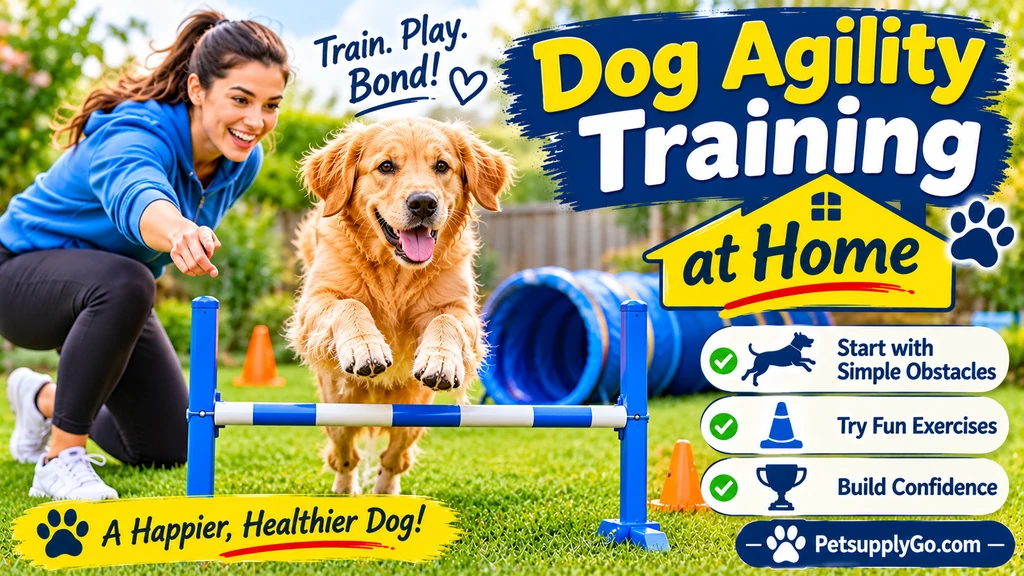
Watch a dog sprint through a tunnel, leap a jump, and weave through a row of poles while their owner jogs alongside, and it is hard not to smile. It looks like pure joy, and for most dogs it is. What many people do not realize is that you do not need a field, a club membership, or a champion dog to start. A backyard, a living room, a handful of treats, and a bit of patience are enough to begin.
Agility is one of the most rewarding ways to spend time with your dog. It burns energy, builds confidence, sharpens focus, and strengthens the bond between you. It also gives bored, busy, or anxious dogs a job to do, which can make life at home calmer.
Keyword data from Google Keyword Planner shows that “agility training” draws roughly 5,000 average monthly searches in the US, with low advertiser competition. That tells us plenty of owners are curious, and most are asking the same practical questions. Is my dog the right age? What equipment do I really need? How do I teach a tunnel, a jump, or weave poles without frightening my dog? How do I keep it safe for joints and paws?
This guide answers all of that in plain language, step by step. It covers the skills to build first, how to train each obstacle, how to choose or build equipment, how to structure a session, a four-week starter plan, common mistakes, and 30 frequently asked questions.
The short answer: start with fun and foundation skills, not equipment. Keep jumps very low or on the ground, keep sessions short, reward often, and wait until your dog is physically mature before asking for anything high or repetitive. Check with your vet first, especially for puppies, seniors, and breeds prone to joint or back problems.
Affiliate disclosure: PetSupplyGo may earn a small commission if you buy through links on this page. It never changes our recommendations or what you pay.
Important Note
This article is general information, not veterinary or professional training advice. Every dog is different. Talk to your vet before starting any new exercise program, particularly for puppies, senior dogs, overweight dogs, flat-faced breeds, and dogs with joint, back, heart, or breathing conditions. If your dog shows pain, limping, heavy panting, or reluctance, stop and call your vet.
Quick Answer: How to Start Dog Agility Training at Home
Here is the fast version before we go deeper.
| Step | What to do | Why it matters |
| 1 | Get a vet check | Confirms your dog is healthy enough |
| 2 | Wait for physical maturity | Protects growing joints |
| 3 | Teach focus, recall, and targeting | Builds the base for every obstacle |
| 4 | Introduce tunnels and low jumps | Easy, fun first wins |
| 5 | Add a pause table and weave poles slowly | Teaches control and precision |
| 6 | Save contact obstacles for later | A-frame and teeter need confidence and maturity |
| 7 | Keep sessions short | Five to fifteen minutes is plenty |
| 8 | Reward often and end on success | Keeps dogs eager |
| 9 | Build simple sequences | Links obstacles into a mini course |
| 10 | Rest and recover | Prevents injury and burnout |
Key Takeaways
- Agility is a sport where a dog follows cues from a handler through a course of obstacles such as jumps, tunnels, weave poles, and ramps.
- Mixed breeds, rescues, and most healthy adult dogs can enjoy it. You do not need a fast or purebred dog.
- Foundation skills such as attention, recall, targeting, and body awareness matter more than fancy equipment.
- Jumps should be very low, or poles can lie on the ground, until your dog is mature and conditioned.
- Many agility organizations require dogs to be at least 12 to 18 months old to compete, so check the rules of the group you want to join.
- Positive reinforcement works best. Treats, toys, and praise keep dogs confident.
- Sessions of five to fifteen minutes, a few times a week, are better than long marathons.
- A harness that fits well, non-slip footing, and a warm-up lower the risk of injury.
- Start at home, then consider a class if you want feedback or plan to compete.
What Is Dog Agility?
Dog agility is a sport in which a handler guides a dog through an obstacle course using voice, body language, and hand signals. Obstacles typically include jumps, tunnels, weave poles, a pause table, and contact obstacles such as the A-frame, dog walk, and teeter. In competition, dogs are judged on accuracy and speed, but for most pet owners the point is simply fun and connection.
You can enjoy agility at three levels.
Backyard fun. A few jumps, a tunnel, and a pile of treats. No rules, no pressure.
Class and club training. Weekly lessons with an instructor who can watch your dog’s movement and your handling.
Competition. Organized trials where dogs run timed courses. Many groups also offer fun runs and beginner classes with no ribbons attached.
Most owners begin at the first level, and plenty never need to go further.
Why Agility Is So Good for Dogs
It uses the body and the brain. Many dogs are physically exercised but mentally bored. Agility asks a dog to listen, think, and move at the same time, which tires them out in a satisfying way.
It builds confidence. Learning to go through a tunnel or onto a table can help a shy dog feel brave. Each small success adds up.
It improves focus and impulse control. Dogs learn to wait, turn on cue, and pay attention to you even when exciting things are happening.
It strengthens your bond. Working as a team creates trust. Many owners say they learn to read their dog’s body language better.
It burns energy safely. High-energy dogs often channel their drive into the course instead of the couch cushions.
It supports fitness. Regular, moderate activity helps with weight, muscle tone, and coordination, when done sensibly.
It gives anxious or reactive dogs a positive outlet. A structured, rewarding task can help some dogs, though dogs with serious anxiety or reactivity should be guided by a qualified trainer or behavior professional. If separation anxiety is part of the picture, agility is a helpful extra, not a cure.
It is fun. That might be the best reason of all.
Is Your Dog Ready for Agility?
Almost any healthy dog can enjoy some form of agility, but readiness depends on age, health, and temperament.
Age: puppies and young dogs
Puppies have open growth plates, which means their bones are still developing. Repeated jumping, hard landings, and tight turns can stress growing joints. Vets and many trainers recommend focusing on gentle foundation games with young puppies, such as name recognition, recall, tunnel play, walking over low, wide boards, and confidence building, and delaying jump height and contact obstacles until your dog is physically mature.
Maturity varies by size and breed. Small dogs may mature earlier, and giant breeds later. Many agility groups set a minimum age for competition, often around 12 to 18 months or older, to protect dogs. Ask your vet when your dog is physically ready for higher-impact work.
Senior dogs
Older dogs can still have fun with a modified version of agility: low obstacles, no jumping, tunnels, slow weaving through cones, and nose-work style games. The goal is movement and engagement, not speed. Get a vet check, especially for arthritis, heart disease, or vision and hearing changes, and keep sessions very short.
Health conditions
Talk to your vet if your dog has:
- Hip or elbow dysplasia
- Arthritis or other joint problems
- Spinal or back issues, including disc disease
- A history of cruciate ligament injury
- Heart or breathing conditions
- Obesity
- Seizures or other neurological issues
Some of these dogs can do modified, low-impact work. Others should skip agility entirely. Only your vet can say.
Flat-faced and short-legged breeds
Flat-faced breeds, such as bulldogs and pugs, can overheat quickly and struggle with exertion in warm weather. Long-backed, short-legged breeds, such as dachshunds, can be prone to back problems. These dogs may enjoy low-impact versions, but need extra caution, short sessions, cool weather, and your vet’s approval.
Temperament
A good agility dog does not have to be fearless. A dog who enjoys treats, toys, or praise, and is curious about new things, can usually learn. Nervous dogs often blossom with gentle, slow, positive training. A dog who is highly fearful, aggressive, or unable to focus around distractions may need help from a behavior professional first.
Which Breeds Do Agility?
Border collies, Australian shepherds, and Shetland sheepdogs are famous for it, but they are far from the only ones. Terriers, spaniels, poodles, retrievers, and mixed breeds all compete and have fun. Many sports organizations offer height divisions, so small dogs jump lower and large dogs jump higher, making the sport fair for dogs of every size.
What matters is not the breed, but the individual dog. A sturdy, athletic mixed-breed rescue who loves treats can do wonderfully. A pure-bred working line who is anxious around noise might need a slower start.
What You Need Before You Begin
You can begin with very little.
Treats. Small, soft, high-value treats that your dog loves. Training portions should be tiny, since you will use many of them. If you are looking for training-friendly options, our guide to freeze dried dog treats covers single-ingredient choices that suit training and sensitive stomachs.
A toy or tug. Some dogs work harder for play than food.
A treat pouch. Keeps your hands free and treats handy.
A comfortable harness and leash. A harness that fits well keeps pressure off the neck while you train and walk. Our guide to dog harnesses for large dogs explains what to look for in fit and security. Remove leashes, collars with dangling tags, and anything that can snag before your dog goes over a jump or through a tunnel.
A safe, enclosed space. A fenced yard, a quiet room, or a garage. If your yard is not fenced, consider reading about a GPS dog fence for a virtual option, or practice in a fenced area.
Non-slip footing. Grass or rubber mats work better than slick floors.
Water. Always have fresh water ready.
That is the entire starter kit. Equipment comes later.
Foundation Skills to Teach First
Most agility problems trace back to missing foundations. A dog who cannot focus on you, come when called, or handle small frustrations will struggle when the equipment appears. These skills are simple, work in any room, and make every obstacle easier.
Attention and name response
Say your dog’s name in a happy voice. When she looks at you, mark the moment with “yes” and give a treat. Repeat in different rooms, then in the yard, then with mild distractions. A dog who checks in with you is a dog you can guide.
Recall
A reliable “come” is essential, since agility is usually done off leash in a fenced space. Start close, reward generously, and make coming to you the best thing that happens all day. Never call your dog to end the fun or to scold her.
Marker words or a clicker
A marker is a short, consistent signal that tells your dog “that exact thing earned a reward.” Many trainers use a clicker, and others use a word such as “yes.” Say it, then treat. Timing matters more than the tool. Mark the instant your dog does the right thing, such as stepping into a tunnel or touching a target.
Hand targeting
Teach your dog to touch her nose to your open palm. Hold the hand out, mark when she touches, then reward. Targeting lets you steer your dog without pulling, and it becomes the basis for directing her toward obstacles, turns, and the pause table.
Sit, down, and stay
Impulse control matters. Teach a calm sit and down, and a short stay with a release word such as “okay.” In agility, a dog often waits at the start, or pauses on a table, and the release cue tells her when to go.
Go-on and send
“Go” means move forward toward an obstacle, even when you are not right beside it. Start by tossing a treat ahead, or sending your dog to a target on the floor, then to an object such as a cone. Over time, she learns to work at a distance.
Left and right
Teach turning cues. Many handlers use “left” and “right,” or “come” and “go.” Pick words you will say consistently, and practice by luring or targeting in each direction.
Collection and “close”
Teach your dog to stay near your side on either side, and to turn tight toward you when asked. This helps on corners and prevents sprawling wide.
Body awareness
Dogs are not always aware of where their back feet are. Games that build awareness include walking over a ladder laid flat on the ground, stepping over cavaletti poles, putting front paws on a low platform, and walking through cones. These build coordination and prepare the body for obstacles.
Handling comfort
A dog should be comfortable being touched, guided, and handled in many places. This also helps your vet and groomer.
Calm confidence
Practice around gentle sounds, new surfaces, and different objects. A dog who is relaxed around a rattling board or a rolling object will find equipment less scary. Build slowly, never forcing.
How Dogs Learn Best: Positive Reinforcement
Modern agility training relies on rewards. When a behavior earns something your dog likes, she does it again. Corrections, scolding, or forcing a frightened dog toward an obstacle can lead to fear, shut-down, and refusal.
Reward what you like. Mark and treat good choices.
Use high-value rewards. Dogs need something truly exciting for harder tasks.
Keep rewards varied. Mix treats, toys, praise, and play.
Reward often at first. You can space rewards out once a behavior is solid.
Reward in position. Deliver the treat where you want your dog to be, which helps teach position and speed.
Do not bribe, reward. A lure shows the dog what to do early on, but fade it quickly so the dog is not just following food.
Stay patient. Dogs learn at different speeds. A slow dog is not a bad dog.
Keep it fun. If your dog is not enjoying it, adjust the plan.
Setting Up a Training Session
A good session is short, structured, and ends on a win.
Length and frequency
Five to fifteen minutes is plenty, especially for beginners. Two or three short sessions a week usually beat one long one. Puppies and seniors should do even less.
Warm-up
Start with a few minutes of walking, gentle trotting, and easy stretches such as a play bow and slow circles. A warm body is less likely to be injured.
Main work
Pick one or two goals per session. For example, “tunnel twice and low jump five times.” Do not try to teach everything at once.
Cool-down
Finish with a calm walk and some water. Check paws and pads, and let your dog rest.
End on success
If your dog is tired, frustrated, or struggling, return to an easier skill and finish with a win. Quitting while your dog is still eager keeps motivation high.
Watch for signs of stress or fatigue
- Heavy, fast panting
- Lagging behind or slowing down
- Lip licking, yawning, or turning away
- Refusing treats
- Limping or favoring a leg
- Reluctance to jump or move
If you see these, stop and let your dog rest. If anything seems painful, call your vet.
Pick a good time and place
Avoid training right after a meal, in very hot or cold weather, or when your dog is already tired. Cool mornings and evenings suit most dogs.
Use a consistent routine
A simple ritual, such as the same start word, helps your dog understand that training is beginning, and that she is expected to work with you.
The Agility Obstacles: What They Are
Before we dive into training, here is a quick tour of the main obstacles.
Jumps
Bars that rest on stands and are set at a height suited to your dog. There are single bar jumps, double and triple jumps for spread, and tire or hoop jumps.
Tunnels
Open tunnels, which are flexible tubes the dog runs through, and collapsed tunnels, also called chutes, which have a fabric end the dog pushes through. Most dogs start with a short, straight, open tunnel.
Weave poles
A row of upright poles that a dog threads through, entering from the correct side and alternating left and right. They are one of the hardest obstacles to teach, and take patience.
Pause table
A raised platform where the dog must stop for a few seconds. It teaches control and calm.
A-frame
Two ramps joined at the top, forming an A shape. The dog climbs up and down, and must touch a colored zone at the bottom.
Dog walk
A long, raised plank with ramps at each end. The dog walks across, touching the contact zones.
Teeter-totter
A plank balanced on a pivot. It tips when the dog crosses the center. It is exciting, noisy, and often scary at first.
Tire jump
A hoop hanging in a frame that the dog jumps through. Tires should be set low for beginners.
Other obstacles
Some courses include a broad jump, panel jumps, and other variations.
The obstacles fall into three groups. Jumps and tunnels are the easiest. The pause table and weave poles teach precision. The contact obstacles are the hardest, and should wait until your dog is mature, confident, and conditioned.
Step-by-Step: Training Each Obstacle
Take your time with each step. If your dog struggles, go back to the previous one. Never push a nervous dog forward, and keep the equipment low and safe.
Training the tunnel
Tunnels are usually the easiest and most fun, so they make a good first obstacle.
- Start short. Use a short tunnel, scrunched up so your dog can see light through the other end.
- Show it. Let your dog sniff it and explore. Toss a treat just inside the entrance.
- Lure through. Have a helper hold your dog at one end while you call from the other. Or toss a treat out the far end. Mark and reward when your dog comes out.
- Lengthen. Gradually stretch the tunnel out, and add a gentle curve.
- Add a cue. When your dog is running through reliably, say “tunnel” as she enters.
- Send from a distance. Increase the distance between you and the entrance, and ask your dog to go through while you stand to the side.
- Secure it. Make sure the tunnel is anchored so it does not roll or collapse on your dog.
If your dog hesitates, make it easier, shorten the tunnel, and reward even a single step inside.
Training the jump
Safety first. Start with the bar on the ground or at a very low height.
- Poles on the ground. Lay a pole flat and walk your dog over it. Reward.
- Raise slightly. Raise the pole just a few inches for small dogs, or a little more for larger dogs, only after the flat version is easy.
- Add a cue. Say “jump” or “over” as your dog crosses.
- Use wings or guides. Place objects at each side so your dog goes over, not around.
- Work both directions. Practice from the left and right, and on either side of you.
- Keep the bar knockable. Never use a jump that is fixed. A bar that falls away is safer.
- Keep it low. Jump height should be well below what your dog could clear, especially during training.
- Limit repetitions. A handful of jumps per session is enough, particularly for young dogs.
Do not jump a puppy until your vet says her growth plates have closed.
Training the pause table
- Introduce the surface. Start with a mat or a low platform on the ground.
- Reward four paws. Mark and treat whenever she steps on with all four feet.
- Add the sit or down. Once she steps on happily, ask for a sit or down.
- Add duration. Increase the pause a second at a time, rewarding in position.
- Release. Teach a release word, then let her hop off.
- Raise it gradually. Use a taller platform only when she is confident.
A pause table helps with impulse control, so even dogs who are not interested in racing can benefit.
Training the weave poles
Weaving is hard, and there are several methods. Some use channel poles, others guide wires, and others use a “2 by 2” method where the dog learns to enter between two poles. Whatever method you choose, go slowly.
- Start with two poles. Make sure your dog understands entering correctly, between the first and second pole.
- Use a wide channel. Space the poles far apart, or use a channel, so the path is clear.
- Lure and reward. Guide your dog through with a treat, and mark and reward at the exit.
- Add poles slowly. Add two poles at a time, and keep the channel wide.
- Close the channel. Narrow it only when your dog weaves confidently.
- Add speed later. Speed comes naturally with confidence.
- Be patient. Weaves can take weeks or months.
Do not rush weaving, since it is frustrating and easy to teach badly. If your dog starts skipping poles or going around, widen the channel and return to an easier step.
Training the A-frame, dog walk, and teeter
Contact obstacles require confidence, balance, and a mature body. Many trainers wait until a dog is well past puppyhood, and teach these in a class, where equipment is sized and secured for safety.
If you are working at home, start with low, wide boards on the ground, and let your dog walk across calmly.
A-frame basics. Begin with a low ramp or a board propped against a low surface. Reward your dog for walking up and down. Raise it gradually, and add a target at the bottom, such as a mat, to teach the contact zone.
Dog walk basics. Start with a plank on the ground. Reward walking across. Raise it a few inches at a time, and never leave your dog unsupervised.
Teeter basics. The tipping motion and the noise startle many dogs. Start with a low board on a small pivot that barely moves, and use treats to build comfort. Let your dog get used to the sound and movement slowly. Many trainers use a helper to hold the end so the plank only drops a little.
Contact obstacles carry the highest injury risk. Use non-slip surfaces, never force your dog, and consider professional help.
Training the tire jump
Use a safe, breakaway tire. Start with the opening large and low, walk your dog through, and reward. Raise gradually. A tire should never be set to a height that forces your dog to jump awkwardly.
Putting obstacles together
Once your dog knows two or three obstacles, link them.
- Two-obstacle sequence. For example, jump then tunnel.
- Three-obstacle sequence. Add a turn.
- Simple loop. Jump, tunnel, jump, and back.
Keep sequences short, reward at the end, and change the order often so your dog follows you instead of memorizing the pattern.
Basic Handling: How to Guide Your Dog
Handling is how you use your body, voice, and position to tell your dog where to go.
Your shoulders and feet matter. Dogs read your body. Turn your shoulders toward the next obstacle to tell her where to go.
Use your arm closest to the dog. A clear, consistent hand signal helps.
Use your voice. Say the obstacle name before the turn, so your dog has time to prepare.
Move with energy. A fast handler encourages a fast dog.
Front cross. You turn toward your dog, changing sides in front of her. It tells her to turn and follow you.
Rear cross. You cross behind your dog, which pushes her ahead and across your path. Used with care, it helps keep distance.
Flat work. Practice changing sides and turning without any obstacles, so your dog learns the signals.
Lead-outs. Teach your dog to wait while you move ahead, then release.
Stay consistent. Use the same cues in the same way, and do not change your words randomly.
Rewards, Toys, and Motivation
A reward is anything your dog wants. Learning what motivates your dog is one of the most useful things you can do.
Food rewards. Small, soft treats work well for precision and teaching new skills.
Toy rewards. Tug toys and balls build speed and excitement. A toy reward after a tunnel or jump creates energy.
Play and praise. For some dogs, a happy “good girl” and a quick game of chase is the best reward.
Mix it up. Surprises keep dogs keen. Use treats for harder skills and toys for fast runs.
Match reward to effort. A tough new skill earns the best treat, while an easy repeat earns a smaller one.
Watch calories. Training treats add up. A common guideline is that treats should be about 10 percent or less of daily calories, so adjust meals on training days. Ask your vet if you are unsure.
If your dog loses interest, check whether the reward is exciting enough, the session is too long, or she is tired, stressed, or uncomfortable.
Safety and Injury Prevention
Agility is rewarding, but it involves jumping, turning, and running, so safety matters.
Warm up and cool down
A brief warm-up and cool-down reduce the chance of strains.
Mind the surface
Grass, rubber mats, and firm, level ground are better than slick tile, wet pavement, or loose gravel. Check for holes, stones, and debris.
Keep jumps low
Lower bars protect joints. Resist the urge to raise the bar to see how high your dog can go.
Limit repetitions
Too many jumps or turns in a row stress the body. Keep sessions short.
Check the equipment
Inspect for sharp edges, loose parts, wobbling, and wear. Secure jump stands and tunnels, and replace anything damaged.
Watch the weather
Avoid training in extreme heat or cold. In hot weather, dogs overheat quickly, especially flat-faced breeds. If it is cold, a warm layer can help, and our guide to dog winter coats explains how to choose one that fits properly and does not restrict movement. After muddy or snowy sessions, see our guide on how to clean dog paws.
Protect the paws
Check pads for cuts, cracks, or wear after each session. Rough surfaces can scrape pads, and hot ground can burn them.
Keep your dog at a healthy weight
Extra weight puts more stress on joints. Ask your vet about an ideal weight.
Avoid collars and leashes on equipment
Dangling collars and leashes can catch on equipment. Remove them in training, and make sure your dog is in a safe space.
Rest and recovery
Dogs need rest days. A comfortable place to recover also helps, and our dog beds category can help you compare supportive options for tired joints.
Know when to stop
If your dog limps, yelps, avoids obstacles she used to like, or seems sore afterward, stop and see your vet. Do not push through pain.
Choosing Agility Equipment for Home
Equipment is where many beginners overspend. You do not need a full course. A few well-chosen pieces, or simple DIY versions, are plenty. Searches for terms like “dog toys” and other equipment run very high in the US, which shows how many owners shop for gear before they have a plan.
What to buy first
A tunnel. A short, sturdy, open tunnel is the best first purchase for most dogs. Look for a wide opening, strong fabric, and a way to anchor it.
A set of low jumps. Adjustable jumps with lightweight bars that fall away easily. Make sure they go low enough for your dog.
A pause table or platform. A stable, non-slip surface at a safe height.
Weave poles. Adjustable or channel sets are easier for beginners.
Cones. Handy for turns, targets, and flat work.
What to wait on
Contact obstacles, such as the A-frame, dog walk, and teeter, are big, expensive, and require training. Many owners find it better to learn these in a class with proper equipment.
What to look for in equipment
- Stability. Nothing should wobble or tip over.
- Safe materials. Smooth edges, no splinters, no pinch points.
- Non-slip surfaces. Good grip on ramps and tables.
- Adjustability. Height settings that match your dog.
- Breakaway design. Jump bars should fall away if hit.
- Weather resistance. Equipment left outdoors should handle rain and sun.
- Easy storage. Foldable or stackable pieces save space.
- Reasonable price. Compare a few options and read recent reviews.
Buying sets versus single pieces
A starter set can offer good value if it includes the pieces you need, but quality varies. Check what is in the set, and decide whether you will use all of it. Single pieces let you build gradually.
Fit for your dog’s size
Small dogs need low jumps, short tunnels, and small tables. Large dogs need wide tunnels and sturdier stands. A tunnel that is too narrow can scare a big dog, and a jump that is too high can hurt a small one.
Browsing options
For ideas on toys and gear to use alongside training, browse our dog toys category. For rewards and tug toys that survive heavy use, see our guide to indestructible dog toys for aggressive chewers, and always supervise play with any toy.
DIY Agility Equipment at Home
You can make a surprisingly good setup from household and hardware-store items. Safety comes first, so keep designs simple, stable, and low.
Cavaletti or low jumps. Lay broom handles, PVC pipes, or poles across two stacks of books or sturdy blocks. Keep them very low, and make sure the bar can fall away.
Cone weaves. Use traffic cones or bottles filled with sand, and set them in a line. Start with a wide gap.
A tunnel. Many owners buy a tunnel, but a large cardboard box with both ends open can serve as a first practice tunnel for small dogs. Keep it short and stable.
A pause mat. A yoga mat or non-slip rug on the ground works as a first pause target.
A low platform. A sturdy wooden box or a plastic step, with a non-slip surface, works for four paws on a box.
Ladder on the ground. A ladder laid flat teaches foot placement and body awareness.
Hoops. A hula hoop held up by hand, or a lightweight hoop on a stand, can teach a dog to go through.
Balance work. A cushion or wobble board can build core strength. Introduce it very gradually.
Safety tips for DIY.
- Use materials that do not splinter or crack.
- Avoid sharp edges, nails, or screws that stick out.
- Do not use anything heavy that could fall on your dog.
- Test the equipment yourself.
- Check it before each session.
- Keep jumps low.
Setting Up Your Space
You do not need a large area.
A yard. A flat, fenced area with grass is ideal. Clear away holes, stones, and anything pointy.
A garage or basement. Good for rainy days if the floor has traction, such as rubber mats.
A living room. Small spaces can host tunnel play, cone weaves, and targeting games. Move breakable items.
A park or field. Public spaces can work if they are fenced or you have a reliable recall. Follow local rules, and keep your dog leashed where required.
Space guidelines. Leave enough room to run, turn, and land. A course of a few obstacles can fit in a modest yard.
Layout tips. Start with obstacles far apart, so your dog sees each one clearly. Gradually bring them closer. Use a simple loop shape to practice turns.
If you also use the yard as a bathroom, clean up before training, and wash your hands afterward.
A Four-Week Beginner Plan
This plan is a general guide for a healthy adult dog. Adjust the pace for your dog, and skip anything that seems uncomfortable.
Week 1: Focus and fun
- Practice name response, recall, and hand targeting daily.
- Teach sit, down, and stay with a release.
- Introduce a short tunnel and let your dog explore.
- Play body awareness games, such as walking over a flat ladder.
- Keep sessions to five to ten minutes.
Week 2: Tunnels and low jumps
- Lengthen the tunnel slightly.
- Add a cue word, “tunnel.”
- Introduce a pole on the ground, then raise it a few inches.
- Teach “go” with a treat toss.
- Begin simple turns left and right.
Week 3: Table and early weaves
- Introduce the pause table or mat, and teach four paws on.
- Add a sit or down with a short pause.
- Start two weave poles with a wide channel.
- Link a jump and a tunnel.
- Practice a front cross on flat ground.
Week 4: Sequences
- Add two or three more weave poles if your dog is ready.
- Run a short sequence: jump, tunnel, table.
- Practice a lead-out and release.
- Keep rewarding generously.
- Review what your dog loves and what feels hard.
After week four, decide whether to continue at home, join a class, or take a break. Progress is not a race.
Common Problems and How to Fix Them
My dog will not go in the tunnel. Shorten it, let your dog see through it, and reward tiny steps. Make it a game. Do not push or force.
My dog knocks bars. Lower the jump, slow down, and practice approach. Check that the bar is not too heavy.
My dog runs around the jump. Use wings or guides, reward going over, and keep the jump very low.
My dog ignores me. Shorten sessions, use higher-value treats, and train in a quieter space. Practice attention games.
My dog is scared of the equipment. Go back to basics. Let your dog explore, reward calm behavior, and introduce one step at a time. Seek professional help if fear is intense.
My dog gets too excited. Practice sit and stay, add calm breaks, and reward settled behavior. Short sessions help.
My dog loses focus. End earlier, change rewards, and reduce distractions.
My dog slips on surfaces. Use non-slip mats, train on grass, or trim nails and hair between pads.
My dog is tired or sore afterward. Reduce intensity, extend rest, and talk to your vet.
My dog will not stay on the table. Make the table rewarding, start low, and shorten the pause.
My dog pulls on the leash. Practice loose-leash walking away from the course.
My dog barks during training. Barking often means excitement or frustration. Reward quiet, and keep sessions short.
My dog will not come back. Go back to recall games, practice on a long line, and make returning rewarding.
Common Mistakes Beginners Make
- Starting with equipment before foundations. Focus first, obstacles second.
- Raising jumps too soon. Low is safer.
- Training too long. Short sessions work better.
- Skipping warm-ups. A warm body is safer.
- Forcing a scared dog. Fear spreads, and trust is lost.
- Using punishment. It reduces enthusiasm and can create fear.
- Teaching contacts too early. These are for mature, confident dogs.
- Skipping the vet. Health problems can be hidden.
- Comparing your dog to others. Every dog learns differently.
- Ignoring signs of pain. Limping or reluctance needs attention.
- Training on slippery floors. Footing matters.
- Overusing treats. Adjust meals and use small pieces.
- Not ending on a win. Always finish with success.
- Inconsistent cues. Choose words and stick with them.
- Forgetting rest days. Recovery matters as much as training.
Myths About Dog Agility
Myth: Only purebred sport dogs can do agility. Mixed breeds and rescues compete and do very well.
Myth: Agility is only for young dogs. Many older dogs enjoy modified versions with low obstacles.
Myth: Dogs should jump as high as possible. Lower is safer, and height is not the goal.
Myth: Agility will fix behavior problems. It can help with energy and focus, but serious issues need professional guidance.
Myth: You need expensive equipment. Simple, safe, DIY tools can work well.
Myth: You must compete. Plenty of owners train just for fun.
Myth: Small dogs cannot do agility. Small dogs often love it, and height divisions keep it fair.
Myth: Puppies should start jumping early. Growing joints need protection.
Myth: A tired dog is a happy dog. Mental stimulation and rest matter, not just exhaustion.
Myth: If my dog is scared, she will get over it. Fear usually needs gentle, gradual work.
Joining a Class or Competing
If you enjoy agility at home, you may want to take it further.
Classes
A good class offers proper equipment, feedback, and a safe environment. Look for instructors who use positive reinforcement, keep jump heights appropriate, and welcome beginners. Visit before you sign up, watch a session, and ask about their approach to safety and fearful dogs.
Clubs and organizations
In the US, several organizations run agility trials and set rules for age, height divisions, and equipment, including the American Kennel Club, the United States Dog Agility Association, the United Kennel Club, and others. Rules differ, and mixed breeds are welcome in many of them. Check each group’s current requirements, since minimum ages and registration rules change.
Fun runs and beginner events
Some clubs offer fun matches with no pressure. They are a good way to see how your dog handles new places.
What to bring
Water, treats, toys, a crate or mat, and a towel. A comfortable pad or bed gives your dog a place to rest between runs, and a warm coat helps in cold weather.
Know why you are there
Competition should be fun for you and your dog. If your dog is stressed or not enjoying it, take a break.
Pre-Training Checklist
Use this list before each session.
- My dog is healthy and my vet has approved activity.
- My dog is physically mature enough for the obstacles I plan to use.
- The surface is non-slip and free of hazards.
- Equipment is stable, safe, and set at a low height.
- My dog’s harness fits, and leashes and loose collars are off.
- I have small, tasty treats and a favorite toy.
- I have fresh water.
- The weather is comfortable.
- I have a plan for the session, with one or two goals.
- I will end on a success.
Quick Glossary
Agility: A sport where dogs navigate a course of obstacles guided by a handler.
Cue: A word or signal that asks for a behavior.
Marker: A sound or word that says “yes, that was right.”
Lure: Using food to guide a dog into position.
Target: An object or hand that a dog touches with her nose or paw.
Contact obstacles: The A-frame, dog walk, and teeter, which have colored zones the dog must touch.
Weave poles: A row of poles a dog weaves through.
Pause table: A raised table where the dog stops for a few seconds.
Front cross: A handling move where the handler turns in front of the dog.
Rear cross: A handling move where the handler crosses behind the dog.
Lead-out: Moving ahead of the dog while she waits.
Growth plates: Areas at the ends of a young dog’s bones where growth happens. They close as the dog matures.
Cavaletti: Low poles on the ground used for footwork.
Conditioning: Building a Strong, Balanced Body
Agility asks a lot of muscles, joints, and tendons. A little off-course conditioning helps your dog stay sound, and most of it is simple enough to do on a walk or in the living room. Check with your vet before starting, and build up slowly.
Walks on varied ground. Hills, grass, sand, and gentle trails build stabilizing muscles better than a flat sidewalk. Keep the pace steady, and avoid very steep or rocky terrain at first.
Sit-to-stand repetitions. A few controlled sits and stands, rewarded with a small treat, strengthen the hind end. Start with three or four, and stop before she tires.
Cavaletti walks. Walking slowly over a row of low poles lifts the feet and builds coordination. Space them so she can step naturally.
Balance and wobble work. Standing with front paws on a firm cushion or a low, stable platform teaches balance. Reward calm stillness, and keep it brief.
Backing up. Asking your dog to walk backward a few steps works the core and hindquarters. Many dogs find it odd at first, so use a treat to encourage it.
Figure eights. Walking in a slow figure eight around two cones builds flexibility and teaches turning on both sides.
Stretching and massage. Gentle stretching after a session and a calm rub-down help many dogs relax. If your dog flinches or pulls away from a spot, mention it to your vet.
Swimming. For dogs who enjoy it, swimming is a low-impact way to build fitness. Use a life vest where appropriate, and never leave your dog unsupervised in the water.
Rest days. Muscles repair on rest days, not training days. Most dogs benefit from at least one or two days off from jumping each week.
Hydration, Food, and Energy
Training uses fuel, and the way you feed around sessions matters.
Water. Offer small amounts before, during, and after training. Gulping a lot of water right after hard exercise is not ideal, so let your dog sip.
Meal timing. Avoid training right after a full meal, and do not exercise hard immediately afterward. Many vets suggest waiting a couple of hours, especially for deep-chested dogs that are at risk of bloat. Ask your vet what suits your dog.
Treat math. Cut treats into pea-sized pieces, and count them toward the daily total.
A balanced diet. Active dogs may need more calories, but not all do. Weigh your dog regularly, feel her ribs, and ask your vet for guidance.
Watch the stomach. Heavy exercise plus rich treats can cause loose stool, so change treats gradually. If you notice stool changes, our guide on the dog food category can help you compare options, and ask your vet before changing a main diet.
Slow down fast eaters. Dogs who gulp food after exercise may swallow a lot of air. A slow feeder or a lick mat turns the cooldown into a calm activity. If you use a lick mat, choose dog-safe spreads and check labels for xylitol.
Rainy-Day and Indoor Agility Games
You do not have to skip training when the weather turns. These games work in a small space.
Tunnel through the sofa. Drape a blanket over two chairs, and invite your dog to go under it. Reward the second she goes through.
Treat trail. Scatter treats along a path of cones, and let your dog follow her nose.
Paws-up targets. Ask for front paws on a low step, a book, or a firm cushion.
Spin and twist. Teach a quick spin left and right. It builds flexibility and responds well to a lure.
Hide and seek. Ask your dog to stay, hide, and call her. It builds recall and excitement.
Mat work. Teach your dog to go to a mat and lie down on cue. This doubles as a pause table lesson.
Name the toy. Teach the names of several toys, and send your dog to fetch one. It builds focus.
Obstacle with a towel. Roll a towel into a log for a tiny jump, and reward stepping over.
Calm time. Finish with a settled down on a comfortable bed, and reward quiet.
Play with food puzzles. A snuffle mat or puzzle toy gives the brain a workout without stressing joints.
If you have a puppy, these are also good ways to socialize her to new textures and sounds. Our puppy starter kit essentials list covers the basics new owners need, and our guide to crate training a puppy explains how a calm crate routine helps her rest between sessions.
Low-Impact Agility for Seniors and Special Cases
Not every dog can or should jump. A modified approach can still give her a joyful workout.
No jumping. Replace jumps with poles on the ground, cavaletti, or walking over a low board.
Slow weaving. Weave around cones at a walk, with wide spacing.
Tunnel play. A short, soft tunnel is usually gentle on joints, though check with your vet.
Scent games. Nose work is a favorite for older dogs, since it uses the brain more than the body.
Short sessions. Three to five minutes may be plenty.
Soft surfaces. Grass or mats cushion landings.
Supportive gear. A harness with a handle can help you steady a dog who wobbles, and orthopedic bedding helps recovery.
Watch for fatigue. Older dogs tire quickly, and may be sore the next day.
Joint care. Ask your vet about weight management, supplements, and medication if your dog has arthritis. Do not start supplements without advice.
Celebrate small wins. A senior dog who weaves three cones with a wagging tail is a champion.
Traveling to Classes and Trials
If you take your dog to a class or event, a little planning makes the day smoother.
Safe car travel. Use a secure harness, crate, or car seat, so your dog is restrained. Our guide to dog car seats and car beds explains how to choose a safe and comfortable option.
Arrive early. Give your dog time to sniff, settle, and take it all in.
Bring a crate or mat. A familiar spot helps her rest between runs.
Pack the basics. Water, a bowl, treats, a toy, poop bags, a towel, and a first-aid kit.
Keep vaccines current. Many events require proof of vaccination.
Watch the weather. Shade, a cooling mat, or a warm coat can matter.
Keep distance. Not every dog enjoys meeting others. Give space, and ask before letting dogs greet.
Pick up after your dog. Always carry bags and dispose of waste properly.
Rest afterward. A calm evening, a light meal, and a comfortable bed help recovery.
Reading Your Dog’s Body Language During Training
Your dog tells you how she feels all the time. Learning to read it keeps training fun and safe.
Relaxed and eager. Loose body, soft eyes, a wagging tail held at a natural height, ears forward or neutral, and a ready-to-go stance. This is the state you want.
Overexcited. Frantic movement, barking, mouthing, jumping on you, and ignoring cues. Slow down, ask for a sit, and let her settle before you continue.
Stressed. Lip licking, yawning, turning away, a tucked tail, a low body, shaking off, sniffing the ground suddenly, or panting when it is not hot. Make the task easier, add distance from the scary object, and give her a break.
Tired. Slower speed, dropping her head, lagging behind, and losing interest in treats. End the session.
Sore or hurting. Limping, stiffness, favoring a leg, yelping, reluctance to jump, or flinching when touched. Stop, rest, and call your vet.
Overheated. Heavy panting, drooling, bright red or pale gums, wobbling, and vomiting are warning signs. Move to shade, offer water, and seek vet care right away for heatstroke symptoms.
Confident. Quick approach to equipment, a loose body, and bold, curious sniffing. Reward it with a jackpot of treats.
When in doubt, trust your gut. If your dog seems off, stop and try again another day.
A Simple Eight-Week Progression
If you enjoy the four-week plan and want to keep going, here is a gentle outline for weeks five to eight. Adapt it to your dog, and slow down whenever she needs.
Week 5: Confidence on the table and in the tunnel
- Lengthen the tunnel and add a curve.
- Ask for a longer pause on the table, with a calm release.
- Practice sending your dog to the tunnel from a short distance.
- Review recall games with a mild distraction.
Week 6: Weaves and turns
- Add more weave poles with a slightly narrower channel, if she is ready.
- Practice front crosses and rear crosses on flat ground.
- Add a second jump a few strides after the first.
- Keep jump height low, and limit repetitions.
Week 7: Sequences
- Run three-obstacle sequences, such as jump, tunnel, table.
- Change the order, so your dog follows your cues instead of memorizing patterns.
- Add a short lead-out, then release.
- Introduce gentle background noise to practice focus.
Week 8: Review and celebrate
- Run a short mini course of four or five low obstacles.
- Reward big at the end, with a toy and a party.
- Note which skills felt easy and which need more work.
- Decide whether to keep training at home, join a class, or take a break.
A Cheat Sheet of Handy Cue Words
Choose short, distinct words, and use them the same way every time. Here are common examples, though any consistent words work.
| Cue | What it means |
| Yes (or click) | That was right, a treat is coming |
| Okay | You are released from the position |
| Touch | Touch your nose to my hand or the target |
| Tunnel | Go into the tunnel |
| Jump (or over) | Go over the jump |
| Table | Get on the table and pause |
| Weave | Go through the poles |
| Go | Move ahead to the next obstacle |
| Left or right | Turn in that direction |
| Come | Come to me and turn toward me |
| Wait | Stay in place until released |
Say each word before the movement starts, so your dog has time to respond. If you change a cue, give your dog time to relearn it.
Gentle Ways to Keep It Fun for Both of You
Remember that you are part of the team, too. Your mood, your pace, and your body language shape your dog’s experience.
Laugh at mistakes. Missed cues, wrong turns, and funny tangles are part of learning. If you get frustrated, take a break.
Celebrate tiny steps. A dog who walks into a tunnel for the first time deserves a party.
Stay flexible. If your dog wants to play tug today and work for food tomorrow, follow her lead.
Keep notes. A short journal of what went well helps you track progress, and keeps motivation high when you feel stuck.
Train with a friend. Another person can hold your dog, set up equipment, or film a session so you can review your handling.
Film your sessions. Watching a video shows your dog’s movement and your timing, and often reveals easy fixes.
Remember why you started. The goal is a happier, healthier, better-connected dog, not perfect runs.
Frequently Asked Questions (30 FAQs)
1. What is dog agility training?
Dog agility training teaches a dog to follow a handler’s cues through a course of obstacles such as jumps, tunnels, weave poles, a pause table, and contact obstacles like the A-frame. It combines exercise, mental work, and teamwork. You can do it for fun at home, in a class, or in organized competitions. Most beginners start with simple foundation skills and a few low obstacles.
2. How do I start dog agility training at home?
Start with a vet check, then teach foundation skills such as name response, recall, hand targeting, sit, stay, and a release cue. Add a short tunnel and a pole on the ground, and keep sessions to five to fifteen minutes. Use small, tasty treats and end on a success. Add more obstacles slowly, and wait to introduce contact obstacles until your dog is mature and confident.
3. What age can a dog start agility training?
Puppies can start gentle foundation games early, such as recall, targeting, tunnel play, and walking over low, flat boards. High jumps and repetitive impact should wait until a dog is physically mature, since growth plates are still open in young dogs. Many organizations set a minimum age for competition, often around 12 to 18 months or older. Ask your vet when your dog is ready, since size and breed matter.
4. Is agility good for dogs?
Yes, for most healthy dogs. It provides physical exercise, mental stimulation, confidence, and bonding. It can also help channel energy. It does carry injury risk if jumps are too high, sessions are too long, or the dog has an unrecognized health issue, so get a vet check, keep obstacles low, and watch for signs of pain or fatigue.
5. Can any dog do agility?
Many dogs can enjoy some form of agility, including mixed breeds and rescues. Health, age, and temperament matter more than breed. Dogs with joint, back, heart, or breathing problems, and some flat-faced or long-backed breeds, need special care and a vet’s approval. Dogs who are very fearful or reactive may need help from a behavior professional first.
6. How long should an agility training session be?
For beginners, five to fifteen minutes is plenty. Short, frequent sessions, a few times a week, are better than long ones. Puppies and seniors need even shorter sessions. Stop sooner if your dog is tired, stressed, or losing focus, and always end on something she does well.
7. What equipment do I need for dog agility training?
You can start with almost nothing: treats, a toy, a treat pouch, and a safe space. When you are ready, the most useful first pieces are a short open tunnel, low adjustable jumps, a pause table or platform, cones or weave poles, and non-slip footing. Contact obstacles such as the A-frame and teeter are expensive and are usually best learned in a class.
8. What is the easiest agility obstacle to teach?
Most dogs find the open tunnel easiest and most fun, followed by low jumps. Start with a short, scrunched tunnel so your dog can see light at the end, reward small steps, and lengthen it gradually. Never push a hesitant dog through, since a bad first experience can create fear.
9. How do I teach my dog to use weave poles?
Weaving takes patience. Many trainers start with two poles and a wide channel, guide the dog through with a treat, and add poles slowly. Methods vary, including channel poles, guide wires, and the “2 by 2” approach. Narrow the channel only when your dog is confident, and add speed later. It can take weeks or months, so keep sessions short and positive.
10. How high should agility jumps be for beginners?
Very low. Start with a pole on the ground, then raise it only a few inches. Keep jumps well below what your dog could clear, since training does not require maximum height. Use a bar that falls away if hit. Puppies and young dogs should not jump high until your vet confirms they are mature.
11. When can I introduce the A-frame, dog walk, and teeter?
Usually later, once your dog is mature, confident, and has strong foundations. These contact obstacles carry the highest injury risk, and the teeter’s noise and movement scare many dogs. Many owners learn them in a class with properly sized, secure equipment. At home, start with low, wide boards on the ground, and never force a nervous dog.
12. Do I need treats for agility training?
Treats are very helpful, but not the only option. Some dogs work harder for a tug toy, a ball, or praise and play. Use whatever your dog finds most motivating, and vary the reward. Keep treats small, and count them toward daily calories. A common guideline is that treats should be about 10 percent or less of daily calories.
13. What should I do if my dog is afraid of the tunnel?
Go back a step. Shorten the tunnel, scrunch it so your dog can see through, and reward any step toward it. Let her explore at her own pace, toss treats near and just inside the entrance, and make it a game. Never force your dog through. If fear is intense, ask a qualified trainer or behavior professional for help.
14. Can small dogs do agility?
Absolutely. Small dogs often love it. Use low jumps, shorter tunnels, and small tables, and watch for fatigue. Many organizations use height divisions so small dogs compete fairly. For long-backed, short-legged breeds, ask your vet about back safety first.
15. Can older dogs do agility?
Many can enjoy a modified, low-impact version. Skip jumping, use poles on the ground, slow weaves, tunnels, and nose games, and keep sessions short. Get a vet check first, especially if your dog has arthritis, heart issues, or vision or hearing changes. Stop if she shows pain or reluctance.
16. How do I stop my dog from knocking bars?
Lower the bar, slow down, and practice the approach. Make sure the bar is light and sits properly in the cups. Reward clean jumps, and do not scold knocked bars. Work on footing and conditioning, and check that your dog is not rushing or tired. If she knocks bars often, ask an instructor to watch her movement.
17. Why does my dog run around the jump?
Often she does not yet understand that the jump is the task, or the path around is easier. Use wings or guides so there is no way around, keep the jump very low, and reward going over. Practice from both sides, and avoid frustration.
18. How do I teach my dog to pause on a table?
Start with a mat or low platform. Reward four paws on, then add a sit or down, then add duration a second at a time. Teach a release word, and raise the table only when she is confident. Reward in position, and keep it calm.
19. Do I need a clicker for agility?
No, but a marker helps. A clicker or a word such as “yes” tells your dog exactly when she did the right thing. Timing matters more than the tool. Use whichever you can deliver consistently, then reward right away.
20. What harness is best for agility?
A well-fitted, comfortable harness that does not restrict shoulder movement is best. Many trainers prefer to train without anything that can snag, so remove leashes and loose collars before obstacles. For help with fit and security, see our guide to harnesses for large dogs and ask your vet or a fitter.
21. Can I make DIY agility equipment?
Yes, with care. Low poles on stacks of sturdy blocks, cones, a yoga mat for a pause target, and a ladder on the ground all work. Avoid sharp edges, splinters, and heavy parts that could fall. Keep jumps low, check everything before each session, and never leave equipment out where it could tip over.
22. How often should I train?
Two to four short sessions a week suits most beginners. Include rest days, since muscles repair when they rest. Puppies and seniors need fewer, shorter sessions. If your dog seems sore, tired, or less enthusiastic, scale back.
23. How do I know if my dog is tired or sore?
Signs include heavy or fast panting, slowing down, lagging, lip licking, yawning, refusing treats, limping, stiffness the next day, or avoiding obstacles she liked before. Stop, give water and rest, and call your vet if you see pain, limping, or breathing difficulty.
24. Does agility help with anxiety or behavior problems?
It can help some dogs by burning energy, building confidence, and giving them a structured job. It is not a cure. Dogs with serious anxiety, reactivity, or aggression need guidance from a qualified trainer or behavior professional, and sometimes a vet. Agility can be a helpful extra alongside that work.
25. Can mixed-breed and rescue dogs compete in agility?
Yes. Many organizations welcome mixed breeds, though registration rules differ, so check each group’s requirements. Rescues often thrive when training is gentle and confidence-building. Take your time, especially if your dog has a history of fear.
26. Is agility safe for puppies?
Gentle foundation games are fine, but high jumps, repetitive jumping, hard landings, and contact obstacles should wait until your puppy is physically mature. Keep play low and short, use soft surfaces, and ask your vet about timing. Early on, focus on recall, targeting, tunnels, confidence, and body awareness.
27. Should I join an agility class?
A class is useful if you want feedback, proper equipment, and a safe place to learn contact obstacles or compete. Look for positive-reinforcement instructors, appropriate jump heights, and a welcoming approach for beginners. Visit and watch a class first. Many owners do foundation training at home and join a class later.
28. What organizations offer dog agility in the US?
Several, including the American Kennel Club, the United States Dog Agility Association, and the United Kennel Club, among others. Rules for age, height divisions, and registration differ, and mixed breeds are welcome in many. Check each group’s current requirements before you plan.
29. How do I protect my dog’s paws and joints?
Use non-slip surfaces, keep jumps low, limit repetitions, warm up and cool down, and keep nails trimmed. Check pads after every session for cuts or wear, and keep your dog at a healthy weight. Avoid extreme heat, cold, and slick floors. After muddy sessions, see our guide on how to clean dog paws.
30. When should I stop agility and call the vet?
Stop right away if your dog limps, yelps, drags a leg, struggles to breathe, collapses, or refuses to move. Call your vet if soreness lasts more than a day, if she avoids obstacles she used to enjoy, or if you notice swelling, heat, or stiffness. When in doubt, rest first and call. It is always better to be cautious.
The Bottom Line
Agility is one of the most enjoyable things you can do with a dog, and you can start with nothing more than treats, patience, and a little space. Build the foundation first: focus, recall, targeting, and body awareness. Add a short tunnel and a few low jumps, keep sessions short and upbeat, and let your dog’s confidence set the pace. Save contact obstacles for later, and always protect joints, paws, and enthusiasm.
Whether you end up in a trial or just a sunny backyard, the real prize is the time you spend together. Go slow, celebrate small wins, and stop for the day while your dog still wants more.
This article is for general information and is not a substitute for veterinary or professional training advice. If your dog is in pain, limping, or has a medical condition, contact your veterinarian before continuing.
Add a Comment