
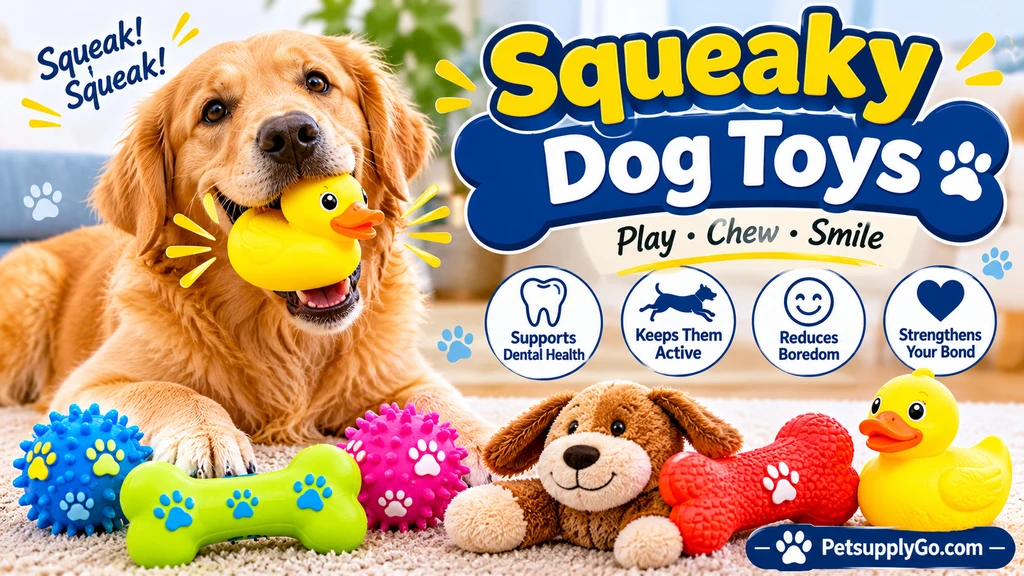
Toss a squeaky toy across the living room and watch what happens. Ears perk up. Eyes lock on. A dog who was dozing a second ago is suddenly a furry rocket, racing after the sound. A few moments later, she is trotting back with the toy in her mouth, squeaking it with the kind of focus usually reserved for dinner.
Squeaky toys are one of the most popular dog toys in the world, and for good reason. They are cheap, they are fun, and they turn ordinary play into an event. But they also come with a few real risks that many owners do not think about until something goes wrong: a swallowed squeaker, a mouthful of stuffing, a toy that is too small for a big dog, or a noisy habit that drives the whole household up the wall.
This guide covers all of it in plain language. You will learn why dogs are so drawn to squeaks, whether squeaky toys are safe, how to choose the right toy for your dog’s size, age, and chewing style, how to play safely, when to take a toy away, how to clean and store them, and what to do if your dog swallows part of one. There are also 30 frequently asked questions at the end.
Keyword data from Google Keyword Planner shows that “squeaky toy” draws roughly 5,000 average monthly searches in the US, so plenty of owners are looking for answers. Most of them want the same thing: a toy their dog will love that does not end in a vet visit.
The short answer: squeaky toys are generally fine for supervised play, as long as the toy is the right size and durability for your dog. The main danger is a dog who destroys the toy and swallows the squeaker, stuffing, or other pieces, which can cause a blockage. Choose toys sized for your dog, supervise play, and throw a toy away as soon as it is torn or the squeaker is exposed. If your dog is a determined shredder, choose a tougher toy or skip the squeaker entirely.
Affiliate disclosure: PetSupplyGo may earn a small commission if you buy through links on this page. It never changes our recommendations or what you pay.
Important Note
This article is general information, not veterinary advice. If you think your dog has swallowed a squeaker, stuffing, or any part of a toy, call your vet or an emergency clinic right away, especially if she is vomiting, lethargic, refusing food, or has a painful belly. Do not wait for symptoms, and do not try to make her vomit unless a vet tells you to.
Quick Answer: Are Squeaky Toys Safe for Dogs?
Here is the fast version before we go deeper.
| Question | Short answer |
| Are squeaky toys safe? | Usually, with supervision and the right size and durability |
| Main risk | Swallowing the squeaker, stuffing, or torn pieces, which can cause a blockage |
| Best for gentle chewers | Plush and soft vinyl squeaky toys |
| Best for strong chewers | Tough rubber toys, or squeaker-free durable toys |
| Should I leave one out all day? | No. Offer squeaky toys during supervised play, and put them away afterward |
| When to throw one away | When it is torn, the squeaker shows, or pieces are coming off |
| Is the sound bad for dogs? | Most dogs enjoy it, but sensitive dogs may be bothered, and loud toys can irritate people |
| What if she swallowed a squeaker? | Call your vet or an emergency clinic right away |
| Good alternative | Silent plush, rubber toys, puzzle toys, and lick mats |
Key Takeaways
- Squeaky toys appeal to a dog’s natural instincts, and many dogs find the sound irresistible.
- The biggest safety risk is swallowing the squeaker, stuffing, or torn pieces, which can block the intestines and may need surgery.
- Choose a toy sized for your dog, and never one small enough to fit entirely at the back of her mouth or throat.
- Match the toy to the chewer. Plush suits gentle dogs, while powerful chewers need tough rubber or squeaker-free toys.
- Supervise squeaky play, and put the toy away when you cannot watch.
- Throw away any toy that is torn, leaking stuffing, or has an exposed squeaker.
- Rotate toys, and keep a mix of squeaky, chew, and puzzle toys.
- If your dog guards toys, play tug, or gets overexcited, build manners with “drop it” and short sessions.
- If a squeaker or stuffing is swallowed, call your vet right away.
Why Do Dogs Love Squeaky Toys?
If your dog goes wild for a squeaky toy, there is a reason. A few ideas help explain it.
Instinct. Dogs descended from predators, and many still carry a strong urge to chase and catch. Many animal behaviorists think the high-pitched squeak of a toy resembles the sound of small prey, which can trigger that instinct. The toy becomes a pretend catch.
Instant feedback. A squeaky toy answers back. Every bite makes a noise, which feels rewarding, and many dogs repeat it again and again.
Attention. A squeak gets your reaction, whether you laugh, call out, or play along. Dogs notice.
Excitement. Sound adds energy to play, especially fetch and chase.
Comfort. Some dogs carry a favorite squeaky toy around like a security blanket.
Mouth fun. Dogs explore the world with their mouths, and a soft, squishy toy that makes noise is satisfying to chew.
Hearing. Dogs hear a wider range of high frequencies than people do, so a squeak may sound sharper and more interesting to them than it does to us.
Not every dog loves squeaky toys. Some ignore them, and some are frightened by the noise. That is normal, and it is fine to choose other toys.
The Pros and Cons of Squeaky Toys
Pros
- They make play more exciting, especially fetch and chase.
- They can keep a bored or energetic dog busy.
- They work well as rewards and for training games.
- They come in a huge range of sizes, shapes, and materials.
- They are usually inexpensive.
- Many dogs find them comforting.
- Soft versions are gentle on puppies’ and seniors’ mouths.
Cons
- A dog who rips the toy apart can swallow the squeaker or stuffing.
- Squeakers can be annoying for people, especially in small homes.
- Some dogs become overexcited or obsessive.
- Squeaky toys can trigger resource guarding in some dogs.
- Plush toys do not last long with strong chewers.
- A very loud squeak can bother sensitive dogs.
- Cheap toys may have weak seams, glued parts, or low-quality materials.
The takeaway is simple: squeaky toys are a fun tool, not a free-for-all. Use them with attention, and they are great.
The Real Risks of Squeaky Toys
Most dogs play with squeaky toys without trouble. But because some do swallow parts, every owner should understand the risks.
Swallowed squeakers
The squeaker is a small plastic piece inside the toy. Once a dog bites through the outer layer and reaches it, she may pull it out and swallow it. Depending on size, a squeaker can pass through the digestive tract on its own, or it can get stuck, especially in small dogs.
Swallowed stuffing
Fluffy filling can cause stomach upset, and a large amount can clump and cause a blockage.
Torn pieces of fabric or rubber
Chunks of plush, rope, or rubber can be swallowed, and some may block the intestines.
Choking
A toy that is too small can lodge in the back of the throat. Balls, small squeakers, and detached parts can all be hazards.
Intestinal blockage
A blockage is a serious emergency. Signs include repeated vomiting, loss of appetite, lethargy, a painful or bloated belly, straining to poop, or diarrhea. It often needs a vet’s care, and sometimes surgery.
Dental damage
Very hard toys can break teeth in some dogs. Squeaky toys are usually soft, but some hard plastic or nylon toys may be too tough for sensitive teeth.
Overexcitement and stress
Some dogs get frantic with squeaky toys, which can lead to rough play or guarding. Know your dog.
Poor-quality materials
Cheap toys may contain weak glue, small parts, or materials that are unsafe if chewed. Buy from reputable sellers, check labels, and avoid toys with a strong chemical smell.
None of this means you should avoid squeaky toys. It means you should choose, supervise, and replace them thoughtfully.
Signs Your Dog May Have Swallowed Part of a Toy
Call your vet right away if you see any of these, or if you saw her swallow something.
- Vomiting, especially repeated
- Loss of appetite
- Lethargy or weakness
- A swollen or painful belly
- Whining when touched near the belly
- Straining to poop, or no stool
- Diarrhea
- Drooling, gagging, or pawing at the mouth
- Coughing or trouble breathing (an emergency)
- A missing squeaker, a torn toy, or stuffing in the vomit or stool
Do not wait for symptoms to build. If you know your dog swallowed a squeaker, call your vet or an emergency clinic anyway. They can tell you whether to watch her, bring her in, or take X-rays.
Types of Squeaky Dog Toys
Squeaky toys come in many forms. Here is a tour of the main kinds, with the strengths and weaknesses of each.
Plush squeaky toys
Soft, stuffed animals and shapes with a squeaker inside. They are popular, cuddly, and cheap. They are best for gentle chewers, puppies, and dogs who like to carry and snuggle. Strong chewers can rip them open quickly, so supervise closely.
Flat or “no stuffing” plush toys
These look like stuffed animals but have little or no filling, just a flat body with a squeaker and sometimes crinkle fabric. They produce less mess, and are good for dogs who love shredding stuffing. The squeaker is still there, so supervision still matters.
Rubber and latex squeaky toys
Made from firm, flexible rubber or latex, often shaped like animals or balls, with a squeaker built in. They are sturdier than plush, and easier to clean. Quality varies, so check for thick walls and a well-protected squeaker.
Vinyl squeaky toys
Soft, squishy toys in cartoon shapes. They are light and cheap, and many dogs enjoy the feel. They tend to wear out quickly, and bits can be bitten off. Best for gentle chewers.
Rope toys with squeakers
A braided rope with a squeaky ball or section. Good for tug, but strands can be chewed and swallowed, so check them often and discard when frayed.
Squeaky balls
A rubber ball with a squeaker. Choose a size large enough that it cannot fit at the back of your dog’s throat, and avoid balls that are small for your dog’s mouth.
Hide-and-seek or “puzzle plush” toys
A large plush toy with small squeaky critters tucked inside, such as the “hide a squirrel” style. They encourage sniffing, pulling, and problem-solving. They are great for brainy dogs, but the small inner toys can be swallowed, so supervise.
Squeaky tennis balls and fetch toys
Fetch toys with squeakers add excitement to a game. Check that the material is dog-safe and tough, and watch for dogs who peel apart the cover.
Squeaky chew toys for puppies
Soft, teething-friendly toys that squeak, often with textured surfaces. Many are designed for puppy mouths, but they still need supervision.
Squeaky toys designed to be durable
Some toys use reinforced stitching, tougher fabric, or protected squeakers. They are a good middle ground for dogs who chew harder than average. No toy is truly indestructible, though, so keep an eye on wear.
Squeaker-free “quiet” versions
Some plush and rubber toys offer the same look without a squeaker, or with a crinkle sound. These are good for noise-sensitive homes, and for dogs who tear into the squeaker.
How to Choose the Right Squeaky Toy
There is no single best toy. The best squeaky toy is the one that fits your dog’s size, age, chewing style, and home. Use this checklist.
1. Size
Too small is dangerous. A toy should be large enough that your dog cannot fit it entirely in her mouth or swallow it. If she can wrap her mouth around the entire thing, it is too small.
Too big is frustrating. A toy that is huge for a small dog is hard to carry and play with.
A good rule: choose a toy slightly larger than what your dog can fit at the back of her mouth, and big enough to hold comfortably.
2. Chewing style
Gentle mouthers. Soft plush and vinyl toys are fine. These dogs carry and cuddle, and rarely tear.
Moderate chewers. Choose sturdier plush with reinforced stitching, or rubber toys.
Strong chewers and shredders. Plush squeaky toys may not last more than a few minutes. Consider tough rubber toys, or skip squeakers. See our guide to indestructible dog toys for aggressive chewers for more durable options.
Stuffing destroyers. Choose no-stuffing plush, or non-plush toys.
Squeaker hunters. Some dogs go straight for the squeaker. For these dogs, a squeaker-free toy is the safer choice.
3. Age
Puppies. Choose soft, lightweight, puppy-sized toys. Teething puppies chew everything, so supervise and replace worn toys. Our puppy starter kit essentials guide covers the basics for new puppy owners.
Adult dogs. Match the toy to her chewing style and energy.
Seniors. Soft, lightweight toys are gentle on older teeth and mouths. Avoid hard toys that could hurt sore teeth or gums.
4. Materials and construction
- Strong seams. Double stitching and thick fabric last longer.
- Protected squeaker. Some toys have the squeaker in a pocket or a sturdier chamber.
- Non-toxic materials. Choose toys made for dogs from reputable brands, and check labels.
- No small parts. Avoid plastic eyes, buttons, bells, and glued-on pieces that can detach.
- No strong chemical smell. A heavy odor can signal poor-quality materials.
- Easy to clean. Machine-washable plush or wipeable rubber is a plus.
5. Noise level
Some squeakers are loud and sharp, while others are soft. If your dog or household is sensitive, choose a gentler squeak, or a toy with a quieter squeaker. If you live in a small apartment, consider squeaker-free options, or use squeaky toys only at certain times.
6. Your dog’s personality
High-energy dogs. Squeaky balls and fetch toys burn energy.
Brainy dogs. Puzzle plush adds mental work.
Cuddlers. A soft plush toy makes a good companion.
Guarders. If your dog guards toys, introduce squeaky toys carefully, and practice trading.
7. Where she will play
Indoor play suits plush and rubber toys. Outdoors, choose toys that are easy to see and resistant to water and mud. Our dog toys category is a handy place to compare different styles side by side.
Squeaky Toys by Dog Size
Toy and small breeds
Choose small, lightweight toys that fit comfortably in the mouth, but are too large to swallow. Small dogs can choke more easily on tiny squeakers, so be extra careful. Soft plush works well for gentle chewers. Avoid toys that are heavy or oversized.
Medium breeds
A wide range of toys works. Choose sturdy plush or rubber, and keep an eye on wear.
Large and giant breeds
Large dogs can swallow toys that look big, and they can tear through plush quickly. Choose large, tough rubber toys or reinforced plush, and avoid small balls. Supervise closely.
Squeaky Toys by Chewing Style
| Chewing style | Good choices | Be careful with |
| Gentle carrier | Plush, vinyl, soft rubber | Very small toys |
| Moderate chewer | Reinforced plush, rubber squeakers | Thin vinyl, loose rope |
| Strong chewer | Tough rubber, squeaker-free durable toys | Plush with stuffing, soft vinyl |
| Shredder | No-stuffing plush, durable rubber | Anything with loose stuffing or a squeaker |
| Squeaker hunter | Squeaker-free or quiet toys | Any toy with an accessible squeaker |
Safe Play: How to Use Squeaky Toys
A few simple habits make squeaky toys much safer.
Supervise. Squeaky toys are for supervised play, not for leaving with a dog all day.
Offer one at a time. Too many toys at once can cause fights and overexcitement.
Check the toy before and after play. Look for tears, loose threads, and exposed squeakers.
Take it away when it is damaged. Do not let her keep chewing a torn toy.
Remove the squeaker if it becomes exposed. Then decide whether the toy is still safe. Often, the better choice is to throw it away.
Do not leave her alone with plush. Especially if she is a chewer.
Put toys away afterward. This keeps them special, and prevents over-chewing.
Rotate toys. Swap them every few days to keep them interesting.
Match play to energy. Use squeaky toys for lively games, and quieter chews for calm time.
Teach “drop it.” A solid “drop it” or “trade” cue is the best safety tool you have. Trade the toy for a treat, such as small pieces of freeze dried dog treats, then give the toy back.
Keep kids safe. Teach children to play gently, and never to pull a toy from a dog’s mouth. Supervise play between kids and dogs.
Teaching “Drop It” and “Trade”
Because squeaky toys can be exciting, a reliable “drop it” is essential.
- Start with a low-value toy. Hold a tasty treat near your dog’s nose.
- Wait for her to drop the toy. When she lets go, say “drop it” and give her the treat.
- Give the toy back. This shows her that dropping is not a loss.
- Repeat several times.
- Add difficulty. Practice with more exciting toys, and in more distracting places.
- Never chase or grab. Chasing turns it into a game. If she runs, calmly walk away, or trade.
- Reward generously. Make dropping the best option she has.
If your dog growls, stiffens, or snaps when you reach for a toy, do not try to take it. Trade from a distance, and talk to a qualified trainer or your vet about resource guarding.
Fun Games With Squeaky Toys
Squeaky toys are fantastic for interactive play.
Fetch. Toss the toy and let her bring it back. Trade for a treat, then throw again.
Find it. Hide the toy in a room, and let her sniff it out and squeak it.
Gentle tug. If your dog likes tug, play by clear rules: start and stop on your cue, keep it gentle, and drop it when asked. Avoid tug if your dog is a puppy with loose teeth, or has a neck problem.
Chase. Drag the toy along the floor and let her pounce.
Puzzle play. Hide small squeaky critters in a plush “den,” and let her dig them out.
Squeak and wait. Squeak the toy, then ask for a sit or a down before you toss it. It builds impulse control.
Toy fetch with names. Teach her the name of each toy and ask her to bring a specific one.
Quiet squeak. Reward her for squeaking the toy gently, then letting go.
Keep sessions short and fun, and stop while she is still excited.
When to Take a Squeaky Toy Away
Knowing when to retire a toy is one of the most important safety habits. Take it away right away if:
- The outer fabric or rubber is torn
- The squeaker is visible or hanging out
- Stuffing is coming out
- Pieces have been chewed off
- Seams are coming apart
- A button, eye, or other attachment is loose
- The toy has become small enough to swallow
- Your dog is trying to rip it open and swallow what is inside
- The toy is dirty, moldy, or smells bad and cannot be cleaned
- Your dog is guarding it, growling, or becoming too intense
Do not try to repair a damaged toy with glue or tape, since it may be unsafe. When in doubt, throw it out.
What If My Dog Swallowed a Squeaker?
This is a common worry, and a stressful moment. Here is what to do.
1. Stay calm and take the toy away. Make sure your dog cannot swallow more.
2. Check her mouth. If you can see something and can remove it easily, do so gently. Do not stick your fingers deep into her throat, since you can push it further in.
3. Call your vet or an emergency clinic. Even if she seems fine, call. They will ask the size of your dog, the size of the squeaker, and when it happened.
4. Do not make her vomit unless a vet tells you to. It can be dangerous with certain objects.
5. Follow the advice you are given. Your vet may suggest watching her, bringing her in for X-rays, or other steps, depending on the object and the dog.
6. Watch for symptoms. Vomiting, lethargy, loss of appetite, a painful belly, or straining to poop need a vet visit right away.
7. Save the toy. If you can, bring the damaged toy to the clinic, so the vet can see what is missing.
Some squeakers pass without problems, especially in large dogs, but you cannot tell without a vet’s advice. Be cautious.
Cleaning and Caring for Squeaky Toys
Dirty toys harbor bacteria and smell bad, and a clean toy is a safer toy. Always follow the maker’s care instructions first.
Plush toys
- Check the label for washing instructions. Many are machine washable.
- Use a gentle cycle and a mild, unscented detergent.
- Place small toys in a mesh laundry bag.
- Rinse thoroughly, so no soap is left behind.
- Let them dry completely before giving them back, since damp stuffing can grow mold.
- Squeakers can rust or stop working over time. If the toy no longer squeaks, it is still fine as a soft toy.
Rubber and vinyl toys
- Wash with warm water and mild dish soap.
- Rinse well and dry completely.
- Some rubber toys can go in the dishwasher, but only if the label says so.
- Check for cracks, and throw out damaged toys.
Rope toys
- Rinse and let dry completely.
- Throw out frayed ropes, since loose strands can be swallowed.
Everyday tips
- Wash toys every week or two, more often if they are slobbery or muddy.
- Wipe outdoor toys after use.
- Store dry toys in a clean basket or bin.
- Replace toys that are worn, stained, or smell bad.
- Wash your hands after handling soiled toys.
If your dog spends a lot of time outdoors, our guide on how to clean dog paws can help keep muddy messes in check, so toys and floors stay cleaner.
Toy Rotation: Keeping Things Fresh
Dogs get bored of toys they see every day. A simple rotation system keeps toys exciting and reduces wear.
- Pick a set. Choose four to six toys for the week, including one or two squeaky, a chew, a puzzle toy, and a comfort toy.
- Store the rest. Keep the others in a closet or box out of sight.
- Swap weekly. Bring out a fresh set every week.
- Watch her interest. If she loves a toy, keep it in rotation more often.
- Check toys regularly. Inspect each one when you swap.
- Keep a few favorites accessible. Comfort toys are fine to keep out all the time, if they are safe.
Rotating toys also makes it easier to spot damage, since you handle each one regularly.
Squeaky Toys for Puppies
Puppies love to chew, especially while teething, and soft squeaky toys can be a big hit. A few special points apply.
Choose puppy-sized toys. Soft, lightweight toys that fit her mouth.
Avoid hard toys. Puppy teeth are fragile, and very hard toys can damage them.
Supervise. Puppies are curious and will try to eat everything.
Check often. Puppy teeth are sharp, and soft toys can tear quickly.
Redirect biting. Offer a toy when she nips your hands, and praise her when she takes it.
Use toys to teach. Trade toys for treats, practice “drop it,” and play gentle fetch.
Combine with crate training. A safe chew in the crate can help her settle, but do not leave plush or squeaky toys in the crate unsupervised. Our guide to crate training a puppy explains how to build positive crate habits.
Use calm time. A lick mat is a quiet alternative to squeaky play, when your puppy needs to settle. If you use a lick mat, choose dog-safe spreads and check labels for xylitol.
Replace often. Puppies chew things up fast.
Squeaky Toys for Senior Dogs
Older dogs can still enjoy a squeaky toy, with a few adjustments.
- Choose soft, lightweight toys that are gentle on teeth and gums.
- Avoid hard rubber or nylon if your dog has dental issues.
- Keep sessions short, and watch for fatigue.
- Use toys that encourage gentle movement, such as soft fetch indoors.
- Choose easy-to-pick-up shapes, if your dog has trouble gripping.
- Check with your vet if your dog has health concerns or mouth pain.
- Provide a comfortable bed for rest after play. Our dog beds category can help you compare supportive options.
Squeaky Toys and Noise-Sensitive Dogs or Homes
Squeaks are not for everyone.
If your dog is scared of the noise
Some dogs flinch or hide when a toy squeaks. Do not force it. Try quieter toys, squeaker-free versions, crinkle toys, or other forms of play, such as puzzle toys and chews.
If the squeak is too loud for you
- Choose softer squeakers. Some toys have gentler sounds.
- Remove the squeaker. If the toy has an easily accessible squeaker pocket, some owners remove it. Only do this if you are confident it is safe, and never leave small parts where your dog can reach them.
- Set squeak time. Use squeaky toys at certain times, such as the afternoon, and put them away afterward.
- Play outside. Squeaky fetch games are great in the yard.
- Use silent alternatives. Rubber toys, rope toys, and plush without squeakers are all good choices.
If you work from home or have neighbors
Squeaky toys can be a big annoyance in a small space. A few quiet toys in rotation help keep the peace.
When Squeaky Toys Cause Problems
Obsession
Some dogs fixate on a squeaky toy, and cannot settle. If your dog becomes frantic, carries the toy everywhere, or whines for it constantly, limit access. Offer the toy only during play, and give calm activities, such as chews or lick mats, at other times.
Resource guarding
A dog who growls, stiffens, or snaps over a toy may be guarding it. Do not take it by force. Trade from a distance, and ask a qualified trainer for help.
Fighting between dogs
Squeaky toys can spark squabbles. Give each dog her own toy, play in separate areas, and pick up toys when you cannot supervise.
Destruction
If your dog destroys every squeaky toy within minutes, she may need a tougher toy, a different type of enrichment, or more exercise. Squeaky plush may not suit her.
Overexcitement
Some dogs get wild. Practice calm behaviors, such as sit and wait, before play, and end games before she is frantic.
Excessive barking
A dog who barks while playing may be overexcited. Keep sessions short, and ask for a calm break.
Attention seeking
If your dog squeaks the toy constantly to get your attention, reward quiet moments, and ignore the squeaking, within reason.
Alternatives to Squeaky Toys
If squeaky toys are not right for your dog or your home, many other options are safe and fun.
Rubber chew toys. Tough, durable, and satisfying to chew.
Treat-dispensing toys. Stuff them with dog-safe food for a longer challenge.
Puzzle toys. Great for brainy dogs.
Rope toys. Good for tug and chewing, with supervision.
Crinkle toys. A quieter sound that many dogs enjoy.
Plush without squeakers. The same cuddly feel, without the noise.
Lick mats. Calming, slow, and good for boredom. See our guide to lick mats for dogs.
Fetch toys. Balls, discs, and tug toys for the yard.
Snuffle mats. Scatter treats and let her sniff them out.
Cardboard boxes. A box with treats hidden inside is a free and fun puzzle, with supervision.
Safe chews. Ask your vet which edible chews suit your dog.
Walks and training. Sniffing, exploring, and training games meet needs that toys cannot.
Common Mistakes Owners Make
- Choosing a toy that is too small. It can become a choking hazard.
- Leaving squeaky toys out all day. Supervision matters.
- Ignoring damage. A torn toy is a risk.
- Giving plush to a strong chewer. It may not last, and it can be unsafe.
- Letting a dog gut the toy. Do not let her chew out the squeaker.
- Not teaching “drop it.” A key safety skill.
- Using the toy to wind up an excited dog. Keep play controlled.
- Not washing toys. Dirt and bacteria build up.
- Forgetting rotation. Dogs get bored with the same toys.
- Taking toys by force. It can create guarding.
- Buying cheap, low-quality toys. Poor materials can be dangerous.
- Assuming “indestructible” means unbreakable. No toy is.
- Ignoring signs of a swallowed object. Call the vet right away.
Myths About Squeaky Toys
Myth: Squeaky toys make dogs aggressive. Squeaky toys do not cause aggression, but they can trigger prey-like excitement or guarding in some dogs. Good management and training help.
Myth: Squeaky toys are bad for dogs’ ears. Most dogs tolerate normal squeakers, but sensitive dogs may be bothered, and very loud toys held close can be unpleasant. Choose gentler toys if your dog seems uncomfortable.
Myth: If a dog destroys the toy, she is happy. Destruction can be a sign of high drive, but swallowing parts is dangerous.
Myth: Squeakers are always too big to swallow. Squeakers vary in size, and a small dog can swallow one.
Myth: Plush toys are safe for every dog. They suit gentle dogs, but not strong chewers.
Myth: Dogs only like squeaky toys because they are bored. Many dogs simply enjoy the sound and the play.
Myth: Removing the squeaker always makes it safe. It can help, but small parts and stuffing remain risks.
Myth: Dogs know when to stop chewing. Many do not. Supervision keeps them safe.
Myth: Any toy sold for dogs is safe. Quality varies, so read labels and buy from trusted sellers.
A Buyer’s Checklist for Squeaky Toys
Use this list in the store or online.
- The toy is sized for my dog, and cannot fit entirely in her mouth.
- It matches her chewing style, from gentle to strong.
- The seams look strong, and the fabric or rubber feels thick.
- The squeaker is protected, and not easy to pull out.
- There are no small parts, such as buttons, eyes, or bells, that can come off.
- The materials are made for dogs, and I can read the label.
- It does not have a strong chemical smell.
- It is easy to clean, and the care instructions are clear.
- The squeak is not too loud for my dog or my home.
- I can supervise play with it.
- I have a plan to inspect it often.
- I have a “drop it” plan, and treats for trading.
A Simple Toy Safety Routine
Make safety a habit with a quick routine.
Before play: Inspect the toy for tears, loose parts, and wear.
During play: Watch your dog, and stay close.
After play: Put the toy away, and check it again.
Weekly: Wash toys, rotate the set, and throw away anything damaged.
Monthly: Review what is working, and replace worn favorites.
This takes just a minute or two, and it can prevent a costly vet visit.
Pairing Squeaky Toys With Good Habits
Toys work best when they fit into a healthy routine for your dog.
Exercise. A tired dog is less likely to destroy toys out of boredom. Daily walks and play help.
Mental work. Puzzle toys, training games, and sniffing walks give her brain a workout.
Calm time. Teach her to settle on a bed, and use calm activities such as chews and lick mats.
Training. Short sessions with treats and toys teach manners, and make play safer.
Healthy treats. If you use treats for trading, choose small, dog-safe ones and count them toward her daily calories. A common guideline is that treats should be about 10 percent or less of daily calories. Browse our dog food category if you are comparing diets, and ask your vet before making changes.
Vet care. Regular check-ups, dental care, and weight management all support safe play.
Good gear. A well-fitted harness and leash make outdoor fetch safer, and our guide to harnesses for large dogs explains what to look for in a secure fit.
For more everyday guides and tools, browse our dog care category.
How to Introduce a New Squeaky Toy
First impressions matter, especially for nervous dogs.
- Let her sniff it. Hold the toy, and let her investigate.
- Squeak it gently. Watch her reaction. If she seems scared, stop and try a different toy.
- Play together. Toss it a short distance, or wiggle it on the floor.
- Reward interest. Praise and treat when she touches it.
- Keep it short. A few minutes is enough at first.
- Supervise. Watch how she handles it, and note how she chews.
- Check afterward. Look for damage, and decide whether it suits her.
If she shreds it at once, take it away and choose a tougher option next time.
Seasonal and Travel Tips
Winter. Indoor play becomes more important when it is cold. Keep a few toys ready for rainy and snowy days. If you walk outside, a warm layer helps, and our guide to dog winter coats can help you choose one that fits.
Summer. Waterproof rubber toys are great for the yard and the pool. Always supervise around water, and keep toys clean.
Car trips. Bring a favorite toy to help your dog settle. A quiet, soft toy is best in the car, and our guide to dog car seats and car beds explains how to keep your dog safe and comfortable on the road.
Hotels and visits. Pack familiar toys, but choose quiet ones if you will share walls with neighbors.
Boarding. Ask the facility about its toy policy. Many do not allow plush toys.
A Quick Glossary
Squeaker: A small plastic noisemaker inside a toy.
Plush toy: A soft, stuffed toy covered in fabric.
Latex toy: A soft, flexible toy made from natural or synthetic latex.
Vinyl toy: A squishy toy made from vinyl, often cartoon-shaped.
Intestinal blockage: A serious obstruction caused by a swallowed object.
Prey drive: The instinct to chase and catch moving things.
Resource guarding: Growling or snapping to protect a toy or other item.
Drop it: A cue that asks a dog to release an item.
Toy rotation: Swapping toys on a schedule to keep them interesting.
No-stuffing toy: A plush toy with little or no filling.
Reading Your Dog’s Body Language During Toy Play
Play should look loose, wiggly, and fun. Watching your dog’s body language tells you when to keep going and when to step in.
Signs of happy, healthy play
- A loose, wiggly body and a relaxed mouth
- A play bow, with front legs down and rear in the air
- Bouncy, exaggerated movements
- Taking turns chasing and carrying the toy
- Frequent pauses, shakes, and sniffing
- Bringing the toy back to you, or offering it for a game
Signs of overexcitement
- Frantic, wild running
- Rough mouthing, and hard biting at your hands
- Barking or whining nonstop
- Difficulty responding to cues
- Panting heavily, even in cool air
If you see these, calm things down. Ask for a sit, put the toy away for a moment, and let her settle before you try again.
Signs of stress or discomfort
- Stiff body, and a hard, fixed stare
- Lip licking, yawning, or turning away
- Tucked tail, flattened ears, or backing off
- Freezing over the toy, or guarding it with her body
- Growling, showing teeth, or snapping
These are signals to stop. Do not push, scold, or grab. Give her space, and talk to a qualified trainer if it keeps happening.
Signs she needs a break
- Slowing down, lying down, or dropping the toy
- Heavy panting, drooling, or a very red tongue in warm weather
- Limping or favoring a leg
- Losing interest in the game
Always stop if you see signs of heat stress, pain, or exhaustion, and call your vet if you are worried.
Squeaky Toys and Your Dog’s Teeth
Chewing is natural, but some toys are better for teeth than others.
Soft toys are gentle. Plush and soft vinyl squeakers rarely damage teeth, which makes them good for puppies and seniors, but they do little to clean teeth.
Very hard toys can crack teeth. Hard nylon, bones, antlers, and some very stiff plastics can fracture teeth in some dogs. If you are unsure, ask your vet about the hardness of toys your dog uses.
A simple test. Many vets suggest the “thumbnail test,” which means that if you cannot press a thumbnail into the surface and leave a slight dent, the toy may be too hard.
Watch for signs of dental pain. Dropping toys, chewing on one side, drooling, bad breath, bleeding gums, or reluctance to eat can all be signs of dental problems. See your vet.
Brush regularly. Toys do not replace tooth brushing and vet dental care.
Rotate textures. A mix of soft, rubbery, and rope toys keeps chewing varied, and helps wear patterns even out.
Toys, Exercise, and Mental Work
Toys are a great tool for exercise and enrichment, but they work best as part of a bigger plan.
Physical exercise ideas
- Fetch in a yard or a safe, enclosed area
- Chase games with a toy dragged on a string or a long line
- Indoor fetch in a hallway for rainy days
- Short, gentle tug sessions for dogs who enjoy them
- Gentle games for seniors, such as rolling a soft toy across the floor
Mental exercise ideas
- Hide the toy and ask her to find it
- Teach her the names of her toys
- Use puzzle plush, where small squeaky critters are hidden inside
- Ask for a sit, a down, or a trick before throwing the toy
- Rotate toys, so she has something new to investigate
How much play does a dog need?
It varies by age, breed, health, and energy level. Many adult dogs do well with a combination of walks, play sessions, and training spread through the day. Puppies need short, frequent bursts, while seniors do better with gentle play. Ask your vet what suits your dog, and watch her behavior. A dog who is restless, destructive, or noisy may need more activity, and one who is limping or exhausted needs rest.
Pair play with training
Play is the perfect time to practice manners. Ask for a sit before you throw the toy, teach “wait” at the door, practice “drop it,” and reward calm behavior. Short, positive sessions teach her that good manners make play happen.
Living With Squeaky Toys: Apartment and Multi-Pet Tips
Apartment living
Squeaks carry through thin walls, so a few habits go a long way.
- Save squeaky toys for certain times of day, such as early evening.
- Choose toys with softer squeakers.
- Play on a rug or carpet to muffle noise.
- Use squeaker-free toys when neighbors are home, or at night.
- Take fetch games outside or to a park, if allowed.
- Offer quieter activities, such as chews, puzzle toys, and lick mats.
Homes with more than one dog
Squeaky toys can spark competition.
- Give each dog her own toys, and keep duplicates of favorites.
- Play with dogs separately, or supervise closely.
- Pick up toys when you cannot watch.
- Teach each dog to wait her turn.
- Watch for guarding, stiff bodies, or growling, and separate dogs if tension builds.
Homes with cats or small pets
Dog toys can be a temptation for cats, and a squeaky toy can excite a dog’s prey drive near small animals. Keep dog toys and pet toys separate, supervise interactions, and keep small pets safe.
Homes with children
Kids love squeaky toys, too, but dog toys and children’s toys can get mixed up.
- Keep the dog’s toys in a separate bin.
- Teach children to play gently, and never to pull a toy out of a dog’s mouth.
- Show them how to trade a toy for a treat.
- Supervise play between kids and dogs at all times.
- Check that children’s toys, with small parts, are kept away from the dog.
Budget Tips: Getting the Most From Your Toys
Dog toys do not have to be expensive, but cheapest is not always best.
Buy for the chewer. A cheap plush toy that lasts two minutes costs more over time than a sturdy toy that lasts months.
Choose quality over quantity. A few safe, well-made toys beat a basket of flimsy ones.
Look for good reviews. Read recent reviews from owners with dogs like yours, and pay attention to comments about durability and safety.
Wash and rotate. Clean toys last longer, and rotation spreads the wear.
Repurpose safely. A knotted old towel can be a simple tug toy, but supervise closely, and throw it away when it frays.
Skip gimmicks. Many dogs love basic toys, so you do not need fancy designs.
Watch for sales and sets. Multi-packs can offer good value, but check sizes and quality.
Do not overspend on one toy. Even a well-made toy can wear out, so keep your expectations realistic.
Remember the real cost. A surgery to remove a swallowed object is far more expensive than a good toy, so spend wisely where safety is concerned.
What Your Vet Wants You to Know
Vets see the results of toy accidents regularly, and a few themes come up again and again.
Supervision matters most. Many emergencies happen when a dog is left alone with a toy.
Size matters. Toys that are too small are a common cause of choking and blockages.
Strong chewers need a plan. Giving a plush toy to a powerful chewer is a frequent mistake.
Early action saves dogs. Calling right away after a swallowed object gives a dog the best chance.
Do not induce vomiting at home. Wait for your vet’s advice.
Keep a record. Know your dog’s weight, medications, and any past surgeries, in case of an emergency.
Keep contact numbers handy. Save your vet’s number and the nearest emergency clinic in your phone.
Regular check-ups. Your vet can help with dental care, weight, and advice on safe toys.
A Simple Emergency Plan
A little preparation makes a scary moment easier.
- Save numbers. Your vet, the closest 24-hour emergency clinic, and a pet poison hotline.
- Know the route. Check how long it takes to reach the emergency clinic.
- Keep a small kit. A leash, a towel, a copy of your dog’s records, and a carrier for small dogs.
- Take the toy. If your dog swallows part of one, bring what is left.
- Note the time. Tell the vet when it happened.
- Stay calm. Dogs pick up on your stress, and a calm helper is the best helper.
- Follow instructions. Do exactly what your vet advises.
Squeaky Toy Scenarios: What Would You Do?
Real life is messier than a checklist. Here are common situations, and a sensible way to handle each one.
Scenario 1: Your puppy rips the ears off a new plush toy in five minutes
This is normal puppy behavior, and it is a sign the toy is too delicate for her. Take it away, check that no pieces were swallowed, and switch to a sturdier option. Keep plush for short, supervised cuddles, and offer a tough chew for serious chewing time.
Scenario 2: Your dog loves squeaking, but the noise is driving you crazy
You do not have to choose between a happy dog and a calm home. Set squeak time for certain hours, use softer squeakers, and mix in quieter toys. Many owners also find that dogs enjoy a crinkle toy almost as much.
Scenario 3: Your adult dog suddenly stops caring about squeaky toys
Dogs can lose interest for many reasons: boredom, a toy that has lost its squeak, a sore mouth, or a change in health. Rotate in new toys, check her teeth and gums, and call your vet if she seems uncomfortable or has stopped playing with other things too.
Scenario 4: Your dog hides with the squeaky toy and growls when you come close
This is resource guarding, and it is best handled carefully. Do not reach for the toy. Toss a high-value treat a few feet away, and when she moves to eat it, calmly pick up the toy and trade it back. Talk to a qualified trainer if the guarding is strong.
Scenario 5: Your small dog is overwhelmed by a big toy
A toy that is bigger than she is can be frustrating, but it is far safer than one that is too small. Look for a lightweight version of the same shape, or a plush toy made for small mouths, and play together to build her confidence.
Scenario 6: Your dog swallows the squeaker while you are at work
Call your vet or the nearest emergency clinic as soon as you notice. Describe the toy, the size of the squeaker, and how long it has been. Bring what is left of the toy, and follow the vet’s advice. In the future, leave safe, durable chews, not plush or squeaky toys, when you are out.
Scenario 7: Your senior dog enjoys her squeaky toy but struggles to chase it
Switch to gentle games. Roll the toy slowly across the floor, hide it under a blanket for sniffing, or sit with her while she squeaks it on her bed. She still benefits from the play, even if the pace is slower.
Scenario 8: Two dogs want the same squeaky toy
Keep duplicates of favorite toys, and play with each dog separately. If one dog is pushy, ask her to wait while the other plays. If you see stiff bodies or growling, end the game calmly, and pick up the toys.
Scenario 9: A guest’s child hands your dog a squeaky toy and tries to pull it away
Step in calmly. Explain that dogs like to keep their toys, and show the child how to ask for a trade. Give the child a treat to offer after the dog drops it. Supervise all play between children and dogs.
Scenario 10: You find a half-chewed toy and a bit of stuffing on the floor
Check your dog for signs of illness, and count the pieces if you can. If you think she swallowed anything other than a small bit of fluff, call your vet. Remove the damaged toy, and choose a tougher one next time.
A Week of Safe Squeaky Play: A Sample Schedule
You do not need a complicated plan. Here is one way to build safe toy time into a normal week.
Monday. A short fetch session in the yard with a squeaky ball, followed by a lick mat for calm time.
Tuesday. Indoor hide-and-seek with a favorite plush toy, with “drop it” practice using small treats.
Wednesday. A rest day for toys. Focus on a sniffy walk and a puzzle feeder.
Thursday. Fetch with a rubber squeaky toy, then a calm chew on her bed.
Friday. Toy swap. Wash the week’s toys, check for damage, and bring out a new set.
Saturday. A longer play session with a puzzle plush toy, plus a family game of find-it.
Sunday. A quiet day with chews, cuddles, and a gentle walk.
Adjust the plan to suit your dog’s age, health, and energy, and let her rest when she needs it.
Final Safety Reminders
Before you head out to buy your next toy, keep these points in mind.
- A toy is only as safe as the way it is used.
- Supervision is the best safety feature you have.
- Size and durability matter more than looks.
- Damaged toys belong in the trash.
- A reliable “drop it” is worth practicing every week.
- Quiet and calm activities are just as valuable as squeaky play.
- When something goes wrong, call your vet right away.
Choosing Between Squeaky, Crinkle, and Silent Toys
Not every dog needs a squeaker, and many do just as well with other sounds and textures. Here is how the main options compare.
Squeaky toys. The most exciting for many dogs, and the best for sparking chase and fetch. They carry the squeaker risk, so match them to dogs who are gentle with toys.
Crinkle toys. These contain crinkly material that rustles when squeezed. Many dogs like the sound, and it is usually quieter than a squeak. Check that the crinkle layer is sealed inside the toy.
Silent plush. The same soft, cuddly feel with no noise. Good for comfort, naps, and noise-sensitive homes.
Rubber toys without squeakers. Durable and easy to clean, and many have a satisfying bounce. A good choice for strong chewers.
Treat-dispensing toys. Dogs work to get the food out, which adds a mental challenge. Use small amounts of food, and count it toward her daily calories.
Rope toys. Good for tug and gentle chewing, but supervise and discard when frayed.
If you are not sure what your dog prefers, buy one of each type in her size, and watch which she goes back to. Over a few weeks, you will learn her favorites, and which ones last.
How to Know If a Toy Is Working for Your Dog
A good toy should make your dog happier and your life easier. Ask yourself a few questions after a week or two.
- Does she play with it with enthusiasm?
- Does it hold up to her chewing, or is it falling apart?
- Does she settle well after play, or stay wound up?
- Is the noise manageable for your home?
- Has it caused any guarding, fighting, or stress?
- Is it easy to clean?
- Is it the right size, now that she has had time to use it?
If the answer to most is yes, you have a winner. If not, try a different style, and do not worry. Finding the right toy is often a matter of trial and error, and every dog is different.
Frequently Asked Questions (30 FAQs)
1. Are squeaky toys safe for dogs?
Usually, yes, when you choose the right size and durability and supervise play. The main danger is a dog who tears a toy apart and swallows the squeaker, stuffing, or pieces, which can cause a blockage. Pick toys that suit your dog’s chewing style, inspect them often, and throw them away once they are damaged.
2. Why do dogs love squeaky toys?
Many behaviorists think the high-pitched squeak resembles the sound of small prey, which can trigger a dog’s chase and catch instinct. The toy also gives instant feedback with every bite, makes play more exciting, and gets your attention. Dogs hear higher frequencies than people, so the sound may be even more interesting to them.
3. Can a dog swallow a squeaker?
Yes. Once a dog bites through the outer layer, she may pull out the squeaker and swallow it. Small dogs are at higher risk, but any dog can. If you know or suspect she swallowed one, call your vet or an emergency clinic right away, even if she seems fine.
4. What should I do if my dog swallowed a squeaker?
Take the toy away, check her mouth for anything you can remove easily, and call your vet or an emergency clinic. Do not try to make her vomit unless a vet tells you to. Watch for vomiting, lethargy, loss of appetite, a painful belly, or straining to poop, which need prompt care. If you can, bring the damaged toy with you.
5. Can squeaky toys cause a blockage?
Yes. Swallowed squeakers, stuffing, and torn pieces of fabric or rubber can block the intestines. Signs include repeated vomiting, loss of appetite, lethargy, a painful or swollen belly, and no stool. A blockage is an emergency and may need surgery, so call your vet immediately if you suspect one.
6. Should I let my dog play with a squeaky toy alone?
It is safer not to, especially with plush toys and dogs who chew. Offer squeaky toys during supervised play, then put them away. If you must leave her alone, give her a tough, durable chew that is safe for unsupervised use, and ask your vet what suits your dog.
7. When should I throw away a squeaky toy?
Throw it away if it is torn, the squeaker is exposed, stuffing is coming out, seams are splitting, pieces have been chewed off, or it has become small enough to swallow. Also discard toys that are moldy or cannot be cleaned. Do not try to repair them with glue or tape.
8. What size squeaky toy should I buy?
Choose a toy that is too big to fit entirely in your dog’s mouth or lodge at the back of her throat, yet comfortable for her to carry. A toy that is too small is a choking and swallowing hazard. When in doubt, go a size up, and check the maker’s size guide.
9. What are the best squeaky toys for puppies?
Soft, lightweight, puppy-sized plush or vinyl toys are popular, since they are gentle on teething mouths. Avoid very hard toys, and supervise closely, since puppies chew and swallow things. Replace toys as soon as they show wear. Our puppy starter kit essentials guide covers other basics for new puppies.
10. What are the best squeaky toys for strong chewers?
Plush squeaky toys rarely last with strong chewers. Look for tough rubber toys, reinforced designs, or squeaker-free durable toys, and always supervise. No toy is truly indestructible. For more options, see our guide to indestructible dog toys for aggressive chewers.
11. Are plush squeaky toys safe?
They are fine for gentle chewers and supervised play, but not for dogs who rip toys apart. The stuffing and squeaker can be swallowed, and plush wears out quickly. Choose strong seams, no small attachments, and consider no-stuffing versions for dogs who love to shred.
12. Can squeaky toys hurt my dog’s ears?
Most dogs tolerate normal squeakers well, but some are sensitive to noise, and a very loud squeak right next to the ear can be unpleasant. If your dog flinches, hides, or avoids the toy, choose a quieter option. If you are concerned about hearing, ask your vet.
13. Why does my dog destroy squeaky toys?
Many dogs are driven to “kill” the squeak, which comes from natural prey instincts. Some are simply curious, bored, or have a strong chewing urge. Offer tougher toys, give plenty of exercise and mental work, and supervise. If she goes straight for the squeaker, choose squeaker-free toys.
14. Should I remove the squeaker from the toy?
Some owners do, to reduce noise or risk, but it is only safe if you can do it without leaving holes, small parts, or loose stuffing. A toy with the squeaker removed can still be chewed apart, so supervision and inspection still matter. Squeaker-free toys are a simpler alternative.
15. Are squeaky toys good for puppies who are teething?
Soft squeaky toys can be comforting, but they are not the best teething tool on their own, and puppies can tear them quickly. Offer a mix of teething-friendly chews, and supervise all play. Check with your vet if your puppy seems to be in pain, or you are unsure what to give her.
16. Can squeaky toys make dogs aggressive?
Squeaky toys do not cause aggression, but they can trigger intense excitement or resource guarding in some dogs. If your dog growls, stiffens, or snaps over a toy, do not take it by force. Trade from a distance, practice “drop it,” and talk to a qualified trainer or your vet.
17. How do I teach my dog to drop a squeaky toy?
Start with a low-value toy. Offer a tasty treat near her nose, and when she lets go, say “drop it,” and give the treat. Then give the toy back. Repeat, and gradually use more exciting toys. Never chase her or grab the toy. For treat ideas, see our guide to freeze dried dog treats.
18. How often should I wash squeaky toys?
Every week or two, and more often if they are slobbery or muddy. Follow the care label. Many plush toys can go in the washing machine on a gentle cycle with mild, unscented detergent, and rubber toys can be washed with warm soapy water. Dry them completely before play.
19. Can I put squeaky toys in the washing machine?
Many plush toys can, but check the label first. Use a gentle cycle, a mild detergent, and a mesh bag for small toys. Wet squeakers may stop working, and damp stuffing can grow mold, so dry the toy completely. If the label says not to machine wash, wipe it clean instead.
20. How many squeaky toys should my dog have?
There is no set number, but fewer is better. A good approach is to have a small rotating set of four to six toys, including one or two squeaky toys, a chew, and a puzzle toy, and swap them weekly. It keeps toys exciting, and makes it easier to check them for damage.
21. Can I leave a squeaky toy in the crate?
It is safest not to leave plush or squeaky toys in the crate when you are not watching, since a dog could chew them apart. Offer a safe, durable chew instead, and ask your vet what is suitable. Our guide to crate training a puppy explains how to build calm crate habits.
22. What can I use instead of a squeaky toy?
Many options work well: tough rubber chew toys, treat-dispensing and puzzle toys, rope toys with supervision, crinkle toys, plush without squeakers, snuffle mats, and lick mats. Walks, sniffing games, and training sessions also meet your dog’s needs for exercise and mental work. See our dog toys category for ideas.
23. My dog is scared of squeaky toys. What should I do?
Do not force it. Some dogs are sensitive to the sound. Try a quieter toy, a crinkle toy, or a squeaker-free option, and let her explore at her own pace. Reward calm curiosity with a treat. If she seems very frightened by many noises, talk to your vet or a trainer.
24. Are squeaky toys good for anxious dogs?
It depends. Some anxious dogs find a soft toy comforting, while others are upset by the noise or become overexcited. Watch her body language. For calm time, many owners prefer quieter options such as chews and lick mats. For serious anxiety, talk to your vet or a qualified behavior professional.
25. Can squeaky toys help with boredom?
Yes, as part of a balanced routine. A squeaky toy can make fetch and chase more exciting. But toys alone do not replace exercise, training, and attention. Mix in puzzle toys, sniffing games, walks, and calm chews, and rotate toys often to keep them interesting.
26. What if my dog guards her squeaky toy?
Do not try to take it by force, since that can make guarding worse or lead to a bite. Trade from a distance with a better treat, practice “drop it” when she is calm, and give her space with her toys. If guarding is intense or she has growled or snapped, ask a qualified trainer or your vet for help.
27. Is it okay to play tug with a squeaky toy?
Gentle tug can be fine for many dogs, if you set rules: start and stop on your cue, keep it controlled, and ask her to drop the toy on request. Avoid tug with puppies who have loose teeth, and with dogs who have neck or dental problems. Supervise closely, since plush can tear.
28. What materials are safest for dog toys?
Look for toys made for dogs, by reputable brands, with clear labels and no strong chemical smell. Choose sturdy seams, thick rubber, and no small attachments such as plastic eyes or buttons. The safest material depends on your dog’s chewing style, so match the toy to the chewer.
29. Can I give my dog a squeaky toy if I have another pet?
Yes, but supervise. Squeaky toys can trigger excitement or guarding between pets. Give each pet her own toy, play in separate areas if needed, and pick up toys when you are not watching. Keep dog toys away from cats, birds, and small pets, and check that toys are safe for each animal.
30. When should I call the vet about a toy?
Call right away if you think your dog swallowed a squeaker, stuffing, or any part of a toy, or if she shows vomiting, lethargy, loss of appetite, a painful or swollen belly, straining to poop, drooling, gagging, or trouble breathing. Do not wait for symptoms to worsen. When in doubt, a quick call to your vet is always a good idea.
The Bottom Line
Squeaky toys are a classic for good reason. They bring out your dog’s playful side, make fetch and chase more fun, and give many dogs a source of comfort. They also need a little care. Choose the right size and durability for your dog, supervise play, check toys often, and throw them away as soon as they are damaged. Teach a reliable “drop it,” rotate toys, and keep quieter options on hand.
If your dog is a determined shredder, skip the squeaker or choose a tougher toy. And if she ever swallows part of a toy, call your vet right away rather than waiting. With a little attention, squeaky toys can be a safe, joyful part of your dog’s day.
This article is for general information and is not a substitute for veterinary advice. If your dog may have swallowed part of a toy, or seems unwell, contact your veterinarian or an emergency clinic right away.
Add a Comment