
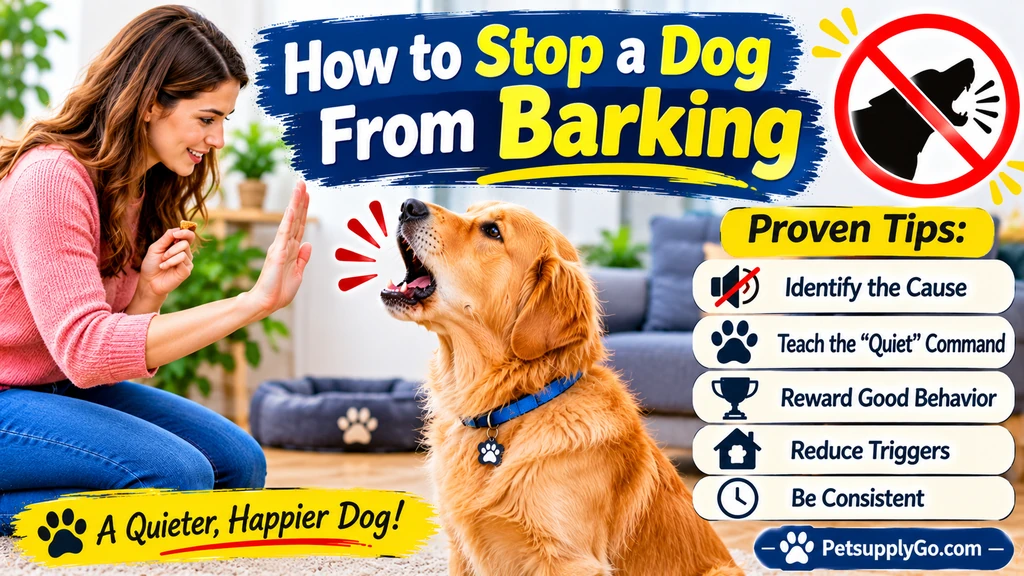
It is 6:15 on a Saturday morning. The mail carrier is walking up the path. Your dog is at the window, barking like the house is on fire, while you stand in the hallway in your socks, whispering “quiet, quiet, QUIET” in the voice of someone who has said it a thousand times and has not been listened to once.
If that is your life right now, you are in very good company. Barking is one of the top reasons people lose patience with their dogs, get complaints from neighbors, and in the worst cases, give a dog up. It is also one of the most fixable problems, once you understand what your dog is actually trying to say.
The key idea is simple: barking is communication, not misbehavior. A dog barks because something is happening, whether that is fear, excitement, boredom, loneliness, or a very strong opinion about the squirrel. To change the barking, you have to change the reason behind it.
The short answer: To stop a dog from barking, first work out why your dog is barking. Then meet the need behind it: more exercise and mental work for boredom, gradual training for fear or separation anxiety, and management (like blocking the window view) for alert barking. Teach a “quiet” cue by rewarding silence, reward calm behavior before barking starts, and never punish barking, since that raises stress and often makes it worse. Rule out pain and medical causes if the barking is new or sudden. Most dogs improve in a few weeks with consistent training, and persistent cases respond well to a certified trainer or a veterinary behaviorist.
This guide covers why dogs bark, how to decode each type of bark, how to stop barking at the door, window, fence, car, leash, and at night, how to handle barking when you leave, what to do for puppies, rescue dogs, and seniors, which tools help and which to avoid, and how to talk to your neighbors. There is also a six-week training plan and a shopping checklist near the end. Use the contents list to jump to what you need.
Key Takeaways
- Barking is normal. The goal is not a silent dog. It is a dog who barks appropriately, then settles.
- There is always a reason. Common ones include alerting, excitement, boredom, attention-seeking, fear, frustration, loneliness, and pain.
- Never punish barking. Yelling, spray bottles, and shock collars add stress and can make fear and anxiety barking much worse.
- Meet the need first. Many nuisance barkers simply need more exercise, mental work, and routine.
- Management makes training easier. Blocking the window view, using white noise, and controlling triggers cuts down on practice barking.
- Teach what to do instead. A dog who knows how to go to a mat, take a toy, or come to you has a better option than barking.
- Reward quiet. Catch your dog being calm and pay for it generously.
- Be consistent. Everyone in the home must use the same rules, or the training will stall.
- Sudden changes in barking, especially in older dogs, can signal pain, hearing loss, or cognitive changes. Check with your vet.
- Separation anxiety barking needs a gradual, special plan and often professional help. It is not the same as boredom.
- Patience pays off. Most dogs show real improvement within two to six weeks of consistent work.
Contents
- Why Do Dogs Bark?
- The Types of Barking and What They Mean
- Normal Barking vs. Excessive Barking
- Start With a Bark Log
- Rule Out Medical Causes
- Breeds and Barking
- Five Rules Before You Start Training
- Meet Your Dog’s Needs First
- Teach the Quiet Cue
- Teach a Replacement Behavior
- Stop Barking at the Door and Doorbell
- Stop Barking at the Window and Fence
- Stop Barking at People and Dogs on Walks
- Stop Demand and Attention Barking
- Stop Excitement Barking
- Stop Boredom Barking
- Stop Barking When You Leave
- Stop Fear and Noise Barking
- Stop Territorial and Alert Barking
- Stop Barking in the Car
- Stop Barking at Night
- Puppies
- Rescue Dogs
- Senior Dogs
- Multi-Dog Homes
- Quick Reference: Bark Type, Likely Cause, and First Fix
- A Sample Daily Routine for a Barky Dog
- Barking and Children
- Barking During Holidays, Visitors, and Fireworks
- Tools That Help
- Tools and Methods to Avoid
- Apartments, Neighbors, and Noise Complaints
- How Long Does It Take?
- Common Mistakes
- Troubleshooting Common Problems
- When to Call a Vet or Trainer
- A 6-Week Plan to Reduce Barking
- Shopping Checklist
- Final Thoughts
- 30 Frequently Asked Questions
Why Do Dogs Bark?
Dogs bark because it works. It gets a response, relieves tension, or tells the world something important. Barking is built into the species, and some dogs were bred specifically to use their voices, whether to alert, to herd, or to flush game.
Dogs Bark to Communicate
A bark can mean “someone is here,” “I am scared,” “I want that,” “play with me,” “I am lonely,” or “back off.” The sound, pitch, length, and body language together tell the story.
Barking Releases Energy and Emotion
Excitement, frustration, and anxiety build up in a dog’s body, and barking is one outlet. A dog who is thrilled that a friend has arrived and a dog who is terrified of the vacuum are both using their voices to deal with big feelings.
Barking Is Self-Rewarding
When a dog barks at the mail carrier and the mail carrier leaves, the dog learns: “my barking works.” Every successful bark strengthens the habit, even though the mail carrier was always going to leave.
Barking Can Be Learned and Reinforced by You
If your dog barks for attention and you look, talk, or hand over a treat, you have just paid for the barking. Even scolding can reward a dog who wants any interaction at all.
Genetics and Breed
Some breeds are naturally more vocal. Terriers, hounds, herding breeds, and many toy breeds bark more readily. Others, like Basenjis, bark very little but make other sounds.
Environment
A dog who lives next to a busy street, near other dogs, or with a big window view has more triggers than a dog in a quiet home.
Health and Age
Pain, hearing loss, vision changes, and cognitive decline can all increase barking, especially in senior dogs.
Learning to Decode
Once you know why your dog is barking, the fix gets much clearer. The next section shows you how to tell.
The Types of Barking and What They Mean
Not all barks are the same. Listen and watch.
Alert or Territorial Barking
What it sounds like: Loud, repeated, often deep. Quick bursts that stop when the “threat” leaves.
What you see: Stiff body, upright ears, eyes fixed on something, tail high or still. Often at windows, doors, and fences.
Common triggers: Mail carriers, delivery trucks, passersby, other dogs, strange noises.
Excitement Barking
What it sounds like: High-pitched, rapid, happy. Often with whining or yips.
What you see: Wiggly body, jumping, spinning, play bows, wagging tail.
Common triggers: Greetings, leash being picked up, playtime, car rides, treats.
Attention-Seeking or Demand Barking
What it sounds like: A sharp, repeated bark, usually aimed straight at you, and it often stops the moment you respond.
What you see: Direct eye contact with you, standing near you, pawing, dropping a toy at your feet.
Common triggers: Wanting food, play, walks, or just attention.
Boredom Barking
What it sounds like: Monotone, repetitive, often long stretches with pauses.
What you see: A dog alone in the yard or home with nothing to do, sometimes digging, chewing, or pacing too.
Common triggers: Too little exercise and enrichment.
Fear and Anxiety Barking
What it sounds like: Higher pitched, sometimes mixed with whining, growling, or howling.
What you see: Tucked tail, ears back, hiding, backing away, trembling, or a stiff, frozen posture.
Common triggers: Loud noises, strangers, new places, other dogs, being left alone.
Separation Anxiety Barking
What it sounds like: Continuous barking, howling, or crying that starts soon after you leave and may continue for long periods.
What you see (on camera): Pacing, drooling, scratching at doors, attempts to escape, accidents, destruction around exits.
Common triggers: Being alone or separated from a specific person.
Frustration Barking
What it sounds like: Sharp, intense, sometimes with a growl or whine.
What you see: A dog who cannot reach something: behind a gate, on a leash, in a crate, or at a window.
Common triggers: Barriers, restraints, and desires that cannot be met.
Social or Contagious Barking
What it sounds like: Barking that starts when another dog barks.
What you see: A dog who hears a neighbor’s dog and joins in.
Compulsive Barking
What it sounds like: Repetitive, rhythmic barking with no clear trigger, sometimes with pacing or spinning.
What you see: A dog who seems stuck in a loop and difficult to interrupt.
Note: Compulsive behavior needs veterinary and behavior help.
Pain or Confusion Barking
What it sounds like: Barking that is new or out of character, sometimes at night.
What you see: A senior dog who stares at walls, paces, or seems disoriented, or a dog who barks when touched in a certain spot.
Greeting Barking
What it sounds like: A mix of barking and whining when a person or pet arrives.
What you see: A friendly dog who is simply overjoyed.
Normal Barking vs. Excessive Barking
All dogs bark. When does it become a problem?
Normal Barking
- A few barks to alert you to a visitor, then settling
- Short bursts during play
- Barking at a squirrel or a passing dog, then returning to normal
- Responding to a bark from another dog nearby for a moment
Excessive Barking
- Barking that goes on for long periods
- Barking that does not stop when you ask or when the trigger is gone
- Barking at everything, all day
- Barking that disrupts sleep, work, or neighbors
- Barking that comes with signs of distress or compulsion
- Barking that is a sudden change from your dog’s usual behavior
How to Judge
Ask yourself:
- How many times a day does it happen?
- How long does each episode last?
- Does my dog calm down quickly once the trigger is gone?
- Does it seem like my dog is upset or just excited?
- Are neighbors affected?
The answers tell you how much work is needed and what kind.
Start With a Bark Log
Before you change anything, spend three to seven days observing. A simple log will point you to the cause faster than guessing.
What to Record
- Date and time
- Where your dog was and where you were
- Trigger: what happened right before barking
- Type of bark: alert, excited, demand, fearful
- Duration: how long it lasted
- What happened next: what you did, and how your dog responded
- Dog’s state: well exercised, bored, tired, stressed
Look for Patterns
- Does barking spike when the mail arrives?
- Does it happen only when you are out?
- Does it get worse in the evening?
- Does it follow a skipped walk?
- Does it begin when a certain neighbor’s dog is out?
Record Video
If you suspect your dog barks while you are gone, set up a camera. You may be surprised. Some dogs are quiet within minutes, while others panic for hours. A short video clip is also very useful for your vet or trainer.
Why It Matters
Without a log, owners often treat the wrong problem. A dog who barks at the window needs a different plan than a dog who barks from loneliness.
Rule Out Medical Causes
Always consider health first, especially if the barking is new.
Pain
Arthritis, dental disease, ear infections, and injuries can make dogs vocal. A dog who barks when picked up or touched may be in pain.
Hearing or Vision Loss
Dogs who cannot hear or see well can become startled and bark more, especially at night or when touched unexpectedly.
Cognitive Dysfunction
Senior dogs can develop confusion, pacing, and nighttime barking, sometimes called canine cognitive dysfunction. Signs include staring at walls, getting stuck in corners, and changes in sleep patterns.
Hormonal or Metabolic Conditions
Thyroid issues and other conditions can change behavior.
Medication Effects
Some medications can cause restlessness or vocalization.
Digestive Upset or Needing to Go Out
A dog who barks at night may need a bathroom break or feel unwell.
What to Do
Schedule a vet visit if:
- Barking began suddenly
- Your dog is a senior with new nighttime barking
- Barking is paired with changes in appetite, drinking, or toileting
- Your dog yelps when touched
- Your dog seems disoriented
Bring your bark log and any video clips.
Breeds and Barking
Breed does not decide everything, but it gives clues.
Breeds Often Described as Vocal
- Terriers (Jack Russell, Fox, Yorkshire): alert and energetic.
- Hounds (Beagles, Basset Hounds, Coonhounds): bred to bay and howl.
- Herding breeds (Border Collies, Shetland Sheepdogs, Australian Shepherds): alert, sensitive to movement.
- Toy breeds (Chihuahuas, Pomeranians, Miniature Pinschers): quick to alert.
- Guardian breeds (German Shepherds, Rottweilers): protective barking.
- Northern breeds (Huskies, Malamutes): howling and “talking.”
- Spitz types (Pomeranians, Samoyeds): often barky.
Breeds Often Described as Quieter
- Basenjis (they yodel instead)
- Greyhounds and Whippets
- Newfoundlands
- Bulldogs and Bullmastiffs
- Many gentle giants
What This Means for You
A vocal breed will always have a voice. You can teach it to be used at the right times, and you can meet its needs for exercise and work. But you cannot turn a Beagle into a library mouse.
Mixed Breeds
Pay attention to your dog’s behavior, not guesses about parentage.
Five Rules Before You Start Training
These five rules make everything else work.
Rule 1: Never Punish Barking
Yelling, spraying water, tossing objects, and using aversive collars all add stress. A scared dog barks more, not less. Punishment may also teach a dog to hide the warning signs, which can be riskier.
Rule 2: Manage the Environment
Training takes time. In the meantime, stop your dog from practicing the barking. Close curtains, move the dog away from windows, use white noise, or close a door. Every bark that does not happen is a habit that does not get stronger.
Rule 3: Meet Needs First
A tired, mentally satisfied dog barks less. Review exercise, enrichment, sleep, and routine.
Rule 4: Teach What to Do Instead
“Stop barking” tells a dog nothing about what to do. Teach a replacement behavior like going to a mat or picking up a toy.
Rule 5: Be Consistent
Everyone in the home must respond the same way. If one person yells, another gives treats for barking, and a third ignores it, the dog learns nothing.
Meet Your Dog’s Needs First
Many barking problems shrink when basic needs are met.
Physical Exercise
Most adult dogs need at least 30 to 60 minutes of activity daily, and energetic breeds need more. Mix it up: brisk walks, fetch, hiking, and play. Exercise before the time of day when barking is worst.
For strong dogs who pull, the right gear helps walks be more enjoyable and less of a battle. See our guide to dog harnesses for large dogs.
Mental Enrichment
Mental work tires dogs more than you expect. Ideas:
- Food puzzles and slow feeders turn mealtime into a challenge. See our guide to slow feeder bowls for fast-eating dogs.
- Lick mats and snuffle mats provide calming, repetitive activity. Our guide to lick mats for dogs explains what to spread and how to use them.
- Sniff walks and nose work: let your dog sniff, and hide treats around the room.
- Short training sessions: five minutes of sit, down, and touch tires the brain.
- Durable chew toys: chewing is soothing. For heavy chewers, see our guide to indestructible dog toys.
Sleep and Rest
Dogs need 12 to 14 hours of rest daily, and puppies need even more. An overtired dog is often a barky dog. Provide a quiet, comfortable place to sleep, such as a supportive bed. For big dogs, our guide to large dog beds that support joints covers good options.
Routine
Predictable meal times, walks, and play lower stress. Dogs who know what to expect bark less out of anxiety.
Social Time
Some dogs bark because they are lonely. Make sure your dog gets quality time with you every day.
Check the Basics
Is your dog hungry, thirsty, too hot, too cold, or needing to go outside? Make sure.
What Meeting Needs Does Not Do
It does not remove alert barking at the window or fear of strangers. Those need training and management too. But it gives you a calmer dog to start with.
Teach the Quiet Cue
A reliable “quiet” cue is one of the most useful skills for any barky dog. It is easier than it sounds.
The Basic Idea
You cannot tell a dog to be quiet while they are mid-bark and expect results. Instead, you mark and reward the moment of silence, then add a cue.
Method 1: Capture the Quiet
- Wait for your dog to bark at a normal trigger, like a knock.
- Let them bark a few times. Allow your dog to alert.
- Say “thank you,” then calmly walk to your dog.
- The moment your dog pauses, even for one second, say “yes” and give a treat.
- Repeat. Gradually lengthen the pause before the treat.
- Once your dog is reliably pausing, say “quiet” just before they stop.
- Add the cue, reward, and build up the duration.
Method 2: Teach “Speak” First
Counterintuitively, teaching your dog to bark on cue gives you control over it.
- Wait for a bark, mark and reward it, and name it “speak.”
- Repeat until your dog barks on the cue.
- Now ask for “quiet” and reward the silence.
- Alternate: “speak,” “quiet,” “speak,” “quiet.”
- Build the length of the quiet before rewarding.
Method 3: Use a Distracting Treat
For some dogs, a treat held at the nose breaks the barking. This is a quick fix, not a training method, so be careful not to reward barking. Give the treat only when your dog stops, and move to the capture method as soon as possible.
Tips
- Use a calm, normal voice, not a shout.
- Use high-value treats. Cheese and soft meat work well. Our guide to freeze-dried dog treats covers safe single-ingredient options.
- Practice in easy situations first, with the trigger at a distance.
- Build slowly from one second of quiet to ten, thirty, and sixty seconds.
- Reward quiet generously, even when no trigger is present.
- Never repeat the cue over and over. Say it once, then help your dog succeed.
Troubleshooting
- My dog ignores me: Practice with a lower-level trigger, or from a greater distance. Use better treats.
- My dog barks louder: You may be waiting too long or being too intense. Reward smaller moments of quiet.
- My dog stops only for the treat: Fade the treat gradually, and add a different reward, like play or a walk.
Teach a Replacement Behavior
Dogs need an alternative that is incompatible with barking.
Good Replacement Behaviors
- Go to your mat or bed: a classic and reliable choice.
- Pick up a toy: a dog with a toy in their mouth finds it hard to bark.
- Come and sit: your dog gets attention for being calm.
- Touch: nose to your hand.
- Look at me: eye contact.
- Lie down: a calm position.
How to Teach “Go to Your Mat”
- Place a mat or bed in a quiet spot.
- Toss a treat onto it. Mark and reward when your dog steps on.
- Reward again for staying.
- Add the cue “mat” or “place.”
- Gradually add distance, duration, and distractions.
- Practice at the door, the window, and during dinner.
Teach a “Greeting Plan”
When the doorbell rings, your dog goes to the mat, sits, and earns treats. That turns the trigger into a signal for a rewarding routine.
Use It Early
The best time to ask for the replacement is before the barking starts. If you see your dog fixate on a trigger, call them away, ask for the behavior, and reward.
Stop Barking at the Door and Doorbell
One of the most common barking complaints.
Why It Happens
Doorbells and knocks predict that a person is coming, which is exciting or scary. Dogs also learn that barking makes the person “go away” when it is only a delivery.
Step-by-Step Plan
- Make a list of triggers: doorbell, knock, footsteps, car doors.
- Teach “go to mat” in a quiet room first.
- Practice with a recorded doorbell at low volume. Ring, then say “mat,” then reward your dog for going to the mat and staying.
- Raise the volume slowly as your dog stays calm.
- Add a helper who rings the real doorbell and waits.
- Reward calm behavior, not just the mat. Give treats for any quiet moment.
- Practice greeting guests: let the person in only when your dog is calm. Use a leash if needed.
Management Tips
- Put a sign on your door asking delivery people to leave packages without ringing.
- Use a basket for treats near the door.
- Keep a baby gate between the door and your dog if needed.
- Use a white noise machine to cover footsteps and car doors.
- Move your dog to a quiet room with a chew when you expect deliveries.
Do Not Reward Chaos
Do not open the door while your dog is jumping and barking. That teaches that barking opens the door.
Stop Barking at the Window and Fence
Visual triggers can keep a dog on constant alert.
Why It Happens
Windows and fences give dogs a view of “intruders” walking by. The intruder always leaves, which feels like success. Every day, the habit grows.
Management Is Step One
- Block the view: use frosted window film, a lower curtain, or move furniture so your dog cannot perch on the sill.
- Use baby gates or a pen to keep your dog away from the front window.
- Close the blinds when you are not home.
- Add white noise or music to mask outdoor sounds.
- Limit unsupervised yard time if your dog barks at the fence.
- Install a solid privacy fence or screen if possible.
Training Plan
- Let your dog look out for a moment at a calm time.
- When your dog notices a passerby, say “thank you,” call your dog away, and reward.
- Teach “mat” and send your dog there.
- Reward every moment of calm near the window.
- Increase exposure slowly.
Yard Barking
- Do not leave a barky dog outside alone for long periods.
- Provide toys and enrichment.
- Take your dog out on a leash for potty breaks if they bark at passersby.
- Teach “come” and reward heavily.
- Consider supervised play only.
Fence Fighting
Dogs who race along a fence line barking at neighbors rehearse frustration. Break the cycle by limiting access, adding a visual barrier, and teaching calm alternatives.
Stop Barking at People and Dogs on Walks
Barking on the leash is common and often fear or frustration based.
Why It Happens
On a leash, your dog cannot flee or greet naturally. They may bark to make the scary thing go away, or out of frustration at not being able to say hello.
Fear vs. Frustration
- Fear barking: Stiff, backing away or lunging then retreating, ears back.
- Frustration barking: Bouncy, whining, pulling toward the trigger, then explosive barking when held back.
Training Plan
- Find your threshold. This is the distance where your dog notices the trigger but is still calm.
- Reward calm behavior at that distance. Give a treat the moment your dog looks at the trigger without barking.
- Gradually reduce the distance over many sessions.
- Use “this way” and U-turns to move away when needed.
- Teach a “watch me” cue to redirect attention.
- Walk at quieter times while you train.
- Avoid forcing greetings. Not every dog should meet every dog.
Gear
A well-fitted harness with a front clip gives more control without neck pressure, and the right leash keeps things safe. See our guide to harnesses for large dogs.
Do Not
- Yank the leash or shout
- Flood your dog by dragging them closer
- Use prong, choke, or shock collars
Get Help
If your dog lunges or bites, work with a certified trainer or veterinary behaviorist.
Stop Demand and Attention Barking
“Feed me, play with me, look at me, now!”
Why It Happens
At some point, barking got a response, so your dog repeats it.
What to Do
- Stop rewarding it. Do not look, talk, touch, or give in when your dog barks at you.
- Wait for a pause. Even one second counts. Reward it with attention or the thing your dog wants.
- Ask for a different behavior. A sit, a down, or a mat is a polite way to ask.
- Be consistent. If you give in even occasionally, the barking comes back stronger.
- Expect an extinction burst. Barking may get worse for a few days before it improves. Hold firm.
- Provide attention at other times. Give your dog plenty of quality time so they do not need to demand it.
Practical Tips
- Turn away and walk out of the room for a moment if barking continues, then return when quiet.
- Give a chew or lick mat before your busy time, such as phone calls.
- Teach a “settle” cue.
- Reward “ask politely” behaviors, like sitting by the door when they need to go out.
Remember
You are teaching your dog a new way to get what they want.
Stop Excitement Barking
Joyful, loud, and exhausting.
Common Moments
- When you come home
- When the leash comes out
- During play
- When a guest arrives
- Before meals
Strategies
- Keep arrivals calm. Ignore your dog for a minute, then greet quietly.
- Teach “sit” for everything. A sit unlocks the leash, the door, the bowl, and the game.
- Pause the activity. If your dog barks as you clip on the leash, stop, wait for quiet, and try again.
- Reduce intensity. Tone down your own excitement, since dogs mirror it.
- Use the replacement behavior. Toss a treat on a mat or ask for a toy.
- Exercise before the exciting event.
- Practice impulse control games, such as “wait” at the door, “leave it,” and “stay.”
Be Patient
Some dogs have big feelings. You are teaching them to manage them, which takes time.
Stop Boredom Barking
Barking because there is nothing else to do.
Signs
- Barking when you are home but busy
- Barking while alone in the yard
- Barking with other restless behaviors, like digging and chewing
Solutions
- Increase exercise in the morning and evening.
- Add enrichment: food puzzles, snuffle mats, chew toys, and rotating toys.
- Provide mental work: short training sessions, scent games, and learning new tricks.
- Use a dog walker, daycare, or playdates if your dog is alone much of the day.
- Change the scenery: new walking routes, new places, new smells.
- Rotate toys weekly to keep them interesting.
- Give a long-lasting chew during quiet times.
Quick Enrichment Ideas
- Stuff a rubber toy with wet food and freeze it.
- Spread yogurt or pumpkin on a lick mat.
- Hide kibble around the house.
- Scatter treats in the grass.
- Play a short tug or fetch game.
Measure Success
If barking goes down as enrichment goes up, boredom was a big part of the problem.
Stop Barking When You Leave
Barking while you are away is often the most stressful kind, for you and the neighbors.
Is It Boredom or Separation Anxiety?
This is the key question, and a camera helps answer it.
Boredom or alert barking: Intermittent. Your dog barks at noises and then settles, naps, or plays.
Separation anxiety: Starts soon after you leave and can continue for long stretches. Your dog may pace, drool, pant, scratch at doors, have accidents, or refuse food.
If It Is Boredom or Alert Barking
- Exercise before you leave.
- Leave a stuffed toy or lick mat.
- Use white noise or soft music.
- Limit window access.
- Use a dog walker if the day is long.
- Practice calm departures and returns.
If It Is Separation Anxiety
Separation anxiety is a genuine panic response, not misbehavior.
- See your vet to rule out medical causes and discuss options.
- Start tiny. Practice absences of a few seconds, then build up very slowly, staying below the point where your dog gets upset.
- Desensitize departure cues like keys and shoes.
- Keep greetings and goodbyes low-key.
- Use enrichment like a stuffed toy, but if your dog will not eat when alone, they are too stressed.
- Never punish.
- Work with a certified separation anxiety trainer or a veterinary behaviorist, especially for moderate to severe cases.
Crates
A crate can help some dogs feel secure, but it can make separation anxiety worse for others. Introduce it gradually, and never lock in a panicking dog. Our crate training guide explains how to build a calm, positive crate habit step by step.
What Not to Do
- Do not leave a panicking dog crated.
- Do not punish barking after you return.
- Do not get a second dog as a fix without thinking it through.
Stop Fear and Noise Barking
Fear barking is a plea for help.
Common Triggers
- Thunder and fireworks
- Vacuum cleaners and appliances
- Strangers, especially men, hats, or people in uniforms
- Unfamiliar places and objects
- Other dogs
What Helps
- Give distance. Move away from the scary thing.
- Create a safe space, such as an interior room with a bed, white noise, and chews.
- Stay calm. Speak softly and move slowly.
- Offer comfort if wanted. Comforting a scared dog does not reinforce fear.
- Use desensitization and counterconditioning. Expose your dog to a low-level version of the trigger and pair it with treats, then slowly increase.
- Build confidence with new experiences at your dog’s pace.
- Ask your vet about help for severe noise phobia or anxiety.
What to Avoid
- Forcing your dog to face the fear
- Scolding barking
- Laughing it off
Remember
A frightened dog needs reassurance and a plan, not a reprimand.
Stop Territorial and Alert Barking
Dogs who guard the house and yard.
Why It Works for Them
Strangers come, dogs bark, strangers go away. Success.
Plan
- Allow a “thank you” bark. Acknowledge your dog’s alert, say “thank you,” and call them away.
- Reward the retreat. Give a treat when your dog stops and comes to you.
- Reduce triggers with window film, curtains, and fencing.
- Teach “mat” or “place” to give your dog a job.
- Socialize carefully. Controlled, positive exposure to visitors helps.
- Practice greetings with trusted helpers.
When to Get Help
If barking comes with lunging, growling at people, or other signs of aggression, see a certified trainer or veterinary behaviorist.
Stop Barking in the Car
Car barking can be excitement, fear, or frustration.
Why It Happens
- Excitement about a destination
- Fear or motion sickness
- Frustration at seeing things that cannot be reached
- Territorial reactions to passing dogs and people
Solutions
- Secure your dog. A crash-tested crate, harness, or carrier reduces movement and anxiety. Our guide to dog car seats and car beds helps you choose a safe setup for every dog size.
- Protect upholstery with a seat cover. See our guide to dog car seat covers.
- Take short, calm trips to fun places, not just the vet.
- Reward quiet. Hand treats back during calm moments, or have a passenger do it.
- Reduce the view. A crate cover or a car seat that limits side views can help.
- Exercise before driving.
- Provide a chew for longer rides.
- Treat motion sickness with your vet’s guidance.
Safety
Never leave your dog alone in a parked car, and never let a barking dog distract you while driving.
Stop Barking at Night
Night barking costs everyone sleep.
Common Causes
- Needing to go outside
- Loneliness, especially in new puppies
- Noises outside
- Not enough exercise during the day
- Temperature, hunger, or discomfort
- Pain, confusion, or anxiety in older dogs
- Habit, because barking once got a response
What Helps
- Exercise and enrichment in the evening.
- A calm bedtime routine: a last potty break, a quiet cuddle, and a lick mat or chew.
- A comfortable bed in a draft-free spot. For large breeds, see our guide to supportive dog beds.
- White noise or soft music to mask sounds.
- Keeping the sleeping area near you at first.
- Blocking light and view from windows.
- Limiting water close to bedtime if toilet needs are the cause.
How to Respond
- If your dog needs to go, take them out calmly, keep it boring, and go straight back to bed.
- If your dog is just protesting, wait for a pause in barking before you respond, so you do not reward the noise.
- Do not yell or give treats for barking.
Puppies
Young puppies cannot hold it all night and may cry from loneliness. Keep the crate near your bed and plan for potty breaks. Our crate training guide covers nighttime routines in detail.
Seniors
New nighttime barking in a senior dog deserves a vet visit, since it can be linked to pain or cognitive changes.
Puppies
Puppies bark, and that is okay. The habits you shape now last for life.
Why Puppies Bark
- Excitement and play
- Loneliness and separation
- Needing to go out
- Learning that barking gets results
- Exploring their own voice
Start Early
- Teach “quiet” and “mat” as part of basic training.
- Reward calm behavior often.
- Practice short alone times so your puppy learns to be comfortable by themselves.
- Meet their needs: sleep, play, potty breaks, and chewing.
- Do not reward demand barking. Wait for a pause before you open the crate or give attention.
- Socialize to sounds, people, and places gently.
- Avoid overstimulation. Overtired puppies bark more.
Stock Up
A well-prepared home makes training easier. Our puppy starter kit guide lists the essentials for a calm, well-managed start.
Be Patient
Many puppies bark less as they mature and as training takes hold.
Rescue Dogs
Rescue dogs often have unknown histories.
Common Reasons for Barking
- Fear and stress in a new place
- Separation anxiety
- Under-socialization
- Past trauma
- Confusion about rules
Tips
- Give a quiet, predictable space to decompress.
- Keep routines simple.
- Avoid overwhelming your dog with visitors.
- Use treats and calm praise.
- Teach “mat” and “quiet” slowly.
- Be patient. The “3-3-3” rule suggests about three days to decompress, three weeks to learn the routine, and three months to feel at home.
- Work with a trainer who uses positive methods if barking is intense.
Senior Dogs
Older dogs may bark for new reasons.
Possible Causes
- Cognitive decline
- Pain or discomfort
- Hearing or vision loss
- Anxiety
- Needing to go out more often
- Confusion at night
What to Do
- See your vet for a complete checkup.
- Keep routines steady.
- Provide a comfortable bed and easy access to water and potty areas.
- Use night lights if vision is poor.
- Offer gentle mental enrichment.
- Ask about supplements and treatments that support cognitive health.
- Be patient. Barking may be your dog’s way of saying they feel lost or hurt.
Multi-Dog Homes
More dogs, more voices.
The Chain Reaction
Dogs are highly social, and barking spreads quickly. One dog alerts, and the rest join in.
Strategies
- Train each dog separately first.
- Reward calm behavior in the group.
- Separate the instigator during trigger times, using gates or separate rooms.
- Give each dog enrichment in their own space.
- Teach all dogs “mat” or “place.”
- Avoid competition for attention.
- Walk dogs separately if one gets the others worked up.
Neighbor Dogs
If barking is triggered by a neighbor’s dog, block the view and sound where possible, and consider a friendly chat with the neighbor.
Quick Reference: Bark Type, Likely Cause, and First Fix
Use this table as a fast starting point. Each fix is explained in detail above.
| What you see | Likely cause | First thing to try |
| Barks at window, then stops when person leaves | Alert or territorial barking | Block the view, add white noise, teach “mat” |
| Barks and jumps at the doorbell | Excitement or alert barking | Practice with a recorded doorbell and a mat routine |
| Barks at you while you sit, then stops when you respond | Demand or attention barking | Stop rewarding it, reward a pause, ask for a sit |
| Steady barking when alone in the yard | Boredom or loneliness | More exercise, enrichment, and supervised yard time |
| Barks, pants, and paces when you leave | Separation anxiety | Camera check, vet visit, gradual alone-time training |
| Barks and lunges at other dogs on leash | Fear or frustration | Increase distance, reward calm looks, use a harness |
| Barks at thunder or fireworks, trembles | Fear or noise phobia | Safe room, white noise, desensitization, talk to your vet |
| New nighttime barking in an older dog | Pain or cognitive changes | See your vet |
| Barks when the leash comes out | Excitement | Wait for quiet before clipping on, sit for everything |
| Joins in when a neighbor’s dog barks | Social or contagious barking | Block sound and view, reward calm, redirect to a chew |
A Sample Daily Routine for a Barky Dog
A predictable day lowers stress and gives barking fewer chances to start. Adjust the times to your schedule.
Morning: A brisk walk with plenty of sniffing, then breakfast served in a slow feeder or puzzle toy. Practice five minutes of “mat” and “quiet” while your dog is fresh.
Mid-morning: Rest time on a comfortable bed with a chew or lick mat. Close the blinds or use window film so the street view does not set off alert barking.
Midday: A short play session or a quick training game. If you work from home, take a short break to reward quiet behavior. If you are out, a dog walker or a long-lasting stuffed toy can fill the gap.
Afternoon: Another rest period. Dogs who miss naps are often the barkiest dogs by evening.
Early evening: A second walk or a game of fetch before the busiest time in the house. Practice doorbell and greeting routines with a helper if you can.
Dinner: Feed your dog first, or give a chew on the mat while you eat, so begging barking does not get rehearsed.
Evening wind-down: Lower the lights, give a lick mat or a calm chew, and play soft music or white noise.
Bedtime: A last potty break, a short cuddle, and into bed. Keep it boring and consistent.
Why It Works
Barking often peaks when a dog is overtired, bored, or overstimulated. A day with enough movement, mental work, and real rest takes the edge off all three.
Barking and Children
Kids and dogs are a lovely mix, but barking can spike with running, squealing, and rough play.
Why Kids Trigger Barking
- Fast, unpredictable movement can excite or frighten a dog.
- High-pitched voices and squeals can be intense.
- A dog may bark to try to “herd” or stop chaotic play.
- Dogs who feel overwhelmed may bark to ask for space.
What to Do
- Supervise all play. Always have an adult watching when dogs and young children are together.
- Teach children calm habits. Gentle voices, no chasing, and no grabbing the dog.
- Give your dog a retreat. A bed or crate where the dog is never bothered gives a safe place to calm down.
- Do not allow teasing. Barking back at a dog or poking them to “make them bark” teaches the wrong lesson.
- Include kids in training. Older children can help with treats, “sit,” and “mat” under your guidance.
- Plan quiet time. Build short calm periods into the day so everyone can reset.
Watch Body Language
If your dog stiffens, avoids kids, or growls along with barking, step in and separate them. Talk to a certified trainer about a safe plan.
Barking During Holidays, Visitors, and Fireworks
Special occasions often bring more noise, more people, and more stress.
Before the Event
- Exercise your dog earlier in the day.
- Set up a quiet room with a bed, water, white noise, and a long-lasting chew.
- Let guests know your plan, such as “please ignore the dog until he settles.”
- Keep your dog’s routine as normal as possible.
During the Event
- Keep your dog on a leash or behind a gate at the door.
- Reward calm behavior with small treats.
- Give breaks in the quiet room before your dog gets overwhelmed.
- Never force a nervous dog to interact.
Fireworks and Loud Celebrations
- Stay home with your dog if you can.
- Keep windows and curtains closed, and play white noise or music.
- Make sure your dog wears an ID tag and has a current microchip, since frightened dogs can bolt.
- Ask your vet well in advance about help for dogs with severe noise phobia.
After the Event
Give your dog a calm evening and plenty of rest. Overstimulated dogs often bark more the day after.
Tools That Help
The right tools support training. They do not replace it.
White Noise Machines and Soft Music
They mask outside sounds that trigger alert barking. Use a steady, low volume.
Window Film and Curtains
Frosted film lets in light but blocks the view. It is one of the simplest fixes for window barking.
Baby Gates and Exercise Pens
They keep your dog away from the front door and windows when you cannot supervise.
Lick Mats, Snuffle Mats, and Puzzle Feeders
They keep a dog’s mind busy and encourage calm behavior. See our guides to lick mats and slow feeder bowls.
Durable Chew Toys
Good chews give dogs a healthy outlet. For heavy chewers, see our guide to indestructible dog toys.
Treat Pouch and High-Value Treats
Fast, easy rewards make training much more effective. Choose small, soft, single-ingredient options like those in our freeze-dried treat guide.
Comfortable Bed or Mat
A defined “place” gives your dog a spot to settle. A supportive bed helps older and larger dogs rest well.
Pet Cameras
Cameras show what happens when you are away and help you track progress. Some include two-way audio, but a talking voice may excite some dogs, so test carefully.
Pheromone Diffusers and Calming Aids
Some owners find calming diffusers, wraps, and vet-approved supplements useful for anxious dogs. Results vary. Talk with your vet before starting any supplement or medication.
Harness and Leash
A well-fitted front-clip harness helps with leash reactivity by giving you gentle control.
Cameras and Doorbell Alerts
A doorbell camera lets you see deliveries before they arrive and manage your dog proactively.
Tools and Methods to Avoid
Some “quick fixes” cause more problems than they solve.
Shock Collars
Electric collars deliver a painful shock when a dog barks. They can cause fear, stress, and aggression, and they do not teach what to do instead. Many veterinary behavior organizations recommend against them.
Spray Collars
Citronella and other spray collars startle and irritate dogs. Some dogs learn to bark through them, and many become anxious.
Ultrasonic Devices
Results are inconsistent, and the sound may bother other pets or disturb your dog in ways you cannot see.
Yelling, Hitting, or Spraying Water
Punishment does not address the cause, increases fear, and damages trust.
Muzzles Used to Silence a Dog
A muzzle is a safety tool, not a barking solution. Dogs need to pant and drink, and many become distressed when muzzled to stop barking.
Debarking Surgery
Surgery to reduce a dog’s bark does not address the reason for barking, can cause complications, and is considered unethical or prohibited in many places. Please talk to your vet and a trainer instead.
Ignoring Everything
Ignoring works for pure attention-seeking barking, but it will not fix fear, separation anxiety, or boredom.
Giving Up
Many barking problems improve with patient, kind training. Ask for help before things get stressful.
Apartments, Neighbors, and Noise Complaints
Barking affects other people, so it helps to plan for it.
Be Proactive
- Introduce yourself and your dog to neighbors.
- Share your phone number and ask them to text if barking is a problem. Most people appreciate being asked first.
- Apologize and share your plan if barking has been an issue.
Practical Steps
- Use white noise near shared walls.
- Place rugs and soft furniture to absorb sound.
- Keep your dog away from the door and window.
- Exercise your dog well before leaving.
- Use a camera or app to check on barking while you are out.
- Use a dog walker or daycare for long days.
- Give a long-lasting chew as you leave.
Know the Rules
Many cities and apartment buildings have noise policies and sometimes limits on how long a dog may bark. Check your lease and local ordinances.
If You Receive a Complaint
- Stay calm and thank the neighbor for telling you.
- Work out when barking happens, using your log and camera.
- Start a training plan and share progress.
- Seek help from a trainer if needed.
Be Realistic
Training takes time. Communicating with neighbors can buy goodwill while you work on it.
How Long Does It Take?
Every dog is different, but here are rough guidelines.
- Simple demand or attention barking: Often a week or two of consistency.
- Doorbell and window barking: Usually two to six weeks with good management.
- Boredom barking: Often improves within days as enrichment increases.
- Leash barking and reactivity: Weeks to months of gradual work.
- Fear and noise barking: Weeks to months, sometimes longer.
- Separation anxiety: Often months, with professional guidance.
Setbacks Are Normal
Progress is not a straight line. A bad day does not mean failure.
Track Your Progress
Use your bark log. Even small reductions in frequency or duration are wins.
Common Mistakes
- Yelling at your dog. To a dog, it sounds like you are barking too.
- Using shock or spray collars. They add stress and can worsen problems.
- Rewarding barking by accident. Feeding, petting, or opening the door while barking teaches that it works.
- Ignoring exercise and enrichment.
- Not managing triggers. Letting your dog practice at the window every day undoes training.
- Inconsistency. Mixed rules confuse your dog.
- Expecting silence. Aim for appropriate barking.
- Not checking for medical causes.
- Treating separation anxiety like boredom.
- Training only when the barking happens. Practice during calm moments too.
- Using low-value treats.
- Moving too fast. Training needs small steps.
- Giving up too soon.
- Skipping the bark log.
- Comforting with frantic energy. Stay calm.
- Letting a puppy cry it out for hours. Learn the difference between protest and real distress.
- Using the crate as punishment.
- Ignoring neighbors.
Troubleshooting Common Problems
My dog barks every time the doorbell rings.
Teach “mat,” practice with a recorded doorbell, and reward calm behavior. Block the door with a gate and use a sign asking delivery people not to ring.
My dog barks at everything outside the window.
Block the view with film or curtains, move furniture, and use white noise. Teach “mat” and reward calm.
My dog barks at other dogs on walks.
Work below your dog’s threshold, reward calm looks at distance, use U-turns, and avoid forced greetings. Consider a certified trainer.
My dog barks when I am on the phone.
Give a lick mat or chew before the call, reward quiet, and ignore demand barking.
My dog barks for food.
Do not feed while barking. Wait for a pause, ask for a sit, then feed. Consider scheduled meals and a slow feeder.
My dog barks in the crate.
Check potty needs, exercise, and comfort. Go back a step in crate training and reward calm. Do not let your dog out in the middle of barking unless there is distress.
My dog barks when I leave.
Use a camera to see whether it is boredom or separation anxiety. For boredom, increase exercise and enrichment. For anxiety, see your vet or a certified trainer.
My dog barks at night.
Make sure your dog has pottied and exercised, provide a comfy bed and white noise, and check for medical issues, especially in seniors.
My dog barks at visitors.
Leash your dog or use a gate, ask guests to ignore your dog, and reward calm behavior. Teach “mat.”
My dog barks in the car.
Secure your dog, take short fun trips, reward quiet, and consider a crate cover. Ask your vet about motion sickness.
My dog barks at the TV.
Reduce volume, redirect with a treat or toy, and reward calm. Some dogs respond to certain sounds and images.
My dog barks when I try to leave the room.
Practice short separations at home, reward calm behavior, and teach “stay.” Gradually build time.
My dog barks back at me when I say no.
Your dog may be frustrated or overstimulated. Stay calm, avoid argument, and redirect to a simple task like “sit” or “mat.”
My dog keeps barking after the trigger is gone.
Your dog may be overstimulated. Use a calm cue, a short time-out in a quiet space, or a lick mat to help them settle.
My dog’s barking is getting worse in old age.
See your vet to check for pain, cognitive decline, or sensory loss.
My training is not working.
Check your timing, treat value, consistency, and difficulty. Review your bark log. Consider a trainer.
When to Call a Vet or Trainer
Call Your Vet If
- Barking began suddenly or changed in character
- Your dog is a senior with new nighttime barking or confusion
- Barking comes with pain, limping, or sensitivity to touch
- Your dog stops eating or drinking
- Barking is paired with panting, pacing, or restlessness that does not go away
- You suspect hearing or vision loss
Call a Trainer or Behaviorist If
- Barking is intense, constant, or causing real stress
- Your dog shows signs of separation anxiety
- Barking comes with lunging, growling, or aggression
- You have tried consistent training for several weeks with no progress
- Neighbors have complained and you need a faster plan
- You feel overwhelmed
What to Look For
- Certified professional dog trainers who use positive reinforcement
- Certified separation anxiety trainers for alone-time barking
- Veterinary behaviorists for complex anxiety, compulsion, or aggression
Ask what methods they use. Avoid anyone who recommends shock, prong, or choke collars, or “alpha” techniques.
About Medication
For some dogs with severe anxiety, medication prescribed by a vet can help them learn. It is not a shortcut or failure, and it works best alongside training.
A 6-Week Plan to Reduce Barking
A simple plan you can adapt to your dog.
Week 1: Observe and Manage
- Start your bark log and record video if needed.
- Schedule a vet visit if barking is new or sudden.
- Block window views and set up white noise.
- Add exercise and enrichment.
- Stock treats, a treat pouch, a mat, and a lick mat.
Week 2: Build the Basics
- Teach “mat” or “place” in a quiet room.
- Start capturing and rewarding quiet moments.
- Reward calm behavior throughout the day.
- Keep routines consistent.
Week 3: Add the Quiet Cue
- Introduce the “quiet” cue using the capture method.
- Practice “speak” and “quiet,” if you like.
- Start practicing with low-level triggers, such as a recorded sound.
Week 4: Work on Triggers
- Practice doorbell and knock routines.
- Work on window and fence triggers.
- Begin leash work at a distance if barking happens on walks.
- Reward the “thank you” and retreat.
Week 5: Raise the Challenge
- Add real-life triggers with helpers.
- Increase duration of quiet.
- Practice in different rooms and places.
- Keep rewards frequent.
Week 6: Review and Maintain
- Review your log. How much has barking changed?
- Fade treats gradually while keeping rewards unpredictable.
- Keep up with exercise and enrichment.
- Decide whether you need a trainer for remaining issues.
- Celebrate progress.
After Six Weeks
Keep practicing. Habits stay strong when they keep paying off.
Shopping Checklist
Training Supplies
- Soft, tiny, single-ingredient training treats
- Treat pouch
- Mat or bed for “place” training
- Clicker (optional)
- Long line for outdoor recall (optional)
Enrichment
- Lick mat
- Snuffle mat
- Slow feeder bowl or puzzle feeder
- Durable stuffable chew toy
- Heavy-duty chew toys for strong chewers
Management
- Frosted window film or privacy screens
- White noise machine
- Baby gates or exercise pen
- Pet camera
- Sign for the door (optional)
Comfort and Calm
- Supportive dog bed
- Calming diffuser or vet-approved calming aid (optional)
- Crate with cozy cover, if your dog likes it
Walks and Car
- Well-fitted harness and leash
- Car seat cover or secure car seat
- Water bottle and collapsible bowl
For You
- Notebook or app for your bark log
- Patience and a sense of humor
Find treats, lick mats, toys, beds, and more at Pet Supply Go.
Final Thoughts
A barking dog is a dog who is telling you something. Your job is to listen, work out what it is, and give your dog a better way to say it.
Start by watching and writing things down. Rule out medical causes. Meet your dog’s needs for exercise, mental work, rest, and companionship. Manage the triggers so your dog stops rehearsing the habit. Then teach a calm alternative, reward quiet, and be consistent. Skip the shock collars, the yelling, and the quick fixes, because they rarely last and often make things worse.
Some dogs will be quiet in a week, and others will take a few months. Some will always be a little chatty, and that is fine. The goal is a dog who barks when it makes sense, settles when you ask, and feels safe enough in your home to relax.
You and your neighbors will both sleep better. And your dog will, too.
30 Frequently Asked Questions About Dog Barking
1. How do I stop my dog from barking?
Find out why your dog is barking, then meet that need: more exercise and enrichment for boredom, gradual training for fear or anxiety, and management for alert barking. Teach a “quiet” cue, reward calm behavior, and never punish barking. See your vet if the barking is new or sudden.
2. Why does my dog bark so much?
Dogs bark to alert, express excitement, ask for attention, relieve boredom, show fear, or cope with loneliness or pain. Breed, environment, and learned habits also play a role. A bark log helps you spot the pattern.
3. How do I teach the quiet command?
Let your dog bark a few times, say “thank you,” and wait for a pause. Mark the silence with “yes” and give a treat. Repeat, then add the word “quiet” just as your dog stops. Gradually lengthen the quiet before rewarding.
4. Should I yell at my dog to stop barking?
No. Yelling often sounds like barking to your dog and raises excitement or stress. It does not teach what to do instead. Use calm cues, reward quiet, and manage triggers.
5. Do anti-bark collars work?
They may suppress barking temporarily, but shock and spray collars can cause pain, fear, and anxiety without addressing the cause. Many trainers and veterinary behaviorists recommend positive training instead.
6. How do I stop my dog from barking at the door?
Teach “go to your mat,” practice with a recorded doorbell, reward calm behavior, and use a gate or leash for guests. Ask delivery people not to ring the bell, and use white noise to cover sounds.
7. How do I stop my dog from barking at the window?
Block the view with window film or curtains, move furniture, use white noise, and keep your dog away from the window when you cannot supervise. Teach “mat” and reward calm behavior.
8. How do I stop my dog from barking at people and dogs on walks?
Find your dog’s threshold distance, reward calm looks at triggers, and gradually reduce distance. Use U-turns, a front-clip harness, and avoid forced greetings. Consult a trainer if your dog lunges or bites.
9. Why does my dog bark at night?
Reasons include needing to go outside, loneliness, noises, lack of exercise, discomfort, anxiety, or, in older dogs, pain or confusion. Exercise in the evening, provide a comfy bed and white noise, and see your vet if it is new.
10. How do I stop my puppy from barking?
Meet your puppy’s needs for sleep, play, and potty breaks, reward calm behavior, and do not reward demand barking. Teach “quiet” and “mat” early, and practice short alone times. Most puppies improve with consistent training.
11. Why does my dog bark when I leave?
It could be boredom, alert barking, or separation anxiety. Use a camera to see what happens. For anxiety, build alone time very slowly, and work with a vet or certified trainer.
12. How can I tell separation anxiety from boredom?
Boredom barking is usually intermittent, and your dog settles in between. Separation anxiety usually starts soon after you leave and may include continuous barking, pacing, drooling, accidents, or destruction near exits.
13. Does exercise reduce barking?
Often, yes. A well-exercised and mentally stimulated dog is calmer and less likely to bark from boredom or excess energy. Exercise does not fix fear or alert barking on its own.
14. Will my dog grow out of barking?
Some puppies bark less as they mature, but most barking habits persist without training. Consistent reward-based training, enrichment, and management make the biggest difference.
15. Which dog breeds bark the most?
Terriers, hounds, herding breeds, many toy breeds, and some guardian breeds tend to be more vocal. Individual dogs vary, and training and environment matter as much as breed.
16. Should I ignore my dog’s barking?
Ignoring helps for pure attention-seeking barking, but not for fear, separation anxiety, or alert barking. Reward quiet, manage the trigger, and teach your dog what to do instead.
17. Is it okay to let my dog bark sometimes?
Yes. Barking is normal. A short alert bark followed by calming down is healthy. The goal is appropriate barking, not a silent dog.
18. How do I stop my dog from barking at the TV?
Lower the volume, redirect with a treat or toy, and reward calm behavior. Some dogs react to specific sounds or images, so you may need to avoid or gradually desensitize those triggers.
19. Why does my dog bark at nothing?
Dogs hear and smell things we cannot. Barking at nothing can also signal boredom, anxiety, cognitive changes in older dogs, or compulsive behavior. If it is new or persistent, check with your vet.
20. Can medical problems cause barking?
Yes. Pain, hearing or vision loss, cognitive decline, and other conditions can increase barking. Sudden changes deserve a vet visit.
21. How do I stop demand barking?
Do not reward it with attention, food, or play. Wait for a pause, then reward calm behavior or ask for a sit. Be consistent, expect a temporary increase, and provide attention at other times.
22. How do I stop my dog from barking in the crate?
Make sure your dog has exercised, pottied, and is comfortable. Reward calm behavior, build crate time gradually, and wait for a pause before opening the door. Seek help if your dog panics.
23. How do I stop my dog from barking in the car?
Secure your dog in a crate or harness, take short fun trips, reward quiet, and reduce the view. Check for motion sickness and exercise your dog before the ride.
24. Do bark collars hurt dogs?
Shock collars cause pain, and spray collars can irritate or frighten dogs. Both can raise stress and anxiety. Positive training and management are safer and more effective.
25. What is the best treat for training quiet?
Small, soft, high-value treats like cooked chicken, cheese, or single-ingredient freeze-dried treats. Keep pieces tiny, and count them toward your dog’s daily calories.
26. How long does it take to stop a dog from barking?
Simple cases may improve in one to two weeks, doorbell and window barking in two to six weeks, and fear or separation anxiety barking in months. Consistency matters most.
27. What if my neighbors complain about my dog’s barking?
Stay calm, thank them, and work out when barking happens. Use management tools, start a training plan, share progress, and consider a trainer. Check your local noise rules.
28. Can a second dog stop my dog’s barking?
Not reliably. A second dog may add barking or new problems. Address the cause of barking first, and think carefully before adding a pet.
29. Is debarking surgery a good option?
No. It does not solve the reason for barking, carries risks, and is banned or discouraged in many places. Work with a trainer and vet on humane solutions.
30. When should I call a professional for barking?
Call your vet if barking is sudden, new in a senior dog, or comes with pain. Call a certified trainer or veterinary behaviorist for intense barking, separation anxiety, aggression, or if training has not helped after several weeks.
Add a Comment