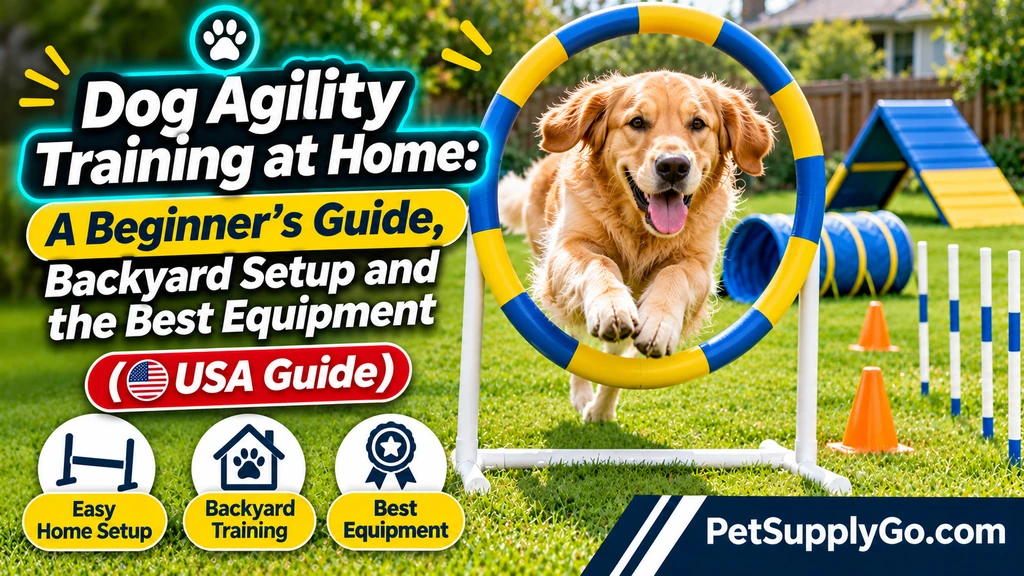
Watch a dog agility run, and you’ll understand the appeal in about eight seconds. A dog sprints off the start line, flies over a jump, dives into a tunnel, rockets out the other side and weaves through a row of poles as though they were never there. The handler runs alongside, pointing, calling, grinning. The dog is grinning too.
Agility looks like a sport for elite dogs and expert trainers, but the basics are surprisingly easy to start at home. You don’t need a big field or expensive gear. A few low jumps, a tunnel, some treats and a patient, positive attitude are enough to get going. And whether you ever step into a competition ring or not, agility gives dogs what many of them crave: a job, mental challenge, physical exercise and a closer connection with their person.
The short answer on how to start dog agility training at home: begin with foundation skills such as recall, targeting, waiting and focus. Introduce obstacles slowly and safely, using low heights and flat or soft surfaces. Use positive reinforcement, such as treats, toys and praise, and keep sessions short, five to ten minutes. Teach one obstacle at a time, starting with the easy ones like tunnels and low jumps, then add weave poles, contact obstacles and sequences. Wait until your dog is physically mature before asking for full-height jumps, check with your vet first and warm up your dog before each session.
This guide explains what agility is, how the obstacles work, who it suits, how to keep your dog safe, which foundation skills to build first, what equipment to buy or make, how to set up a backyard course, how to teach each obstacle step by step, how to handle your dog on course, what a simple eight-week plan looks like, and what to know about competing. It ends with 30 frequently asked questions.
Quick Answer: Dog Agility Cheat Sheet
| Question | Short answer |
| What is agility? | A sport where a handler guides a dog through a timed obstacle course |
| Can I do it at home? | Yes, with a few pieces of equipment and a safe space |
| What age can dogs start? | Foundation skills from puppyhood. Full-height jumping waits until skeletal maturity, often around 12 to 18 months or later for large breeds |
| What breeds can do agility? | Any healthy dog, including mixed breeds |
| How long should sessions be? | Five to ten minutes at first, a few times a week |
| What reward works best? | Small, tasty treats and favorite toys |
| What should I teach first? | Recall, focus, targeting and tunnels |
| Is it hard on joints? | It can be if done wrong. Use low heights, soft surfaces and warm-ups |
| Do I need to compete? | No. Many owners do it purely for fun |
| What equipment do I need? | A few jumps, a tunnel and weave poles for a basic setup |
| How long until I can run a course? | Many dogs and handlers need a few months of steady practice |
| Where can I take classes? | Local dog training clubs and facilities offer beginner agility classes |
If you remember one rule: keep it safe, keep it positive and keep it fun.
What Is Dog Agility?
Dog agility is a sport in which a handler directs a dog through a course of obstacles, off leash, using voice and body signals. The goal is to complete the course accurately and, in competition, quickly. It began in the United Kingdom in the late 1970s as a demonstration at a dog show, and it has since grown into a popular sport in the United States and around the world, with organizations such as the American Kennel Club offering competitions and titles.
Agility is a team sport. The dog provides the speed and athleticism, and the handler provides the plan and the signals. Good communication matters far more than raw speed.
It’s a sport for everyone. Small dogs, large dogs, purebreds and mixed breeds can all compete or just play. Courses and jump heights are adjusted for size.
It’s a mental workout. Dogs have to listen, think and make decisions while running.
It can be as casual or as serious as you want. Some owners practice in the backyard on weekends, and others compete every month.
The Main Agility Obstacles
Here are the obstacles you’ll see on most courses.
Jumps
A bar rests on two uprights, and the dog leaps over it. Jump heights are set by the dog’s height at the shoulder.
What it teaches: Collection, confidence and timing.
Safety note: Use low heights for training and for young dogs.
Tire Jump
A hanging tire in a frame. The dog jumps through the hole.
What it teaches: Accuracy and focus.
Safety note: Use breakaway or adjustable designs and a low setting at first.
Tunnels
An open, flexible tube the dog runs through. There’s also a chute, a collapsed tunnel with fabric that the dog pushes through.
What it teaches: Speed, confidence and driving ahead.
Why dogs love it: It’s often the favorite obstacle. Many dogs take to tunnels quickly.
Weave Poles
A row of vertical poles, usually six to twelve, that the dog weaves through, entering with the first pole on the left.
What it teaches: Precision, focus and rhythm. It’s one of the hardest skills to learn.
Contact Obstacles
Obstacles with painted contact zones on the ends. The dog must touch the zone.
The A-frame: Two ramps in an A shape that the dog climbs and descends.
The dog walk: A raised plank with ramps. The dog runs across.
The teeter or seesaw: A plank that tips when the dog reaches the center.
What they teach: Balance, control and confidence.
Safety note: These require careful, slow training, with low heights at first.
Pause Table
A raised table where the dog stops, sits or lies down for a few seconds.
What it teaches: Self-control and stopping on cue.
Other Obstacles
Some courses include the broad jump and the double or triple jump. Beginners rarely need them.
What Agility Does for Your Dog (and You)
Physical exercise. Agility builds strength, coordination and endurance, when done safely.
Mental stimulation. Learning obstacles and sequences tires the brain.
Confidence. Shy dogs often blossom as they master new skills.
Focus and obedience. Dogs learn to work with distractions.
Bonding. You and your dog become a team.
Weight management. Active play helps keep dogs lean.
Behavior benefits. Many bored or high-energy dogs become calmer with a regular outlet.
Fun. It’s a good time for both of you.
Social opportunities. Classes and clubs connect you with other dog people.
Fitness for you. Running alongside your dog is great exercise.
Is Agility Right for Your Dog?
Dogs Who Often Thrive
- Energetic, athletic breeds, such as Border Collies, Australian Shepherds, Shelties, Jack Russells and Labradors
- Dogs who love to work with their people
- Dogs who like treats and toys
- Dogs with good health and sound joints
- Confident dogs, and shy dogs with careful, positive training
- Mixed breeds of all kinds
Dogs Who Need Extra Care
- Long-backed, short-legged breeds such as Dachshunds and Basset Hounds. Jumping can stress their backs. Talk to your vet first, and avoid high jumps.
- Flat-faced breeds such as Pugs, Bulldogs and French Bulldogs. They overheat easily, so keep sessions short and cool.
- Giant breeds such as Great Danes and Mastiffs. They mature slowly, and joint stress is a concern. Focus on low-impact skills.
- Dogs with joint problems. Hip or elbow dysplasia, arthritis and cruciate issues need veterinary guidance.
- Senior dogs. Gentle, low-impact activities may be better.
- Overweight dogs. Lose weight first, with your vet’s guidance.
- Dogs with heart or breathing problems. Ask your vet.
- Very anxious or reactive dogs. Start with calm training, and work with a trainer.
Dogs Who Shouldn’t Do Agility
Dogs with injuries, severe orthopedic problems or health conditions that make exercise unsafe should skip it unless a vet approves. There are alternatives, such as scent work, trick training and gentle balance exercises.
Age Matters: Puppies and Agility
Puppies are naturally eager, but their bodies are still growing. Their growth plates, the soft areas at the ends of bones where growth happens, close gradually, and the timing depends on breed and size. Jumping and high-impact work too early can cause injuries.
General guidance:
- Start foundation skills early. Recall, targeting, name response, simple tricks and handling can begin in puppyhood.
- Use flat work and low obstacles. Tunnels, low boards, wobble surfaces and ground poles build coordination.
- Delay jumping. Many trainers wait until a dog is around 12 to 18 months old before asking for full-height jumps, and larger breeds may need longer. Ask your vet.
- Keep sessions short. Puppies tire quickly.
- Avoid repetitive high-impact moves. No leaping off furniture or repeated jumping.
- Watch for fatigue. Stop at the first sign of tiredness or sore movement.
- Ask your vet. They can check your puppy’s growth and joints.
If you’re raising a puppy and getting ready for agility, our guide to clicker training for dogs is a good place to start. [INTERNAL LINK: add your clicker training guide here]
Safety First: Keeping Your Dog Healthy
Agility is athletic, and athletes get injured. A little care prevents most problems.
See your vet first. Get a checkup, and ask whether your dog’s joints, heart and weight are ready for agility.
Warm up. Five to ten minutes of brisk walking, gentle stretching and easy movements.
Cool down. Finish with a slow walk.
Use low heights. Especially for jumps and contact obstacles.
Choose the right surface. Soft, even grass or a rubber mat is best. Avoid concrete, slippery wood or wet surfaces.
Check equipment. Look for loose parts, sharp edges and wobbly uprights. Make sure jump bars fall off when knocked.
Keep sessions short. Five to ten minutes is plenty at first.
Limit repetition. Don’t do the same high-impact movement over and over.
Watch the weather. Avoid training in extreme heat, cold or wet. Dogs can overheat, especially flat-faced and thick-coated breeds.
Offer water. Give water breaks.
Know the signs of trouble. Limping, stiffness, yelping, reluctance to jump, panting hard or lagging behind can mean pain or fatigue. Stop, and ask your vet.
Check paws. Look for cuts, cracked pads and torn nails after sessions. [INTERNAL LINK: add your dog nail clippers guide here]
Keep nails trimmed. Long nails reduce traction.
Maintain a healthy weight. Extra weight stresses joints.
Use a harness for walking, not for agility runs. Dogs run off leash and without harnesses in agility, because straps can snag. In practice sessions, many handlers use a flat buckle collar, or nothing, in a fenced area.
Never force a dog over an obstacle. Use rewards and patience.
Build up gradually. Rest days are important.
Know your dog’s limits. Some dogs push past their limits, so you need to be the sensible one.
Foundation Skills to Teach Before Agility Obstacles
Great agility dogs are built on basic skills. Spend a few weeks on these before you add equipment.
1. Focus and Name Response
Your dog should look at you when you say their name or “watch.” Click or mark, and reward for eye contact. Build up to eye contact with distractions.
2. Recall (Come When Called)
Agility is run off leash, so a reliable recall matters. Practice in a fenced area, with high-value treats. Never call your dog for something unpleasant.
3. Hand Target (Touch)
Teach your dog to touch their nose to your hand. A hand target lets you guide your dog around obstacles.
4. Wait and Stay
Your dog needs to wait at the start line until you release them. Teach a short, reliable “wait” and a release word, such as “okay.”
5. Sit and Down
Basic positions help with the pause table and with settling between runs.
6. Go to Mat or Target
Teaching your dog to run to a mat or target builds understanding of “go on” and distance work.
7. Walking and Running Beside You
Practice staying near you at different speeds, on both your left and right.
8. Left and Right
Teach directional cues over time. Some handlers use “left” and “right,” and others use “come bye” and “away.”
9. Confidence on New Surfaces
Let your dog walk on wobbly boards, mats, plastic, wood and different textures. Reward bravery. This prepares them for contact obstacles and the teeter.
10. Handling and Body Awareness
Practice gentle handling, balance exercises and moving over low poles. These build coordination.
11. Tug and Toy Play
A dog who loves toys is easy to motivate and can work longer in the sun. Teach “drop it” and “take it.”
Positive reinforcement is the key. Clicker training and treats make learning fun, and dogs who enjoy training perform better. [INTERNAL LINK: add your clicker training guide here]
Agility Equipment Explained
You don’t need every obstacle. A basic backyard setup can have just a few.
Jumps
Bar jumps. A bar resting on two uprights. Look for adjustable heights, lightweight bars that fall when hit and stable bases.
Window and tire jumps. More advanced. Use only after your dog knows the basics.
Beginner tip: A simple jump set with adjustable cups and several bars is a good first purchase.
Tunnels
Open tunnels. Flexible tubes, usually 10 to 20 feet long, with sandbags or pegs to keep them in place.
Collapsed tunnels (chutes). A fabric chute attached to a barrel. Teach later.
Beginner tip: Choose a sturdy tunnel with a wide opening that matches your dog’s size. Small dogs need smaller tunnels, and large dogs need larger diameters. Secure it so it doesn’t roll.
Weave Poles
Standard poles. Six to twelve poles in a line, spaced about 20 to 24 inches apart.
Training sets. Poles with guide wires or adjustable spacing that help beginners.
Beginner tip: A set of six poles with channel-style training is good for home.
Pause Table
A raised, stable table. Beginners can use a low platform or sturdy box.
Contact Obstacles
A-frame, dog walk, teeter. Large, expensive and potentially risky. Learn these in classes with an instructor, where an experienced person can spot your dog.
Beginner tip: Skip these at home until you’ve had training. Use a low practice board on the ground to teach “contact” behavior safely.
Other Gear
- Cones or markers. For marking the start line, course layout and handler positions.
- Cavaletti or ground poles. Low poles on the ground to teach stride and body awareness.
- Balance discs, wobble boards and cushions. Conditioning and confidence.
- Target stick or mat. For targeting.
- Treat pouch. Fast reward delivery.
- Toy and tug. For play rewards.
- Stopwatch or phone timer. For tracking runs later.
- Equipment bags and storage. To keep gear tidy.
Materials and Quality
PVC. Lightweight, inexpensive and popular for home courses. Check that it won’t crack in cold weather.
Wood. Sturdy, but heavier and can splinter if damaged.
Plastic and metal. Competition-quality pieces are durable and often more expensive.
Fabric tunnels. Washable, but check for tears and wear.
Safety features. Bars that fall away, non-slip bases, rounded edges and stable uprights are important.
Top Agility Equipment Picks
Prices are approximate and change often. Check the current listing, dimensions, height range and weight recommendations before you buy. I’ve grouped these by use rather than ranking them, because the best choice depends on your dog’s size and your space. Product lines change, so confirm details on the listing.
Best Starter Set: Trixie Dog Activity Agility Set
Trixie sells a range of dog activity gear, including beginner agility sets with a tunnel, jumps and weave poles. These sets are aimed at casual home use, and they’re a common first purchase.
Good for: Small to medium dogs, first-time owners, casual play.
Pros: Several obstacles in one package, easy to set up, affordable.
Cons: Lighter build than competition equipment. Check height ranges and stability for larger or very energetic dogs.
Best for Competition-Style Gear: Max200 Agility Equipment
Max200 is a well-known maker of agility equipment, with jumps, tunnels, weave poles and contact obstacles built for regular training and competition use.
Good for: Serious hobbyists, competitors, owners who want durable equipment.
Pros: Sturdy construction, competition standards, adjustable options.
Cons: Higher price. Larger equipment takes space. Check shipping and availability.
Best for Customizable, Budget-Friendly Gear: Affordable Agility
Affordable Agility sells equipment that’s popular with home trainers, including PVC jumps, weave poles and other basics at lower price points, with options sold individually.
Good for: Budget buyers, home trainers who want to add pieces gradually.
Pros: Pieces sold separately, practical designs, lower cost.
Cons: Lighter than competition equipment. Check specifications for your dog’s size.
Best Tunnel Option: Open Agility Tunnel With Sandbags
Many brands make 10 to 15 foot open tunnels in sturdy fabric, with a flexible wire frame. Look for a wide diameter, non-slip texture and sandbags or ground anchors.
Good for: All dog sizes, with the right diameter. A favorite for beginners.
Pros: Fun, simple, good confidence builder.
Cons: Can roll or collapse if not anchored. Check size and quality.
Best Weave Pole Training Set: Adjustable Weave Poles With Guide Wires
Adjustable sets let you start with wide-open channels and gradually close the gap. This approach, often called the channel method, makes the weave easier for beginners.
Good for: Teaching weaving step by step.
Pros: Clear learning stages, flexible.
Cons: Needs patience. Check stability, and use on soft ground.
Best Conditioning Gear: Balance Discs and Wobble Boards for Dogs
Non-slip, inflatable or foam balance equipment for core strength and coordination. Many dog fitness trainers use them.
Good for: Warm-ups, conditioning, building confidence and body awareness.
Pros: Small, versatile, helpful for older and younger dogs.
Cons: Needs supervision. Start low and slow.
Best Budget Option: DIY Home Agility Course
You can build a decent beginner course for less than the cost of one commercial set. See the DIY section below.
Good for: Testing whether your dog enjoys agility.
Pros: Cheap, customizable.
Cons: Needs care for safety. Not as durable.
A Note on Brands
Equipment sizes, jump heights and tunnel lengths vary, so check the specifications. Look for reviews from owners with dogs your size. Ask local trainers what they recommend, since they often know which equipment is safe and reliable.
Setting Up a Backyard Agility Course
You don’t need a huge yard. Even a small space works with creativity.
What You Need
- A safe, fenced area, if possible
- Flat, even ground, ideally grass or rubber matting
- Enough space to run, about 20 by 40 feet is great, though smaller areas work for beginners
- A few obstacles
- Treats and toys
- A way to mark positions, such as cones
Choose a Good Surface
- Grass. Cushioned and good for traction. Mow and check for holes.
- Rubber mats. Absorb impact, and are good for indoor or patio use.
- Avoid concrete, asphalt, wet or icy surfaces. They can hurt joints and cause slips.
- Avoid slippery wood or tile.
Clear the Space
- Remove sticks, stones, tools and sprinkler heads.
- Fill holes.
- Check for hazards such as glass, thorns and wire.
- Keep other pets and children away from the course while you train.
Start Small
For the first few weeks, set up two or three low obstacles:
- A low jump or a bar on the ground
- A short tunnel
- A mat or a target
Add Gradually
As your dog learns, add weave poles, more jumps and simple sequences.
Keep It Safe
- Use low heights.
- Anchor tunnels and uprights.
- Remove equipment when not in use if children or pets may climb on it.
- Check everything before each session.
Think About Neighbors
Dogs get excited and bark during agility. Choose reasonable times, and keep sessions short.
Weather and Seasons
- Avoid extreme heat. Early morning and evening are best.
- Don’t train on frozen or wet ground.
- Bring equipment inside during storms.
- In winter, you may train indoors, in a garage or a basement with a non-slip floor. Our guide to dog boots covers paw protection outdoors. [INTERNAL LINK: add your dog boots guide here]
DIY Agility Equipment on a Budget
Many owners start with homemade equipment. Here are simple ideas, with safety notes.
PVC Jumps
What you need: PVC pipes, elbow connectors, T connectors and a pipe cutter.
How: Build a simple H-frame or two uprights with a light PVC bar that rests on small cups or notches.
Safety: Make sure the bar falls off if hit. Use lightweight PVC. Cap the ends. Check for cracks, especially in cold weather.
Weave Poles
What you need: Six to twelve PVC pipes or garden stakes and a base or ground spikes.
How: Set poles in a line, spaced about 20 to 24 inches apart. For beginners, start with a wide channel.
Safety: Make sure poles are firmly in the ground, and use soft grass.
Tire Jump or Hoop
What you need: A hula hoop, a pool noodle or a light plastic hoop and stands.
How: Hang or support the hoop at a very low height.
Safety: Keep it low, lightweight and stable. Don’t use heavy or rigid hoops.
Tunnels
What you need: A children’s play tunnel or a purchased dog tunnel.
Safety: Anchor it. Don’t use cardboard tubes, concrete pipes or anything rigid that could collapse.
Pause Table or Platform
What you need: A sturdy low box, bench or plastic crate.
Safety: Make sure it can’t tip, and use a non-slip surface.
Wobble Boards and Balance Work
What you need: A cushion, a foam pad or a piece of plywood on a small rubber ball.
Safety: Keep it low, and supervise. Don’t use a large ball that rolls away.
Cones and Markers
What you need: Plastic cones, cups or buckets.
Ground Poles
What you need: Pool noodles, PVC pipes or broomsticks laid on the ground.
How: Space them for your dog’s stride, and teach your dog to step carefully.
Safety: Keep them on the ground, and use soft material.
What Not to DIY
- Contact obstacles, such as an A-frame, dog walk or teeter. Poor construction can cause serious injuries.
- Heavy jumps.
- Anything that can collapse or trap your dog.
- Anything with sharp edges, nails or splinters.
When in doubt, buy a quality product, or learn in a class.
How to Teach Each Obstacle, Step by Step
Teach one obstacle at a time. Use positive reinforcement, such as treats, toys and praise. Keep sessions to five to ten minutes. End on a success.
Tunnel
Tunnels are usually the easiest and most fun.
- Start short. Scrunch the tunnel to about two or three feet, so your dog can see through to the other side.
- Lure. Have a helper hold your dog at one end, and show a treat or toy at the other. Release, and let your dog run through.
- Reward at the exit. Treat or toy as your dog comes out.
- Lengthen gradually. Add a foot or two, then straighten the tunnel.
- Add a curve. Bend the tunnel a little.
- Add a cue. Say “tunnel” as your dog enters.
- Add distance. Send your dog from farther away.
- Add speed. Run beside your dog.
Tip: If your dog is nervous, let them sniff the tunnel, and toss treats inside. Never push a dog in.
Jumps
- Start with a bar on the ground. Walk your dog over it, with treats.
- Raise it slightly. Use a very low height, such as the dog’s elbow height or lower, and ask your dog to step or hop over.
- Reward after the jump. Treat or toy on the landing side.
- Use a lure at first. Then fade it.
- Add a cue. Say “over” or “jump” as your dog goes over.
- Add distance and speed. Move back a step, then send your dog.
- Keep the bar low for training. You don’t need high jumps to learn. Many trainers use low heights, especially for young dogs and growing puppies.
- Teach jumping from both directions.
Safety: Use bars that fall away when hit. Don’t repeat jumps too many times in a session.
Tire Jump
- Start on the ground. Place the tire or hoop on the ground, and let your dog step through.
- Raise gradually. Use a very low height.
- Reward after the tire.
- Add a cue. “Tire” or “through.”
Safety: Use a breakaway or adjustable design.
Pause Table or Platform
- Place a low platform on the ground.
- Reward your dog for stepping on.
- Add a sit or down. Click for the behavior on the table.
- Increase duration slowly. Count a few seconds.
- Add a cue. “Table” or “place.”
- Release with a word. “Okay.”
Weave Poles
Weaving is the hardest obstacle for many dogs. There are several methods. Here’s a beginner-friendly channel approach.
- Spread the poles wide. Set poles with a gap large enough for your dog to run straight down the middle.
- Lure and reward. Run through the channel with your dog, and treat at the end.
- Add a cue. “Weave” as your dog enters.
- Gradually close the channel. Move the poles closer, a few inches at a time, over several sessions.
- Build to straight poles. Eventually the poles are in a straight line, and your dog weaves through.
- Add speed and distance. Practice entries from different angles.
- Be patient. Many dogs take weeks or months to master weaving.
Alternative methods: Some trainers use guide wires, two-by-two poles or a “2×2” method, where the dog learns to weave between just two poles first. Ask a local trainer which method they prefer.
Tip: Reward at the end of the poles, and keep sessions short. Don’t force it.
Contact Obstacles (A-Frame, Dog Walk, Teeter)
Contact obstacles require a qualified instructor and proper equipment. They’re high, narrow or moving, and a bad experience can cause injury or fear.
Here’s the general idea.
- Foundation work. Teach a target behavior, such as touching a mat or a low board with the front paws.
- Start on the ground. Practice on a low, wide board.
- Raise gradually. Increase height only when your dog is confident.
- Teach a stopping contact or a running contact. Instructors teach one or both.
- Introduce the teeter slowly. The teeter moves and makes noise. Many dogs need a long time to be comfortable. Use low heights, treats and gradual steps.
- Always use proper equipment and a spotter.
If you’d like to include contact obstacles, join a beginner class. Don’t try to build them at home.
Chute and Other Obstacles
Teach the open tunnel first. When your dog is confident, introduce a collapsed tunnel by lifting the fabric and rewarding for pushing through.
Handling Basics: Running the Course With Your Dog
Handling means using your body, voice and position to tell your dog where to go. It’s the human side of agility.
Body position. Dogs read where your shoulders, feet and arms are pointing. Face the direction you want your dog to go.
Voice cues. Use clear, upbeat words for each obstacle and direction.
Hand signals. Use your arm closest to your dog to point to the next obstacle.
Left and right. Practice both, so you can handle your dog from either side.
Distance. With practice, your dog can work farther away from you. Start close.
Timing. Give cues early enough for your dog to react.
Your speed. Dogs follow your motion. Slow down or speed up as needed.
Crosses. Handlers switch sides during a course:
- Front cross: You turn toward your dog and switch sides in front of them.
- Rear cross: You switch sides behind your dog.
- Blind cross: You switch sides while your dog is facing away.
Learn these in a class, and practice them without your dog, then with treats.
Course layouts. Beginners can set up a simple sequence, such as jump, tunnel, jump, and run it slowly. Over time, add more obstacles and turns.
Keep it fun. Reward your dog after each success, and play afterward.
Conditioning and Warm-Ups
Fit dogs have fewer injuries. A good routine covers warm-ups, conditioning and cool-downs.
Warm-Up (5 to 10 Minutes)
- Brisk walk
- Gentle trotting
- Sit-to-stand repetitions
- Slow figure eights around cones
- Gentle shoulder and hip stretches, if your dog is comfortable
- Stepping over low poles
Conditioning Exercises (A Few Times a Week)
- Hill walking. Builds hind-end strength.
- Ground pole work. Encourages careful stepping.
- Balance disc or wobble board. Builds core strength.
- Sit-to-down, down-to-stand. Strengthens muscles.
- Backing up. Works hind muscles.
- Swimming. Low-impact exercise, if your dog likes water and it’s safe.
- Weaving between cones at a walk.
Cool-Down (5 Minutes)
- Slow walk
- Gentle stretching
- Water
- A quick check of paws and joints
Rest and Recovery
- Take rest days.
- Watch for stiffness the next day.
- Ask your vet or a canine fitness professional about a customized plan.
An Eight-Week Beginner Plan
This plan assumes a healthy adult dog who has finished growing. Adjust for your dog’s age and ability. Train three to four days a week, five to ten minutes at a time.
| Week | Focus | Goals |
| 1 | Foundation skills | Focus, recall, hand target, wait and release |
| 2 | Surface confidence and tunnel | Walk over boards and mats, run through a short tunnel |
| 3 | Tunnel and low jump | Lengthen the tunnel, jump a low bar on the ground |
| 4 | Jump and tire (low) | Add cues, small jump heights, simple jump and tunnel sequence |
| 5 | Pause table and weave basics | Table sit or down, begin the wide channel for weaving |
| 6 | Weave progress and handling | Narrow the channel, practice sending and left and right |
| 7 | Short sequences | Three or four obstacles in a row, front cross practice |
| 8 | Mini course and review | Run a simple course, reward, repeat favorites |
Tips:
- Keep sessions fun.
- Review old skills often.
- If your dog struggles, go back a step.
- Take photos or videos to track progress.
- Consider joining a class at week four or five.
Troubleshooting Common Agility Problems
| Problem | Likely cause | What to try |
| Dog won’t enter the tunnel | Fear or uncertainty | Shorten the tunnel, use treats, let them see through |
| Dog knocks bars | Jump too high, rushing or poor form | Lower the jump, slow down, add ground poles |
| Dog runs around obstacles | Not understanding the cue, or distracted | Use a lure and reward, work closer, review cues |
| Dog loses focus | Too many distractions, tired or session too long | Shorten sessions, use higher-value rewards |
| Dog is too excited and barks | High arousal | Calm warm-ups, reward calm behavior, use shorter runs |
| Dog is afraid of the teeter | Moving, noisy board | Go back to low, quiet steps, ask an instructor |
| Weave poles confuse the dog | Method too hard | Return to a wide channel, reward often |
| Dog stops at the table | Table too high or slippery | Lower it, add a non-slip surface |
| Dog won’t stay at the start | Not enough wait practice | Practice short waits, release with a clear word |
| Dog slows down | Tired, sore or bored | Check for pain, shorten, make it fun |
| Dog limps after sessions | Possible injury | Stop, rest and see your vet |
| Handler is confused | Handling is hard | Take a class, film runs, practice without the dog |
Dog Agility Competition: A Quick Overview
You don’t need to compete, but many owners eventually try it.
Organizations. Several groups run agility trials in the United States, including the American Kennel Club, the United States Dog Agility Association, the North American Dog Agility Council, the Canine Performance Events group and the United Kennel Club. Rules, classes and eligibility vary, and many allow mixed breeds.
Classes. Common classes include standard courses with contact obstacles, jumpers courses with jumps and tunnels and sometimes games or timed events.
Jump heights. Dogs are placed into height divisions based on their shoulder height, and each division has a set jump height. Smaller dogs jump lower. Many organizations also offer preferred or reduced-height divisions for dogs who need lower jumps, such as seniors or breeds with back concerns.
Titles. Dogs earn titles by qualifying, which means completing the course without major faults within the time limit.
Eligibility. Rules vary on minimum age, often 15 months or older to compete, and on spayed or neutered status, since many organizations allow both.
What to bring. Your dog’s records, a crate, water, treats, toys and a flat collar or no collar, as the rules require.
Start slowly. Many handlers watch a trial first, then try a fun run or a beginner class.
Remember: Agility is for fun. Don’t let competition pressure your dog.
Common Agility Mistakes to Avoid
Starting too young or too high. Wait for physical maturity before high jumps, and ask your vet.
Skipping foundation skills. A dog who can’t focus or wait will struggle.
Making sessions too long. Short and sweet is best.
Rushing contacts and weave poles. These take time to learn.
Using punishment. It destroys confidence and enthusiasm.
Forcing a scared dog. Slow down.
Setting up unsafe equipment. Check for stability and safety.
Using concrete or slippery surfaces. Injury risk.
Practicing too much of the same thing. Repetition causes stress and boredom.
Skipping warm-ups and cool-downs. Injury prevention matters.
Ignoring pain. Limping and stiffness need a vet.
Comparing your dog to others. Every dog learns at their own pace.
Not rewarding enough. Dogs work for rewards.
Not having fun. If you’re stressed, your dog will be too.
Never taking a class. Learning handling from an expert saves time and prevents bad habits.
How Much Does Agility Cost?
DIY equipment (roughly $20 to $80): PVC jumps, weave poles, cones and a simple tunnel.
Beginner home set (roughly $60 to $200): A tunnel, a few jumps and weave poles.
Quality individual pieces (roughly $50 to $300 each): Jumps, weave sets and tunnels from specialist brands.
Contact obstacles (roughly $300 to $2,000 or more each): Large and expensive. Many owners use club equipment.
Classes (roughly $100 to $250 or more for a multi-week course): Prices vary by region and instructor.
Trial entry fees (roughly $20 to $40 per run): Plus travel and registration costs.
Treats and toys (roughly $10 to $30 a month): Depends on your dog.
Conditioning gear (roughly $15 to $60): Balance discs, wobble boards and mats.
Vet checks and fitness care: Vary.
A simple home setup can cost less than a month of classes. Start small, and add pieces as you and your dog grow.
Final Thoughts: Start Small, Stay Safe and Have Fun
Agility is one of the most rewarding things you can do with a dog. It builds fitness, focus and confidence. It turns walks into adventures and backyards into playgrounds. And it gives you a front-row seat to your dog’s joy.
You don’t need fancy equipment or years of experience. Start with foundation skills, a tunnel and a low jump. Use positive reinforcement and short sessions. Check with your vet, especially for puppies, seniors, flat-faced breeds and dogs with joint problems. Warm up, keep surfaces safe, learn the tricky obstacles in a class and never force your dog. If something doesn’t feel right, stop and rethink.
Most of all, keep it fun. A happy, confident dog who loves the game will go a lot farther than a stressed dog who’s just following orders. Grab some treats, set up a couple of low jumps and see what your dog can do.
Browse more helpful guides in our Dog Care section.
Sample Backyard Course Layouts
Use these ideas as starting points. Adjust the spacing for your dog’s size and the space you have. Start with wide gaps, and move equipment closer as you both improve.
Layout 1: The Tiny Beginner Line (about 15 by 25 feet)
Equipment: one low jump, one short tunnel, one mat.
- Start line, a few feet back.
- Low jump, about ten feet in.
- Tunnel, about ten feet past the jump.
- A mat for a reward at the end.
Goal: Jump, tunnel, reward. Walk it first, then run.
Layout 2: The Simple Loop (about 20 by 35 feet)
Equipment: two jumps, one tunnel, a set of six weave poles.
- Jump one.
- Tunnel.
- Jump two.
- Weave poles.
- Turn back toward the start.
Goal: Practice turns and transitions, such as left turns after the tunnel.
Layout 3: The Figure Eight (about 25 by 40 feet)
Equipment: three jumps, one tunnel and a pause table.
- Jump one and jump two in a gentle curve.
- Tunnel.
- Pause table.
- Jump three, then back to the start.
Goal: Learn to change direction and practice a stop on the table.
Layout 4: The Zigzag (about 30 by 50 feet)
Equipment: four jumps, a tunnel, a set of twelve weave poles and a pause table.
- Jump, then tunnel.
- Jump at an angle.
- Weave poles.
- Pause table.
- Final jump.
Goal: Build handling skills with crosses and angled approaches.
Tips for Any Layout
- Walk the course yourself first, and imagine your dog’s path.
- Leave plenty of room for the dog to land and turn.
- Keep the course consistent for a few sessions, so your dog learns it.
- Change the order now and then to build thinking skills.
- Never place obstacles so close together that your dog has to rush or crash.
Fun Agility Games for Home
Games keep training fresh and help dogs who get bored with drills.
Tunnel Races. With a helper, send your dog through the tunnel, and reward at the exit. Add speed as your dog gains confidence.
Hoop Dash. Place a low hoop on the ground. Your dog runs through to get a toy.
Follow the Leader. Walk or jog through your course, and have your dog follow you on a loose leash or at your side.
Treat Trail. Place treats on or around each obstacle, such as on the mat, at the tunnel exit and past the jump. Your dog follows the trail.
Red Light, Green Light. Run, then stop and ask your dog to stop with you. Reward for stopping.
Hide and Seek. A helper holds your dog while you hide behind an obstacle. Call your dog, and reward when they find you.
Backyard Obstacle Walk. Walk your dog over a plank, a low ladder and a cushion on the ground. This builds confidence and balance.
Switch Sides. Practice moving from your left to your right side, rewarding your dog for staying with you.
Flip the Order. Run your sequence backward or in a new order, so your dog learns to listen, not memorize.
Agility for Different Body Types
Every dog’s body is different, and agility should fit it.
Small and Toy Breeds
Small dogs are often fast, enthusiastic and brave. Use appropriately sized tunnels, lower jumps and smaller weave pole spacing if needed. Keep an eye on slippery surfaces and tiny paws. Protect from heat and cold, since small bodies change temperature quickly.
Long-Backed, Short-Legged Breeds
Dachshunds, Corgis, Basset Hounds and similar breeds are prone to back problems. Avoid high jumps and repetitive leaping. Choose low obstacles, ground poles, tunnels and nosework. Ask your vet first, and consider reduced-height competitions if you decide to compete.
Flat-Faced Breeds
Pugs, French Bulldogs and Bulldogs can overheat and struggle to breathe during exercise. Keep sessions short and cool, with lots of rests. Skip hot days. Stop at the first sign of heavy panting, noisy breathing or fatigue.
Giant Breeds
Great Danes, Mastiffs and similar dogs mature slowly and carry a lot of weight. Focus on low-impact skills, such as tunnels, targeting and balance work. Avoid repetitive jumping, and ask your vet about timing.
Herding Breeds
Border Collies, Australian Shepherds, Shelties and others are intense, fast and eager. They often learn quickly, but can become obsessive or anxious. Teach calm behavior along with speed, and mix in rest and play.
Terriers
Jack Russells and other terriers are bold, energetic and independent. Keep training fun, and use high-value rewards. Many love tunnels.
Retrievers and Sporting Breeds
Labradors, Goldens and Spaniels are food and toy motivated. Watch weight and joints, especially for Labs.
Hounds
Beagles and other scent hounds may be distracted by smells. Use strong rewards, and keep the area clean of tempting scents. Sighthounds like Greyhounds and Whippets are fast but have specific bodies. Their long backs and thin skin need soft surfaces, and some prefer open sprints to tight turns.
Bully Breeds
American Staffordshire Terriers, Pit Bulls and similar breeds are strong, athletic and people oriented. Many love agility. Watch for overheating, and avoid heavy, repetitive impact.
Mixed Breeds
Mixed breeds vary widely. Observe your dog’s body, energy and temperament.
Motivation and Energy Management
A motivated dog learns faster, but too much excitement can ruin focus.
Find your dog’s favorite reward. Some dogs work for food, and others for toys or play. Test several, and keep the best for hard tasks.
Use toys wisely. Tugging after a success builds enthusiasm. Teach “drop it” so the game continues.
Vary rewards. Mix treats, toys and praise.
Build arousal slowly. If your dog is wild, start with calm exercises, then add excitement.
Calm over-excited dogs. Teach a settle on a mat, use shorter runs and reward calm behavior.
Boost low-energy dogs. Play before training, use better treats and keep sessions short.
Pay attention to your tone. Cheerful, upbeat energy helps.
Take breaks. Mental fatigue shows up as sniffing, slowing down or ignoring cues.
End on a high. Stop while your dog still wants more.
Keep it rewarding. Make sure your dog loves the game.
Practice Without Your Dog
Handlers can improve a lot without a dog at all.
Walk the course. Practice your path, your crosses and your cues.
Rehearse your timing. Say cues at the right moment.
Practice your body language. Use clear arm signals.
Film yourself. Watch for late cues, wandering arms and confusing movements.
Work on your own fitness. Running with your dog is easier if you’re fit.
Study courses. Many clubs share sample courses and videos.
Review your runs. Film training sessions, and look for what worked.
Keep a training journal. Note progress, problems and ideas.
Weather and Season Guide
Spring. Great for training. Watch for wet ground, mud and slippery grass. Check equipment after winter storage.
Summer. Train early or late to avoid heat. Watch hot surfaces, since pavement and some turf can burn paws. Keep water handy, and rest often. Flat-faced and thick-coated dogs overheat quickly.
Fall. Cool weather suits many dogs. Watch for wet leaves, which can hide hazards and cause slipping.
Winter. Cold, icy or snowy ground is risky. Train indoors if you can. If you train outdoors, clear the area, warm up well and protect paws. Salt and ice melt can irritate pads. [INTERNAL LINK: add your dog paw cleaning guide here]
Rainy days. Wet ground is slippery. Postpone or move indoors.
Windy days. Tunnels and light equipment can blow around. Secure everything.
Shy, Rescue and Reactive Dogs
Agility can build confidence, but it needs a gentle approach.
Shy dogs. Start with very low, quiet activities. Let your dog explore equipment at their own pace. Reward bravery. Don’t flood your dog with scary things.
Rescue dogs. Many have unknown histories and gaps in training. Build trust first, with basic skills, and go slowly.
Reactive dogs. Dogs who lunge or bark at other dogs need professional help. Train alone, in a quiet space. Agility classes with many dogs may be overwhelming at first.
Noise-sensitive dogs. The clatter of jump bars or tunnels can be scary. Introduce sounds gradually, with treats.
Dogs with past injuries. Ask your vet about safe movements.
Always use positive reinforcement. Fear and pain have no place in agility.
Simple Injury Prevention and First Aid Basics
Even careful owners have the occasional scrape or sprain.
Check your dog after each session. Look at paws, legs, nails and joints.
Common minor problems:
- Torn nails. Can bleed. Apply gentle pressure with a clean cloth, and call your vet.
- Cut pads. Rinse with clean water, and cover with a clean bandage. Call your vet if the cut is deep.
- Muscle soreness. Look for stiffness the next day. Rest, and call your vet if it persists.
- Sprains and strains. Limping, swelling or heat. Rest, and see your vet.
- Overheating. Heavy panting, drooling, weakness or collapse. Move to a cool place, offer water and call your vet immediately.
Basic first aid kit:
- Clean gauze and bandages
- Self-adhesive wrap
- Saline solution
- Blunt-tipped scissors
- Styptic powder
- A cold pack
- A towel
- Your vet’s phone number and the emergency clinic’s number
When to call the vet:
- Limping for more than a day
- Swelling, heat or pain in a joint
- Bleeding that won’t stop
- Signs of heatstroke
- A dog who suddenly refuses to jump or run
- Any serious fall or collision
Prevention tips:
- Warm up and cool down.
- Keep your dog fit and lean.
- Use safe equipment and surfaces.
- Don’t push through pain.
- Schedule vet checkups.
Agility Glossary
A-frame: An obstacle with two ramps that meet in a peak.
Contact zone: The painted area at the bottom of contact obstacles where the dog must touch.
Course: The sequence of obstacles.
Cross: A handler switching sides relative to the dog, such as a front cross or a rear cross.
Cue: A word or signal that tells your dog what to do.
Dog walk: A raised plank with ramps.
Handler: The person running the course with the dog.
Q (qualify): Completing a run with no faults in the time allowed.
Refusal: When a dog passes an obstacle without attempting it.
Run-through: When a dog passes a jump without going over it.
Sequence: A series of obstacles in a row.
Teeter (seesaw): A plank that tips when the dog crosses the middle.
Tunnel: A flexible tube the dog runs through.
Weave poles: A line of vertical poles the dog weaves through.
Wrap: A tight turn around a jump upright.
What to Expect in a First Agility Class
Joining a class is one of the best ways to progress, especially for contact obstacles and handling.
Before class. Take your dog for a potty break and a short walk. Bring high-value treats, a favorite toy, water, a treat pouch and a leash. Wear sturdy shoes.
Class setup. Most beginner classes have a small group, an instructor and a few basic obstacles. Dogs usually wait in crates or on mats between turns.
What you’ll do. Expect foundation work: focus, recall, targeting, simple tunnel and jump exercises, and gentle introductions to equipment. Contact obstacles come later.
How it feels. Dogs may be excited or distracted. That’s normal. Good instructors help you work at your dog’s level.
Class etiquette.
- Keep your dog under control, and give other dogs space.
- Clean up after your dog.
- Don’t let dogs greet unless the instructor says it’s okay.
- Be patient and supportive of other handlers.
- Don’t use harsh corrections.
- Ask questions.
What to avoid. Be wary of instructors who rely on force, fear or punishment, or who push dogs onto equipment they aren’t ready for.
How to Choose an Agility Instructor or Club
Look for a program that puts dogs’ safety and enjoyment first.
Ask about:
- Experience and credentials
- Training methods, such as positive reinforcement
- Class size
- Equipment quality and safety
- Policies on age and health, including puppies and seniors
- Ways to try a class before committing
- Whether the club offers fun runs or trials
Observe a class. Watch how the instructor treats dogs and handlers. Look for relaxed, happy dogs.
Trust your gut. If something feels wrong, find another class.
Agility vs Other Dog Sports
If agility isn’t a perfect fit, many other activities can give your dog exercise and a job.
| Activity | What it is | Good for |
| Agility | Obstacle courses | Active dogs, handlers who like running |
| Rally | Following a course of signs with skills | Calm dogs, beginners, many ages |
| Nosework | Finding hidden scents | Seniors, shy dogs, mental work |
| Obedience | Precision skills and heeling | Focused dogs, structure lovers |
| Trick training | Teaching fun behaviors | All dogs, indoors or out |
| Dock diving | Jumping from a dock into water | Water-loving, athletic dogs |
| Flyball | Relay racing with a ball box | High-drive, ball-loving dogs |
| Lure coursing | Chasing a lure over a course | Sighthounds |
| Canine fitness | Conditioning and balance work | Dogs of all ages and abilities |
| Hiking | Walks on trails | Almost all healthy dogs |
Tip: Try a few activities, and see what your dog enjoys most. Many dogs have a favorite.
Pre-Session Safety Checklist
Run through this list before each home session. It takes about a minute.
- [ ] My dog is healthy, alert and not limping.
- [ ] My dog hasn’t just eaten a large meal.
- [ ] The weather is safe, not too hot, cold, wet or icy.
- [ ] The surface is flat, soft and dry.
- [ ] I’ve checked equipment for cracks, loose parts and sharp edges.
- [ ] Tunnels are anchored, and jump bars fall away when hit.
- [ ] Jump heights are low for my dog’s age and body.
- [ ] I’ve cleared the space of sticks, stones and holes.
- [ ] I have treats, a toy, water and a towel.
- [ ] My dog has had a potty break.
- [ ] We’ve done a warm-up.
- [ ] I know when I’ll stop, and I’ll end on a success.
Reminders for Your Training Notebook
- Short sessions beat long ones.
- Rewards beat corrections.
- Low beats high for jumps, especially for puppies and growing dogs.
- Foundations beat flashy tricks.
- Rest days beat overtraining.
- A happy dog beats a perfect run.
- If you aren’t sure, ask your vet or a qualified instructor.
Agility should be something you and your dog look forward to. If either of you isn’t enjoying it, take a break, and come back with a new plan.
Frequently Asked Questions (30 FAQs)
1. What is dog agility training?
Dog agility is a sport in which a handler guides a dog through a course of obstacles, such as jumps, tunnels, weave poles and contact obstacles, using voice and body signals. It can be done for fun at home or in organized competitions.
2. How do I start agility training at home?
Teach foundation skills first, such as focus, recall, targeting and waiting. Then add low obstacles one at a time, starting with a tunnel and a low jump. Use positive reinforcement and short sessions on a safe, soft surface. Check with your vet before you begin.
3. What equipment do I need for backyard agility?
A basic setup might include a few low jumps, an open tunnel and weave poles, plus cones, treats and toys. Contact obstacles are best learned in a class. You can also build simple equipment from PVC, with care for safety.
4. What age can a dog start agility?
Puppies can learn foundation skills and low, flat obstacles from a young age. Full-height jumping is usually delayed until a dog is physically mature, often around 12 to 18 months, and later for large and giant breeds. Ask your vet.
5. Is agility safe for dogs?
It can be, with sensible precautions. Use low heights, soft surfaces, safe equipment and proper warm-ups. Avoid it for dogs with joint, heart or breathing problems unless your vet approves. Stop if your dog shows pain or fatigue.
6. Can small dogs do agility?
Yes. Small dogs often do very well. Use smaller equipment, lower jump heights and tunnels sized for them. Many competitions have divisions for small dogs.
7. Can large dogs do agility?
Yes, but large and giant breeds mature more slowly and put more stress on joints. Use low jumps, avoid repetitive jumping and talk to your vet about readiness.
8. Can mixed-breed dogs do agility?
Yes. Mixed breeds can enjoy and compete in agility. Many organizations welcome them.
9. Can older dogs do agility?
Many older dogs can enjoy gentle agility with low obstacles, if they’re healthy. Ask your vet first. Some organizations offer reduced-height divisions for seniors.
10. Which breeds are best at agility?
Border Collies, Australian Shepherds, Shetland Sheepdogs, Jack Russell Terriers and many other herding and working breeds often excel, but any healthy, motivated dog can enjoy it.
11. Is agility bad for dogs’ joints?
It can stress joints if done too early, too often or at too high a height, or with poor technique. With veterinary guidance, low heights, conditioning and rest, many dogs do well. Avoid agility if your dog has joint problems unless your vet agrees.
12. How long should an agility session be?
Five to ten minutes is a good start, a few times a week. Watch your dog for signs of fatigue, and end on a success.
13. How high should I set the jumps for training?
Start with the bar on the ground, then raise it only slightly, often to about elbow height or lower. Training doesn’t need high jumps. Competition height divisions depend on your dog’s height at the shoulder.
14. How do I teach my dog to go through a tunnel?
Start with a short, scrunched tunnel so your dog can see through. Use a treat or toy at the exit, let a helper hold your dog, and reward at the exit. Lengthen the tunnel gradually, then add a cue and distance.
15. How do I teach my dog to weave?
Many trainers use a channel method, where the poles are spread wide, and the gap closes gradually as your dog learns. Others use guide wires or a two-pole method. Weaving takes patience, often weeks or months.
16. Can I teach the A-frame, dog walk and teeter at home?
It’s best to learn contact obstacles in a class with an instructor and proper equipment, because they’re high or moving and can cause injury or fear if mishandled. At home, work on low targets and foundation skills.
17. What treats are best for agility training?
Small, soft, high-value treats work well, since they’re quick to eat. Many dogs also love tug toys and balls. Count treats toward daily calories. [INTERNAL LINK: add your freeze-dried treats guide here]
18. Do I need a clicker for agility?
No, but many trainers use a clicker or a verbal marker to mark the moment a dog does something right. It helps with timing and clarity.
19. Should my dog wear a collar or harness during agility?
In practice and competition, dogs run off leash, and straps can snag on equipment. Many handlers use a flat buckle collar or no collar, in a safe, fenced area. Use a harness for walking, not for agility runs.
20. How do I warm up my dog for agility?
Take a brisk walk, trot, do gentle stretches and easy movements for five to ten minutes. Cool down with a slow walk afterward.
21. How often should my dog do agility?
Two to four short sessions a week is common for beginners. Add rest days, and don’t overdo repetitive jumping.
22. What are signs that my dog is hurt or tired?
Limping, stiffness, yelping, reluctance to jump, slowing down, heavy panting and refusing to work can be signs. Stop, rest and contact your vet if signs continue.
23. What surface is best for agility?
Flat, soft grass or rubber matting is best. Avoid concrete, asphalt, wet grass and slippery floors, which increase injury risk.
24. Can I do agility indoors?
Yes, if you have a non-slip floor and enough space. Many people use garages, basements and rental training facilities in winter. Use low obstacles, and protect your dog’s joints.
25. How do I make DIY agility equipment safely?
Use lightweight PVC for jumps and weave poles, cap the ends, anchor everything and keep heights low. Avoid building contact obstacles. Check equipment before every session, and replace damaged parts.
26. Do I need to compete in agility?
No. Many owners enjoy agility as a fun activity with no competition at all. If you’re curious, you can watch a trial or try a fun run.
27. How do I find agility classes?
Search for local dog training clubs, facilities and community groups. Ask about beginner classes, instructor experience and teaching methods. Look for positive reinforcement and safe equipment.
28. What organizations run agility in the US?
Several, including the American Kennel Club, the United States Dog Agility Association, the North American Dog Agility Council, the Canine Performance Events group and the United Kennel Club. Each has its own rules and divisions.
29. How much does agility cost?
A home setup can cost anywhere from about $20 for DIY pieces to a few hundred dollars for a quality set. Classes vary, often $100 to $250 or more for a course, and trial entries cost extra.
30. When should I talk to my vet about agility?
Before you start, and whenever your dog seems sore, stiff or tired. Ask about your dog’s joints, weight, age and readiness, and about conditioning. Dogs with health issues, flat-faced breeds and giant breeds especially need guidance.
Disclaimer: This guide is for general information and isn’t veterinary or professional training advice. Agility involves physical risk. If your dog has health concerns, or shows pain, limping or exhaustion, please talk to your veterinarian before continuing.
AFFILIATE DISCLOSURE
Petsupplygo.com is a participant in the Amazon Services LLC As an Amazon associate program, I earn from qualifying purchases.This costs you nothing extra and help us keep our guide free
Add a Comment