
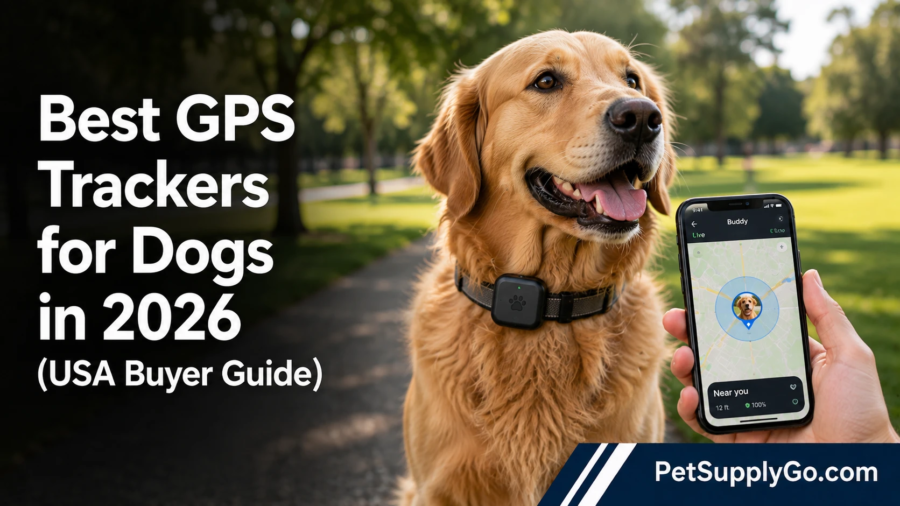
Best GPS Trackers for Dogs in 2026 (USA Buyer Guide)
Published on PetSupplyGo.com | Affiliate Disclosure: As an Amazon Associate we earn from qualifying purchases. This does not affect our recommendations.
Why a GPS Tracker Is One of the Most Practical Investments a Dog Owner Can Make
According to the ASPCA, approximately 10 million pets are lost in the United States every year. A significant portion of those pets are never recovered. Microchips help reunite dogs with their owners once the dog is found and taken to a shelter or veterinary clinic, but a microchip does not help you find the dog in the first place. It is a passive identification tool, not an active location tool. A GPS tracker fills that gap by providing real-time location data that allows you to find your dog immediately, whether they slipped out of a gate, bolted during a thunderstorm, or wandered off a hiking trail. The difference between searching for a lost dog for hours or days and opening an app to see their exact location within seconds is difficult to overstate for anyone who has experienced the panic of a missing dog.
GPS trackers for dogs have improved dramatically over the past several years. Early models were bulky, inaccurate, and had battery lives measured in hours. Current models are compact, lightweight enough for small dogs, accurate to within a few feet in good conditions, and capable of lasting days or even weeks between charges depending on usage. The technology has reached a point where the practical value of a GPS tracker far outweighs the cost for most dog owners, particularly those with dogs that spend time off-leash, in unfenced areas, or in locations where escape is possible.
This guide covers the seven best GPS trackers available in 2026 for dogs of all sizes, evaluated based on tracking accuracy, battery life, durability, subscription costs, and how well each device performs in real-world conditions rather than in idealized manufacturer testing scenarios.
Quick Answer: Best GPS Trackers for Dogs at a Glance
If you are short on time, here are the top picks based on the comparison factors used throughout this guide:
|
Pick |
Product |
Best For |
Price Range |
Our Rating |
|
Best Overall |
Tractive Dog 6 Smart Dog Tracker |
Most owners wanting reliable, accurate tracking |
$50 to $80 + sub |
9.4/10 |
|
Best Battery Life |
Fi Series 3 Dog GPS Collar |
Owners who hate frequent charging |
$100 to $150 + sub |
9.2/10 |
|
Best Compact |
Fi Mini Dog Tracker |
Small dogs under 25 pounds |
$80 to $120 + sub |
9.0/10 |
|
Best No Subscription |
JioBit Pet Tracker |
Owners who want to avoid monthly fees |
$130 to $180 |
8.7/10 |
|
Best for Hiking |
Garmin T5 GPS Dog Tracking Collar |
Off-grid, cellular-free tracking in remote areas |
$250 to $300 |
9.1/10 |
|
Best Budget |
PetFon Pet GPS Tracker |
Basic tracking at the lowest total cost |
$40 to $70 + sub |
8.6/10 |
|
Best Smart Features |
Whistle GO Explore Health + GPS Tracker |
Owners who want health monitoring alongside tracking |
$100 to $130 + sub |
9.0/10 |
Keep reading for the full breakdown of each pick, how GPS dog trackers actually work, and how to choose the right one for your dog and situation.
How GPS Dog Trackers Work and What Actually Matters
GPS dog trackers use a combination of satellite positioning and cellular connectivity to report your dog’s location to your phone. The tracker receives GPS signals from satellites to determine its position, then uses a cellular connection, typically LTE-M or a similar low-power network, to transmit that position data to a cloud server that your phone app accesses. This means the tracker needs both a clear view of the sky for GPS signals and cellular coverage for data transmission. In areas with good cellular service and open sky, most current trackers report location accurately to within 10 to 30 feet. In areas with poor cellular coverage, dense tree cover, or urban canyons with tall buildings, accuracy decreases and reporting may be delayed or intermittent.
Tracking Accuracy
Accuracy is the most important specification, because a tracker that reports your dog’s location with a 200-foot margin of error is significantly less useful than one that narrows it to 15 feet, particularly in suburban or urban environments where a 200-foot radius can encompass multiple streets, backyards, and properties. The best current trackers, including the Tractive Dog 6 and the Fi Series 3, achieve typical accuracy of 10 to 30 feet in good conditions. Accuracy degrades in areas with limited sky visibility, such as dense forests, heavy cloud cover, or urban environments with tall buildings. Some trackers use a combination of GPS, Wi-Fi, and cellular tower triangulation to improve accuracy in challenging environments, switching between methods depending on what signals are available.
Battery Life
Battery life varies enormously between GPS trackers, from a few hours to several weeks on a single charge. The primary factor is how frequently the tracker updates and transmits its location. Trackers that report location every few seconds drain the battery quickly, while those that update every few minutes or only when the dog moves outside a designated safe area conserve battery significantly. The Fi Series 3 is known for exceptional battery life of up to several weeks between charges in normal use, while some budget trackers need charging every one to three days. Consider your willingness to charge the device regularly when choosing a tracker. If you are someone who forgets to charge their phone, a long-battery-life tracker like the Fi is more practical than a feature-rich tracker that needs charging every two days.
Subscription Costs
Virtually all cellular GPS trackers require a monthly or annual subscription to maintain the cellular data connection that transmits location data to your phone. This is an ongoing cost that adds to the total price of ownership over time, and it varies significantly between products. Tractive subscriptions typically run $5 to $10 per month depending on the plan length. Fi subscriptions are similarly priced. The JioBit is one of the few options that does not require a monthly subscription for basic tracking, though it charges for premium features. When comparing trackers, calculate the total cost of ownership over two to three years, including the device price and the cumulative subscription cost, to get an accurate picture of which option is truly the most affordable.
Size and Weight for Your Dog
The tracker needs to be attached to your dog’s collar, which means its size and weight matter for your dog’s comfort and safety. For dogs under 15 pounds, a compact, lightweight tracker like the Fi Mini is essential, since a full-size tracker can be bulky and uncomfortable on a small dog’s neck. For dogs over 50 pounds, size is less of a concern, and full-size trackers are appropriate. The tracker should not be so heavy that it pulls the collar to one side or so large that it catches on objects during normal movement. Most manufacturers specify a minimum dog weight recommendation for their devices, and following these guidelines helps ensure the tracker is appropriate for your dog’s size.
The 7 Best GPS Trackers for Dogs in 2026
1. Tractive Dog 6 Smart Dog Tracker, Best Overall
The Tractive Dog 6 is the most consistently well-reviewed GPS tracker for dogs in 2026, offering reliable tracking accuracy, a solid app experience, and a reasonable subscription price. The tracker uses GPS, LTE-M cellular, and Wi-Fi positioning to maintain accurate location reporting in a variety of environments. The app provides real-time tracking, location history, and a virtual fence feature that alerts you when your dog leaves a designated area. The Dog 6 adds health monitoring features including activity tracking and temperature alerts that notify you if your dog is in an environment that is too hot or too cold. The tracker is lightweight at under an ounce, waterproof, and attaches to most standard collars. Battery life ranges from two to five days depending on usage and update frequency.
Pros:
- Reliable tracking accuracy of 10 to 30 feet in good conditions, with multiple positioning methods for challenging environments
- Virtual fence alerts, activity tracking, and temperature monitoring provide useful features beyond basic location
- Lightweight and waterproof design works for most dog sizes and weather conditions
Cons:
- Requires a monthly subscription of $5 to $10, which adds to the total cost of ownership over time
- Battery life of two to five days is adequate but not exceptional compared to the Fi Series 3
Best for: most dog owners wanting a reliable, feature-rich GPS tracker from a well-established brand.
2. Fi Series 3 Dog GPS Collar, Best Battery Life
The Fi Series 3 is built around a module that slides into a dedicated Fi collar, though it can also attach to most standard collars with an included adapter. The Series 3 stands out primarily for its battery life, which can extend to several weeks on a single charge with typical use, far exceeding most competitors. The tracker uses LTE-M cellular connectivity and GPS for location reporting, and the app provides real-time tracking, location history, and a social feature that shows nearby Fi users. The device is waterproof and the collar is available in multiple sizes and colors. Fi’s subscription is required for cellular tracking and is priced competitively with Tractive.
Pros:
- Exceptional battery life of up to several weeks between charges, significantly reducing the charging burden
- Clean, modern design with a dedicated collar option that integrates the tracker more smoothly than clip-on alternatives
- Social features show nearby Fi users, which can be useful for finding local dog parks and connecting with other owners
Cons:
- The dedicated Fi collar is an additional purchase if you prefer the integrated look, though an adapter for standard collars is included
- Tracking accuracy is good but slightly less consistent than the Tractive in environments with mixed GPS and cellular coverage
Best for: owners who prioritize long battery life and prefer less frequent charging routines.
3. Fi Mini Dog Tracker, Best Compact
The Fi Mini is a smaller, lighter version of the Fi Series 3 designed specifically for small dogs and cats under 25 pounds. It uses the same LTE-M cellular and GPS technology as the full-size Fi but in a form factor that is appropriate for the smaller necks and lighter weights of small breeds. The tracker attaches to collars as narrow as half an inch wide, which covers most small dog and cat collar sizes. Battery life is somewhat shorter than the full-size Fi at roughly one to two weeks, since the smaller battery capacity necessitates more frequent charging. The app features are the same as the full-size Fi, including real-time tracking, location history, and virtual fence alerts.
Pros:
- Compact, lightweight design fits comfortably on small dogs and cats without being bulky or pulling the collar
- Same reliable Fi tracking technology and app experience as the full-size Series 3
- Fits collars as narrow as half an inch, covering most small breed and cat collar sizes
Cons:
- Shorter battery life than the full-size Fi, requiring charging every one to two weeks
- Subscription required for full cellular tracking functionality
Best for: owners of small dogs under 25 pounds who need a GPS tracker scaled to their dog’s size.
4. JioBit Pet Tracker, Best No Subscription
The JioBit stands out in the GPS tracker market by offering location tracking without a mandatory monthly subscription, which is one of the most common complaints about GPS pet trackers. The device uses GPS, cellular, Wi-Fi, and Bluetooth to determine and report location, and the basic tracking plan is included with the device purchase. Premium features like extended location history and family sharing require a paid plan, but core tracking functionality, the ability to see your dog’s current location on a map in real time, is available without ongoing fees. The tracker is small, lightweight, and waterproof, and it attaches to most standard collars. Battery life is moderate at three to five days depending on usage.
Pros:
- No mandatory monthly subscription for basic tracking, a significant cost advantage over most competitors over time
- Multiple positioning technologies, GPS, cellular, Wi-Fi, and Bluetooth, provide redundancy for accuracy in different environments
- Small, lightweight, and waterproof design works for a wide range of dog sizes
Cons:
- Higher upfront device cost of $130 to $180 compared to subscription-based competitors
- Battery life of three to five days is moderate and not competitive with the Fi Series 3
Best for: owners who strongly prefer to avoid monthly subscription fees and are willing to pay more upfront.
5. Garmin T5 GPS Dog Tracking Collar, Best for Hiking
The Garmin T5 takes a fundamentally different approach from cellular GPS trackers. It uses a dedicated radio signal to communicate with a Garmin handheld device or compatible smartphone, rather than relying on cellular networks. This means it works in areas with no cellular coverage, including remote wilderness, dense forests, and mountainous terrain where cellular trackers lose signal. The T5 communicates with the handheld unit at ranges up to 9 miles in open terrain, with reduced range in areas with heavy tree cover or terrain obstacles. The collar is rugged, waterproof, and designed for the kind of harsh conditions encountered during hunting, hiking, and backcountry travel. The tradeoff is that the T5 requires a compatible Garmin handheld device, which is a separate purchase, and the system does not provide tracking through a standard smartphone app without the Garmin device as an intermediary.
Pros:
- No cellular network required, making it the only reliable option for tracking in remote, off-grid areas
- Communication range of up to 9 miles in open terrain far exceeds what cellular trackers can achieve
- Rugged, waterproof construction built for outdoor use in harsh conditions
Cons:
- Requires a compatible Garmin handheld device, adding $200 to $400 to the total system cost
- Cannot be tracked from a standard smartphone app without the Garmin handheld as an intermediary
Best for: hikers, hunters, and outdoor enthusiasts who need off-grid tracking in areas without cellular coverage.
6. PetFon Pet GPS Tracker, Best Budget
The PetFon Pet GPS Tracker provides basic real-time GPS tracking at one of the lowest device prices in the category. It uses GPS and cellular connectivity to report location to a smartphone app, with a typical accuracy range of 15 to 30 feet in good conditions. The tracker is small and lightweight, fitting on most standard collars, and it is water-resistant for light rain and splashes. The app provides real-time location, location history, and basic virtual fence alerts. Battery life ranges from one to three days depending on update frequency. The subscription is priced at roughly $4 to $8 per month, which is competitive with the major brands. The PetFon does not offer the advanced health monitoring, temperature alerts, or social features found in more expensive trackers, but it delivers the core function of GPS tracking reliably at a lower total cost.
Pros:
- Low device price makes it the most affordable entry point into GPS dog tracking
- Core tracking functionality is reliable with typical accuracy of 15 to 30 feet in good conditions
- Small, lightweight design works for a wide range of dog sizes
Cons:
- Battery life of one to three days is shorter than most competitors, requiring frequent charging
- Lacks advanced features like health monitoring, temperature alerts, and detailed activity tracking
Best for: owners on a budget who want reliable basic GPS tracking without paying for premium features they may not use.
7. Whistle GO Explore Health + GPS Tracker, Best Smart Features
The Whistle GO Explore combines GPS tracking with health monitoring features that go beyond what most trackers offer. In addition to real-time GPS location, the device tracks activity levels, rest patterns, scratching and licking behavior, and drinking habits. The app compiles this data into weekly health reports that can help owners identify changes in behavior that might indicate health issues. The GPS tracking uses cellular and Wi-Fi positioning for accuracy in various environments. The tracker is lightweight, waterproof, and attaches to most standard collars. Battery life is approximately seven days with typical use. The subscription is required for full functionality and is priced in line with Tractive and Fi at roughly $7 to $10 per month. Whistle is owned by Mars Petcare, which provides a level of corporate stability and support infrastructure that some smaller tracker companies cannot match.
Pros:
- Health monitoring features including activity, rest, scratching, and drinking tracking provide insights beyond basic location
- Weekly health reports can help identify behavioral changes that might indicate emerging health issues
- Backed by Mars Petcare, providing corporate stability and reliable customer support
Cons:
- Subscription required for full functionality, and the total cost over multiple years is significant
- Health monitoring features are informative but are not a substitute for veterinary care or diagnostic tools
Best for: owners who want both location tracking and health monitoring insights in a single device.
How to Choose the Right GPS Tracker for Your Dog
The two most important factors are where your dog spends time and how often you are willing to charge the tracker. A dog that spends most of its time in a fenced backyard and only needs tracking for occasional trips to the dog park has different requirements than a hunting dog that ranges miles from its owner in remote terrain.
For most suburban and urban dog owners, a cellular GPS tracker like the Tractive Dog 6 or the Fi Series 3 is the right choice. These trackers work well in areas with cellular coverage, which covers the vast majority of populated areas in the United States. Choose based on whether you prioritize battery life, the Fi excels here, or feature richness, the Tractive offers more health and environmental features. Both require a subscription, which is simply the cost of maintaining the cellular data connection that makes real-time tracking possible.
For small dogs, the Fi Mini or the JioBit provides a size-appropriate tracker that will not be bulky or uncomfortable on a small neck. For dogs that accompany you into remote areas without cellular coverage, the Garmin T5 is the only reliable option, though the total system cost is higher when you factor in the required Garmin handheld device.
If you strongly object to monthly subscriptions, the JioBit is the most practical option since basic tracking does not require a paid plan. Calculate the total cost of ownership over two to three years before deciding, since a tracker with a lower device price but a $10 monthly subscription can cost more over time than a more expensive device with no subscription requirement.
Common Mistakes When Choosing and Using a GPS Dog Tracker
- Not accounting for the subscription cost when comparing trackers. A $50 tracker with a $10 monthly subscription costs $290 over two years, while a $150 tracker with no subscription costs $150 total. Always calculate the total cost of ownership over the expected lifespan of the device before making a decision based on device price alone.
- Assuming GPS trackers work everywhere. Cellular GPS trackers require cellular coverage to transmit location data. If your dog escapes into an area with no cell service, the tracker may show the last known location but cannot provide real-time updates until the dog moves back into coverage. This is a fundamental limitation of cellular-based tracking, not a product defect.
- Not charging the tracker regularly. A GPS tracker with a dead battery is useless. Set a recurring calendar reminder or charge the tracker on a fixed schedule, such as every Sunday evening, to ensure it is always ready when you need it. Some apps send low-battery notifications, but relying on these alone is risky if you do not check the app regularly.
- Choosing a tracker that is too large for your dog. A tracker designed for a 70-pound dog can be bulky and uncomfortable on a 10-pound dog. Follow the manufacturer’s minimum weight recommendations and choose a compact tracker for small dogs. The Fi Mini and JioBit are specifically designed for smaller dogs.
- Relying on a GPS tracker as a substitute for a microchip, a collar tag, and a secure fence. A GPS tracker is a useful addition to your dog’s safety toolkit, but it should not replace a microchip, a collar with identification tags, and proper containment. Batteries die, cellular signals fail, and devices malfunction. Multiple layers of identification and containment provide the most robust safety net.
GPS Tracker vs. Bluetooth Tracker vs. Microchip: Understanding the Differences
Many dog owners confuse GPS trackers, Bluetooth trackers, and microchips, or assume they serve the same purpose. They do not, and understanding the differences is important for choosing the right safety tools for your dog.
A GPS tracker uses satellite positioning and cellular connectivity to provide real-time location data on a map that you can access from your phone. It tells you where your dog is right now, anywhere cellular coverage exists, with updates every few seconds to every few minutes depending on the device and settings. GPS trackers are the only option that provides active, real-time location tracking. They require battery power and, for cellular models, a subscription to maintain the data connection.
A Bluetooth tracker, such as an Apple AirTag attached to a dog’s collar, uses Bluetooth to communicate with nearby Apple devices. It does not provide real-time GPS tracking and cannot show you your dog’s location on a map from a distance. It relies on other Apple device users passing near your dog to relay location information, which works well in densely populated areas but is unreliable in rural or less populated locations. Bluetooth trackers are inexpensive and have no subscription fee, but they are not a substitute for a GPS tracker for active location monitoring.
A microchip is a passive RFID implant injected under the dog’s skin that contains a unique identification number. When a found dog is scanned at a shelter or veterinary clinic, the microchip number links to the owner’s contact information in a registry database. A microchip does not provide any location tracking capability. It is an identification tool, not a tracking tool. Every dog should be microchipped, and the microchip registration should be kept current with your current contact information. But a microchip only helps once someone has found your dog and taken them to be scanned. It does not help you find the dog in the first place.
The ideal safety setup for any dog includes all three: a GPS tracker for active real-time location monitoring, a microchip for permanent identification, and a collar with ID tags for immediate visual identification. Each tool addresses a different part of the lost dog problem, and relying on only one creates gaps in your safety net.
Real-World GPS Tracker Accuracy: What to Expect in Different Environments
GPS tracker accuracy varies significantly depending on the environment, and understanding these variations prevents frustration and helps you interpret the location data the tracker reports. The accuracy claims in product listings, typically 10 to 30 feet, apply to ideal conditions with clear sky visibility and strong cellular coverage. Real-world conditions are rarely ideal, and knowing what to expect helps you use the tracker effectively even when conditions are challenging.
In open areas like parks, fields, and suburban neighborhoods with good sky visibility, most current GPS trackers report location accurately to within 10 to 30 feet. This is accurate enough to identify which house, yard, or section of a park your dog is in. In dense urban environments with tall buildings, accuracy degrades to 50 to 100 feet or more due to GPS signal reflection off buildings, a phenomenon called multipath interference. The tracker may show your dog’s location as jumping between nearby positions, which can be confusing but is a known limitation of GPS in urban canyons.
In dense forests, accuracy degrades due to tree canopy blocking GPS signals. Heavy tree cover can reduce accuracy to 50 to 200 feet, and in some cases the tracker may report an older cached position rather than a current one if it cannot acquire a fresh GPS fix. In indoor environments, most GPS trackers cannot receive satellite signals at all and rely on Wi-Fi positioning or the last known outdoor location. If your dog is inside a building, the tracker will typically show the location where the dog was last outside or the location of the nearest Wi-Fi network the tracker detects.
Understanding these limitations helps you use the tracker more effectively. If your dog goes missing in a dense urban area, use the tracker to identify the general area and then search on foot rather than relying on the exact pinpoint location. If you live near a wooded area, test the tracker’s accuracy in the trees before you need it in an emergency so you know what to expect. And always keep in mind that any GPS tracker is a tool that helps you find your dog faster, not a guarantee of instant, pinpoint accuracy in every environment.
How We Evaluated These Products
Each GPS tracker in this guide was assessed against four core criteria based on verified owner feedback, manufacturer specifications, and independent testing results where available.
Tracking accuracy in real-world conditions was the primary criterion. Products were evaluated based on typical accuracy in suburban and urban environments, the reliability of location updates, and how well each tracker maintained accuracy in challenging conditions like dense tree cover or urban canyons. Trackers that consistently reported within 30 feet in good conditions and provided reasonable accuracy in challenging conditions scored highest.
Battery life was the second criterion, assessed based on manufacturer claims verified against aggregated owner reports. Trackers that consistently met or exceeded their stated battery life in real-world use scored higher than those where owners reported significantly shorter battery life than advertised. The availability of low-battery notifications and the charging method were also considered.
Total cost of ownership including subscriptions was the third criterion. The device price, subscription cost, and expected lifespan were combined to calculate a realistic total cost over two to three years. Products that offered the best balance of features and total cost scored highest. Trackers with no mandatory subscription received credit for the cost savings over time.
Durability and build quality was the final criterion, assessed through long-term owner reports of how each tracker held up to daily wear, exposure to water, mud, and the physical abuse that active dogs subject their collars and attached devices to. Trackers that failed after a few months of use scored lower than those that remained functional after a year or more of daily wear.
Frequently Asked Questions
Do GPS trackers for dogs require a monthly subscription?
Most cellular GPS trackers do require a monthly subscription to maintain the cellular data connection that transmits location data to your phone. Subscription prices typically range from $4 to $10 per month depending on the brand and plan length. The JioBit is a notable exception, offering basic tracking without a mandatory subscription. Off-grid trackers like the Garmin T5 do not require a cellular subscription but require a compatible Garmin handheld device, which is a separate purchase.
How accurate are GPS dog trackers really?
In good conditions with clear sky visibility and strong cellular coverage, the best current trackers achieve accuracy of 10 to 30 feet. In challenging environments like dense forests, urban canyons, or areas with poor cellular coverage, accuracy can degrade to 50 to 200 feet or more. The tracker provides your dog’s approximate location, not a pinpoint dot, and you should expect to do some searching on foot once the tracker gets you within the general area.
Can a GPS tracker replace a microchip?
No. A GPS tracker and a microchip serve different purposes. A GPS tracker provides active, real-time location monitoring that helps you find your dog. A microchip provides permanent identification that helps a shelter or vet contact you once your dog has been found. Every dog should have both. The GPS tracker helps you find the dog, and the microchip helps someone else return the dog to you if the tracker fails or the battery dies.
How long does a GPS tracker battery last?
Battery life ranges from one to three days for budget models like the PetFon, two to five days for the Tractive Dog 6, up to several weeks for the Fi Series 3 in typical use. Actual battery life depends on how frequently the tracker updates location, the strength of the cellular connection, and environmental factors like temperature. More frequent location updates drain the battery faster. Setting the tracker to update less frequently extends battery life but reduces the real-time responsiveness of the tracking.
Are GPS trackers safe for small dogs?
Yes, when appropriately sized. Compact trackers like the Fi Mini and the JioBit are designed specifically for small dogs and cats, weighing only a fraction of an ounce. Follow the manufacturer’s minimum weight recommendation, which is typically 8 to 10 pounds for the smallest trackers. A tracker that is too large or heavy for a small dog can cause neck discomfort and should be avoided. Check that the tracker fits comfortably on your dog’s collar without pulling it to one side or dangling loosely.
What happens if my dog goes into an area with no cell service?
The tracker will show the last known location before cellular coverage was lost. Once the dog moves back into an area with cellular coverage, the tracker will update the location. During the time the dog is out of coverage, you will not receive real-time updates. This is a fundamental limitation of cellular-based GPS tracking and applies to all cellular trackers, including the most expensive and feature-rich models. For off-grid tracking, the Garmin T5 uses radio communication instead of cellular and does not have this limitation, though it requires a separate Garmin handheld device.
Can I use an Apple AirTag instead of a GPS dog tracker?
An AirTag can be attached to a dog’s collar as a supplementary tracking tool, but it is not a substitute for a dedicated GPS tracker. AirTags use Bluetooth, not GPS, and rely on nearby Apple devices to relay location. They work well in densely populated areas where many Apple users pass by but are unreliable in rural or less populated areas. AirTags also do not provide real-time tracking updates the way a GPS tracker does. They are a useful backup but should not be your primary tool for active location monitoring of your dog.
Final Thoughts
A GPS tracker is one of the few purchases that can genuinely change the outcome of a worst-case scenario. The difference between searching for a lost dog for hours and opening an app to see their exact location is not a minor convenience. It is the difference between a happy reunion and, in some cases, a dog that is never found. The right tracker for your dog depends on their size, where they spend time, and how often you are willing to charge the device. For most owners, the Tractive Dog 6 or the Fi Series 3 provides the best combination of accuracy, features, and practical usability. For small dogs, the Fi Mini. For off-grid adventurers, the Garmin T5. Whatever you choose, make sure the tracker is charged, the subscription is active, and the device is actually attached to your dog’s collar before you need it. A GPS tracker in a drawer does not protect anyone.
At PetSupplyGo, this guide will be updated throughout 2026 as new GPS trackers and tracking technologies enter the market. Check back for updated comparisons as we continue evaluating new releases for USA dog owners looking for the most reliable way to keep track of their dogs.

RELATED ARTICLES

SPCA, Dog Shelters, GSD Breeders, Bullmastiff Dogs, and Dog Training: A U.S. Pet Owner’s Complete Guide
Introduction: Finding the Right Dog Starts With Good Information Bringing a dog into your home is a long-term decision involving ...

Puppy Training Schedule: A Week-by-Week Guide to Raising a Well-Behaved Dog
Buy on Amazon → Recommended by PetSupplyGo.com Bringing home a puppy is one of the happiest days of y ...