
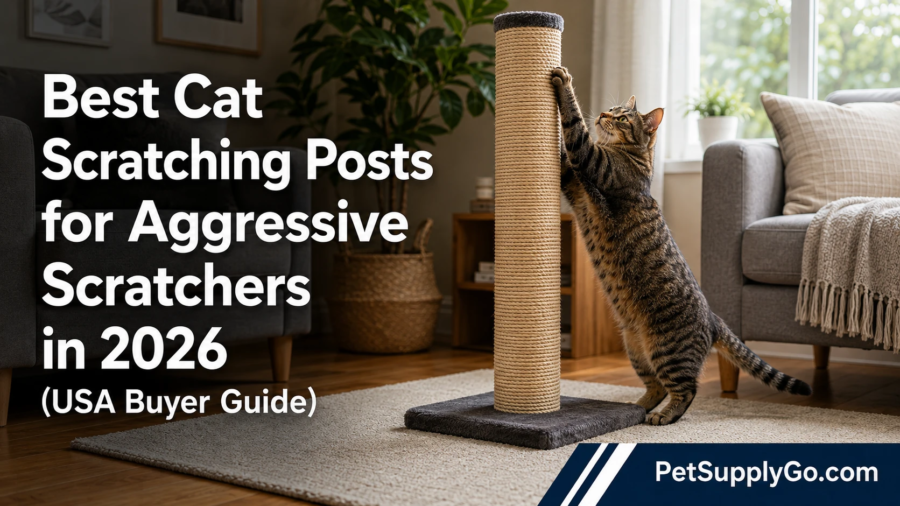
Best Cat Scratching Posts for Aggressive Scratchers in 2026 (USA Buyer Guide)
Published on PetSupplyGo.com | Affiliate Disclosure: As an Amazon Associate we earn from qualifying purchases. This does not affect our recommendations.
Why Aggressive Scratching Demands a Different Kind of Scratching Post
Scratching is a natural, necessary behavior for every cat. It stretches their muscles, removes the dead outer layers of their claws, marks territory through scent glands in their paws, and provides a visible signal to other cats. No amount of training or discipline will or should eliminate scratching entirely. What aggressive scratchers need is not to stop scratching but to redirect that scratching onto a surface that can handle the intensity and frequency without falling apart, tipping over, or becoming so unattractive that the cat abandons it for the sofa armrest.
The problem with most scratching posts on the market is that they are designed for the average cat. The average cat scratches occasionally, uses moderate pressure, and is content with a standard 24-inch post wrapped in thin sisal rope. An aggressive scratcher does not fit this profile. Aggressive scratchers pull hard, scratch frequently throughout the day, and often focus their energy on a single spot on the post until the material is shredded or the post itself is wobbling loose from its base. A post that lasts a casual scratcher two years may be destroyed by an aggressive scratcher in two months, and replacing posts that frequently gets expensive and frustrating.
This guide covers the seven best scratching posts and scratchers available in 2026 for cats that scratch with unusual intensity and frequency. Each pick was evaluated based on material durability under heavy use, structural stability during aggressive scratching sessions, overall height and dimensions, and verified feedback from owners of cats that have destroyed standard scratching posts in the past.
Quick Answer: Best Cat Scratching Posts at a Glance
If you are short on time, here are the top picks based on the comparison factors used throughout this guide:
|
Pick |
Product |
Best For |
Price Range |
Our Rating |
|
Best Overall |
SmartCat The Ultimate Scratching Post |
Most cats needing a durable tall post |
$50 to $70 |
9.3/10 |
|
Best Lounge Scratcher |
PetFusion 3-Sided Vertical Scratcher |
Cats that like to scratch and lounge |
$35 to $50 |
9.2/10 |
|
Best Budget |
Amazon Basics Sturdy Cat Scratching Post |
Affordable durability for one or two cats |
$20 to $30 |
8.8/10 |
|
Best Sisal Rope |
Petmate Fat Cat Kitty Scratching Post |
Cats that prefer sisal rope texture |
$30 to $45 |
8.9/10 |
|
Best Wall-Mounted |
Feline Nuvo Cat Scratching Wall Mount |
Saving floor space and aggressive horizontal scratchers |
$25 to $40 |
9.0/10 |
|
Best Cardboard |
EHEYCIGA Cat Scratcher Lounge |
Cats that love corrugated cardboard texture |
$20 to $35 |
8.7/10 |
|
Best for Large Cats |
Go Pet Club 62-Inch Cat Tree with Scratching Posts |
Large and multiple cats needing tall, sturdy posts |
$80 to $120 |
9.1/10 |
Keep reading for the full breakdown of each pick, what makes a scratching post hold up to aggressive use, and how to get your cat to actually use it instead of your furniture.
What Actually Makes a Scratching Post Hold Up to Aggressive Scratching
A scratching post that works for a casual scratcher often fails quickly under an aggressive scratcher. The differences that matter are specific and easy to identify once you know what to look for.
Material Durability
The scratching surface material is the single biggest factor in how long a post lasts under aggressive use. Sisal fabric is generally more durable than sisal rope for aggressive scratchers, because the fabric wraps the post in a continuous sheet that does not have individual strands that can be pulled loose and unraveled. Once a cat starts pulling at loose sisal rope strands, the damage accelerates quickly as the cat focuses on the already-damaged area. Sisal fabric resists this because there are no individual strands to grab. The SmartCat Ultimate Scratching Post uses sisal fabric specifically for this reason, and it is one of the reasons it holds up so well under heavy use. Corrugated cardboard scratchers, while popular and affordable, are the least durable option for aggressive scratchers. They work well for cats that scratch with moderate pressure, but an aggressive scratcher can shred a cardboard scratcher in days or even hours.
Post Height and Stability
Cats stretch their bodies fully when they scratch. A post that is too short does not allow a full vertical stretch, which means the cat either does not use it or uses it only partially while still scratching furniture for the full-body stretch they need. The generally recommended minimum height for a vertical scratching post is 32 inches, which allows most adult cats to extend fully and anchor their claws at the base while pulling upward. Posts shorter than 24 inches are better categorized as scratching pads or small scratchers, and they work best for kittens, small cats, or horizontal scratching preferences rather than as a primary scratching solution for an aggressive full-body scratcher.
Stability is equally important. A post that wobbles or tips when a cat pulls hard against it will be abandoned quickly, because cats rely on resistance to get a satisfying scratch. A heavy, wide base is essential for aggressive scratchers. Posts with bases less than 16 inches in diameter are at risk of tipping under the force of a large, determined cat pulling at full extension. The SmartCat Ultimate and the Go Pet Club cat tree both use heavy, wide bases that resist tipping even under aggressive use from large cats.
Vertical vs. Horizontal vs. Angled Orientation
Not all aggressive scratchers prefer vertical posts. Some cats prefer to scratch horizontally on carpet or flat surfaces, and others prefer an angled surface that lets them scratch at roughly 45 degrees. If your cat is currently scratching the carpet, the arms of a sofa, or the seat of a chair, they may prefer a horizontal or angled scratcher regardless of how nice the vertical post is. The PetFusion 3-Sided Scratcher works well for cats with mixed preferences because it offers both vertical and angled surfaces on the same unit. Wall-mounted scratchers also work well for horizontal scratchers, since they provide a flat vertical surface at the height the cat prefers, and they are completely stable because they are anchored to the wall rather than relying on a freestanding base.
The 7 Best Cat Scratching Posts for Aggressive Scratchers in 2026
1. SmartCat The Ultimate Scratching Post, Best Overall
The SmartCat Ultimate Scratching Post has been the most consistently recommended scratching post for aggressive scratchers for years, and its reputation is well earned. The post stands 32 inches tall, which accommodates a full vertical stretch for most adult cats. It is wrapped in fibrous sisal fabric rather than sisal rope, which resists the strand-by-strand unraveling that aggressive scratchers can inflict on rope-wrapped posts. The base is a heavy 16-inch by 16-inch wooden platform that resists tipping even when a large cat pulls hard at the top of the post. The construction is simple, with no dangling toys, platforms, or catnip additives, which keeps the focus entirely on providing a durable, stable scratching surface.
Pros:
- Sisal fabric wrapping resists unraveling far better than sisal rope under aggressive, repeated scratching
- Heavy 16-inch square wooden base prevents tipping even with large cats pulling at full extension
- Simple, no-frills construction focuses entirely on durability and function rather than decorative extras
Cons:
- Plain appearance may not appeal to owners looking for a scratcher that blends with home decor
- No horizontal or angled scratching surface for cats that prefer those orientations
Best for: most aggressive scratchers that prefer vertical scratching, particularly larger cats that need a tall, stable post.
2. PetFusion 3-Sided Vertical Scratcher, Best Lounge Scratcher
The PetFusion 3-Sided Scratcher is a corrugated cardboard scratcher that doubles as a lounge or bed for cats that like to rest on their scratchers. The three-sided design provides multiple scratching angles and orientations in a single unit, with two vertical sides and one angled side that cats can use at roughly 45 degrees. The corrugated cardboard is dense and tightly packed, which makes it significantly more durable than cheaper cardboard scratchers that shred quickly. The unit is wide enough for most cats to sit or lie on top of it between scratching sessions, which many cats do, and the weight of the unit provides reasonable stability without the need for a weighted base.
Pros:
- Three-sided design offers vertical and angled scratching surfaces in one unit, accommodating mixed scratching preferences
- Dense corrugated cardboard holds up better than standard cardboard under aggressive scratching
- Doubles as a lounge or bed, which increases the likelihood that the cat will spend time near and on the scratcher
Cons:
- Cardboard is inherently less durable than sisal or wood, and even dense cardboard will eventually shred under very aggressive scratchers
- Replacement cardboard inserts are an ongoing cost, though they are less expensive than replacing the entire unit
Best for: cats that enjoy corrugated cardboard texture and appreciate a scratcher they can also lounge on.
3. Amazon Basics Sturdy Cat Scratching Post, Best Budget
The Amazon Basics Scratching Post offers better durability than its price suggests. It stands 35.4 inches tall with a solid wood base and a jute and sisal rope-wrapped post that provides a satisfying texture for scratching. The base is wide enough to provide reasonable stability for most cats, though very large or very aggressive scratchers may test its limits. The simple construction means there are no weak points, no wobbly platforms, and no decorative elements that might be the first things to break. It is a straightforward, well-built post that focuses on providing a tall, stable scratching surface at an affordable price.
Pros:
- 4-inch height accommodates full vertical stretches for most cats, including larger breeds
- Solid wood construction provides better-than-expected durability at a budget price point
- Wide base offers reasonable stability for the price, suitable for most single-cat households
Cons:
- Sisal rope wrapping is less durable than sisal fabric under aggressive, sustained scratching over time
- Lighter weight than premium posts, meaning very large or strong cats may cause it to wobble during intense sessions
Best for: cat owners on a budget who need a reasonably tall, reasonably sturdy post without spending over $30.
4. Petmate Fat Cat Kitty Scratching Post, Best Sisal Rope
The Petmate Fat Cat Scratching Post uses a thick sisal rope wrapping over a sturdy internal post, with a wide base and a slightly eccentric design that includes a hanging toy for added engagement. The sisal rope is wound more densely than on many competing posts, which extends its useful life under aggressive scratching. The post height of approximately 30 inches accommodates most adult cats, and the weighted base provides stability that exceeds what the post’s appearance might suggest. The Fat Cat branding and design give it more personality than the average plain post, which some owners appreciate for aesthetic reasons.
Pros:
- Densely wound sisal rope provides a satisfying texture that most cats take to quickly
- Weighted base resists tipping better than most similarly priced posts
- Includes a hanging toy for added engagement, which can help attract cats to the post during initial introduction
Cons:
- Sisal rope will eventually show wear from aggressive scratching as individual strands loosen over time
- The 30-inch height is adequate but slightly shorter than the 32+ inches preferred by many large cats for full stretches
Best for: cats that prefer the texture of sisal rope and owners who want a post with a bit more personality than a plain wooden column.
5. Feline Nuvo Cat Scratching Wall Mount, Best Wall-Mounted
Wall-mounted scratchers solve the stability problem entirely by anchoring the scratching surface directly to the wall. The Feline Nuvo wall mount uses a modern, attractive design that looks more like wall art than a cat product, which matters to owners who want the scratcher in a visible living area. The scratching surface is woven sisal fabric that holds up well under aggressive use, and because the unit is anchored to the wall, it cannot tip, wobble, or slide regardless of how hard the cat scratches. Installation requires mounting hardware and a wall that can accept screws, which limits placement options but eliminates the stability concerns that affect all freestanding posts.
Pros:
- Wall-mounted design provides absolute stability that no freestanding post can match, regardless of the cat’s size or scratching intensity
- Attractive, modern appearance blends into home decor better than most freestanding scratchers
- Can be mounted at any height, allowing you to match the exact height your cat prefers for scratching
Cons:
- Requires drilling into walls, which is not possible or desirable for renters or owners of finished walls
- Only provides a vertical scratching surface, so cats that prefer horizontal or angled scratching may not use it
Best for: homeowners who can mount hardware on walls and want an attractive, rock-stable scratching solution.
6. EHEYCIGA Cat Scratcher Lounge, Best Cardboard
The EHEYCIGA Cat Scratcher Lounge is a two-pack of curved corrugated cardboard scratchers that double as resting surfaces. The curved shape provides both a concave and convex scratching angle, and the corrugated texture is appealing to cats that enjoy cardboard scratching. The two-pack pricing makes it an exceptionally affordable option, and the dense cardboard construction holds up reasonably well for the price. Each unit is large enough for most cats to sit or lie on, and the curved shape provides a sense of enclosure that many cats find appealing for napping.
Pros:
- Two-pack pricing makes this one of the most affordable scratching options available per unit
- Curved design provides two different scratching angles and doubles as a comfortable napping spot
- Dense corrugated cardboard construction provides reasonable durability at the budget price point
Cons:
- Cardboard will not withstand truly aggressive scratching for long, even with denser construction
- The curved shape can slide across smooth floors during vigorous scratching sessions
Best for: multi-cat households needing multiple affordable scratchers, and cats that gravitate toward corrugated cardboard texture.
7. Go Pet Club 62-Inch Cat Tree with Scratching Posts, Best for Large Cats
For owners of large cats or multi-cat households, a cat tree with integrated scratching posts provides both a climbing structure and multiple scratching surfaces in one unit. The Go Pet Club 62-inch cat tree includes multiple sisal rope-wrapped posts at varying heights, along with platforms and a condo for climbing and resting. The 62-inch height accommodates even the largest domestic cats for full vertical stretching, and the wide, heavy base provides stability for the entire structure. Multiple scratching surfaces mean less wear on any single post, which extends the overall useful life of the scratching surfaces. The tree is made from pressed wood and faux fur, with sisal rope on all scratching posts.
Pros:
- Multiple scratching posts at varying heights provide options for different scratching preferences and reduce wear on any single surface
- 62-inch height accommodates the largest domestic cats, including Maine Coons and Savannahs
- Combines scratching, climbing, and resting functions in one unit, making it a versatile enrichment investment
Cons:
- Large footprint requires significant floor space, which may not work in small apartments
- Sisal rope on the posts will show wear over time and is not easily replaceable without disassembling the tree
Best for: large cats, multi-cat households, and owners who want to combine scratching functionality with a climbing and enrichment structure.
How to Choose the Right Scratching Post for Your Cat
The two most important factors in choosing a scratching post that your cat will actually use are matching the post to your cat’s scratching orientation preference and placing the post where your cat already wants to scratch. A vertical post placed in a room where the cat never scratches, or a horizontal scratcher for a cat that only stretches vertically, will both fail regardless of how well built they are.
Observe your cat’s current scratching behavior before choosing a post. If they are scratching the arms of a sofa or the back of a chair, they prefer a vertical or near-vertical surface, and a tall post like the SmartCat Ultimate or the Amazon Basics is the right choice. If they are scratching carpet, area rugs, or the seats of upholstered furniture, they prefer a horizontal or low-angle surface, and the PetFusion 3-Sided Scratcher or a wall-mounted option may work better. If they scratch at a variety of angles, a multi-surface option like the PetFusion or a cat tree with posts at different heights covers more preferences in a single purchase.
Placement matters enormously. Cats scratch to mark territory, which means they prefer to scratch in high-traffic areas of the home where their mark is most visible and noticeable to other cats and humans. Placing a scratching post in a back corner or a little-used room reduces its appeal significantly. Position the post near the furniture the cat is currently scratching, in a common area like a living room or hallway, and make the post as or more appealing than the furniture by adding catnip, dangling a toy from it, or placing treats on or near it during the introduction period.
Common Mistakes When Choosing a Scratching Post for an Aggressive Scratcher
- Buying a post that is too short. A post under 30 inches does not allow most adult cats to perform a full vertical stretch, which means they will not use it for their primary scratching sessions and will continue targeting furniture for the full-body stretch they need. Always choose a post at least 32 inches tall for adult cats, and taller for large breeds.
- Placing the post in a location the cat does not frequent. Cats scratch in high-traffic, central areas of the home. A post placed in a spare bedroom, basement, or back corner will get little use regardless of its quality. Put the post where the cat already scratches, not where it would be most convenient for you.
- Not providing the right scratching orientation. If your cat scratches carpet horizontally, a vertical post will not redirect the behavior. Match the post orientation to the cat’s existing scratching angle. If you are unsure, a multi-surface option like the PetFusion or a cat tree with posts at different heights covers more bases.
- Punishing the cat for scratching furniture without providing an alternative. Cats do not scratch furniture out of spite or maliciousness. They scratch because it is a natural, necessary behavior. Punishing scratching without providing an acceptable alternative creates anxiety and often causes the cat to scratch more, not less, or to scratch in hidden areas where you cannot monitor the behavior.
- Replacing the post too infrequently. An aggressive scratcher can wear through sisal rope, shred cardboard, or flatten sisal fabric to the point where it no longer provides the resistance the cat needs for a satisfying scratch. Once the surface is visibly worn or compressed, it is time to replace it. A worn-out post is one of the most common reasons cats return to scratching furniture after initially using the post successfully.
Why Cats Scratch and How to Redirect the Behavior Long Term
Understanding why cats scratch makes it significantly easier to redirect the behavior onto acceptable surfaces. Cats scratch for four primary reasons, and each one can be addressed with a specific approach that works with the cat’s natural instincts rather than against them.
The first reason is claw maintenance. Scratching removes the dead outer layers of the claw, which sheds naturally and needs to be stripped away for the healthy new claw underneath to emerge. This is a physical need, not a behavioral choice, which is why declawed cats often develop behavioral problems related to the inability to perform this natural grooming action. Providing a textured surface that allows the claw to catch and pull is the most effective way to support this need. Sisal fabric, sisal rope, and corrugated cardboard all provide the right amount of resistance for effective claw shedding.
The second reason is stretching. Cats stretch their backs, shoulders, and legs by extending their bodies fully against a vertical or angled surface and pulling backward. This is why a post that is too short does not work. The cat needs enough height to extend fully, plant their claws, and pull backward with their body weight. A post that is 32 inches or taller provides this for most adult cats. For large breeds like Maine Coons, a post 48 inches or taller may be needed for a full stretch.
The third reason is scent marking. Cats have scent glands in their paws that deposit an olfactory mark when they scratch. This mark communicates their presence to other cats and reinforces their sense of territory. Scratching is more frequent in multi-cat households and in areas where the cat feels their territory is shared or contested. Providing multiple scratching posts in different locations gives the cat more marking opportunities without resorting to furniture. In multi-cat homes, having at least one scratching post per cat plus one extra reduces territorial scratching conflicts.
The fourth reason is visual marking. The physical damage left by scratching, shredded sisal, gouged cardboard, or scratched wood, serves as a visible territory marker. This is why cats often return to the same spot on a scratching post or piece of furniture. The visible damage attracts them back to the same location for subsequent scratching sessions. Allowing a scratching post to become visibly worn actually increases its appeal to the cat, which is the opposite of what most owners assume. A brand-new, pristine scratching post is often less appealing to a cat than one that shows signs of previous use.
Sisal Fabric vs. Sisal Rope vs. Cardboard: Which Material Lasts Longest
The three most common scratching post materials each have distinct advantages and limitations, and the right choice depends on how aggressively your cat scratches and what texture they prefer.
Sisal fabric is the most durable option for aggressive scratchers. It is made from the same agave plant fibers as sisal rope but is woven into a continuous fabric sheet rather than wound into individual strands. This means there are no loose strands for a cat to grab and unravel, and the fabric distributes scratching force across its surface rather than concentrating it on individual rope strands. A quality sisal fabric post like the SmartCat Ultimate can last aggressive scratchers one to three years before needing replacement, which is significantly longer than most sisal rope or cardboard options. The texture is slightly coarser than sisal rope, which most cats find satisfying, though a small percentage of cats seem to prefer the feel of rope.
Sisal rope is the most traditional scratching post material and provides a texture that many cats enjoy. The wound rope creates ridges and valleys that give cats multiple angles of resistance during scratching. The main limitation is that individual rope strands can loosen over time, particularly under aggressive scratching, and once a few strands start to pull free, the damage accelerates as the cat focuses on the already-damaged area. Well-made sisal rope posts with tightly wound, thick-gauge rope can last a year or more under moderate scratching but may need replacement every six to twelve months under truly aggressive use.
Corrugated cardboard is the most affordable and the least durable option. It is also the material that many cats find most immediately appealing, possibly because the corrugated texture creates a satisfying crunching sound and sensation during scratching. Dense, tightly packed cardboard scratchers like the PetFusion and EHEYCIGA options in this guide last longer than cheap, loosely packed cardboard, but even dense cardboard will eventually shred under aggressive scratching. Cardboard scratchers are best used as supplementary options alongside a more durable sisal post, giving the cat variety in texture and angle while the sisal post serves as the long-term primary scratching surface.
How We Evaluated These Products
Each scratching post in this guide was assessed against four core criteria based on verified owner feedback from owners of aggressive scratchers, manufacturer material specifications, and general guidance from cat behavior consultants.
Durability under aggressive scratching was the primary criterion. Products were evaluated based on how long they maintained usable scratching surface under daily, intense scratching from cats known to destroy standard posts. Sisal fabric posts generally scored highest, followed by dense sisal rope, with cardboard scoring lowest for longevity but highest for immediate cat appeal and affordability.
Stability during aggressive use was the second criterion. Posts that tipped, wobbled, or slid during forceful scratching scored lower, since cats quickly abandon unstable scratchers. Wall-mounted options scored highest for stability by definition, followed by posts with heavy, wide bases.
Height and size appropriateness was the third criterion. Posts under 30 inches were penalized for not accommodating full vertical stretches, and products offering multiple height options or multi-surface angles scored higher for versatility.
Value relative to price was the final criterion, evaluated on whether the product’s expected lifespan under aggressive use justified its cost. A $60 post that lasts two years represents better value than a $20 post that needs replacement every three months, and both scenarios are common in the aggressive scratcher category.
Frequently Asked Questions
How do I get my cat to use a scratching post instead of the furniture?
Place the post directly next to or in front of the furniture the cat is currently scratching. Sprinkle or rub catnip on the post. Dangle a toy from the top of the post to encourage the cat to reach for it with their paws. Praise the cat and offer a treat when they use the post. Never punish the cat for scratching the furniture, since this creates anxiety without addressing the underlying need. Once the cat is consistently using the post, gradually move it a few inches per day toward your preferred location, though keeping it in the same general area is usually better than moving it to a completely different room.
How tall should a scratching post be for a large cat?
For a large adult cat over 12 pounds, or for breeds like Maine Coons and Ragdolls that have long bodies, a scratching post should be at least 36 inches tall and ideally 48 inches or taller. The post needs to be tall enough for the cat to extend fully, plant their claws near the base, and pull backward with their entire body weight. A post that is too short forces the cat to hunch or scratch at an awkward angle, which reduces both the effectiveness of the scratch and the cat’s willingness to use the post.
Can I repair a scratching post instead of replacing it?
For sisal rope posts, you can rewrap the post with new sisal rope purchased from a hardware or craft store. This is a moderately time-consuming DIY project but costs significantly less than buying a new post. For sisal fabric posts, some owners have success stapling or gluing new sisal fabric over the worn area. For cardboard scratchers, replacement is the only practical option, since shredded cardboard cannot be repaired effectively. Many cardboard scratchers, including the PetFusion, offer replacement cardboard inserts that are less expensive than buying an entirely new unit.
Do cats prefer vertical or horizontal scratching posts?
It varies by individual cat. Some cats strongly prefer vertical posts, others prefer horizontal surfaces, and many will use both if both are available. The best way to determine your cat’s preference is to observe where and how they currently scratch. Scratching on carpet, rugs, or flat upholstery suggests a horizontal preference. Scratching on chair arms, door frames, or drapes suggests a vertical preference. If you are unsure, a multi-surface option like the PetFusion 3-Sided Scratcher or a cat tree with posts at different heights gives your cat the ability to choose.
How many scratching posts does a multi-cat household need?
The generally recommended guideline is one scratching post per cat plus one extra. So a two-cat household should have at least three scratching posts in different locations. Cats in multi-cat households scratch more frequently for territorial marking purposes, and having multiple posts reduces competition and conflict over a single scratching location. Place at least one post in each major living area the cats use regularly.
Is it normal for my cat to destroy a scratching post quickly?
For an aggressive scratcher, yes, it is normal. Some cats scratch with significantly more force and frequency than others, and a post that lasts a casual scratcher a year or more may be shredded by an aggressive scratcher in weeks. If your cat consistently destroys posts faster than expected, focus on the most durable options available, particularly sisal fabric posts like the SmartCat Ultimate, and consider keeping a backup post ready before the current one is fully worn out. A post that is completely worn and provides no resistance is one of the most common triggers for a cat returning to furniture.
Should I trim my cat’s claws to reduce scratching damage?
Regular claw trimming reduces the sharpness of the claws and the damage they cause, but it does not eliminate the scratching behavior or the cat’s need to scratch. Trim the sharp tip of each claw every two to three weeks using cat-specific clippers. Avoid cutting into the pink part of the claw, which contains blood vessels and nerves. Claw trimming is a reasonable complement to providing appropriate scratching surfaces, and it reduces the damage to both scratching posts and furniture while still allowing the cat to perform their natural scratching behavior.
Final Thoughts
An aggressive scratcher does not need a different approach to scratching management, they need a better-built scratching post. The right post for an aggressive scratcher is taller, more stable, and made from more durable material than what works for a casual scratcher. Sisal fabric posts, wall-mounted options, and cat trees with multiple scratching surfaces all provide the durability and resistance that aggressive scratchers need to stay engaged and satisfied. Match the post to your cat’s preferred scratching angle, place it where they already want to scratch, and replace the surface when it wears out rather than waiting for the cat to abandon it entirely.
At PetSupplyGo, this guide will be updated throughout 2026 as new scratching posts and materials enter the market. Check back for updated comparisons as we continue testing new releases for USA cat owners dealing with cats that destroy standard scratching posts.

RELATED ARTICLES

Puppy Training Schedule: A Week-by-Week Guide to Raising a Well-Behaved Dog
Buy on Amazon → Recommended by PetSupplyGo.com Bringing home a puppy is one of the happiest days of y ...
Dog Poop Color Chart: What Healthy and Unhealthy Dog Poop Looks Like, and How to Clean It Up
Buy on Amazon → Recommended by PetSupplyGo.com It is not glamorous, but every dog owner does it. Your d ...