
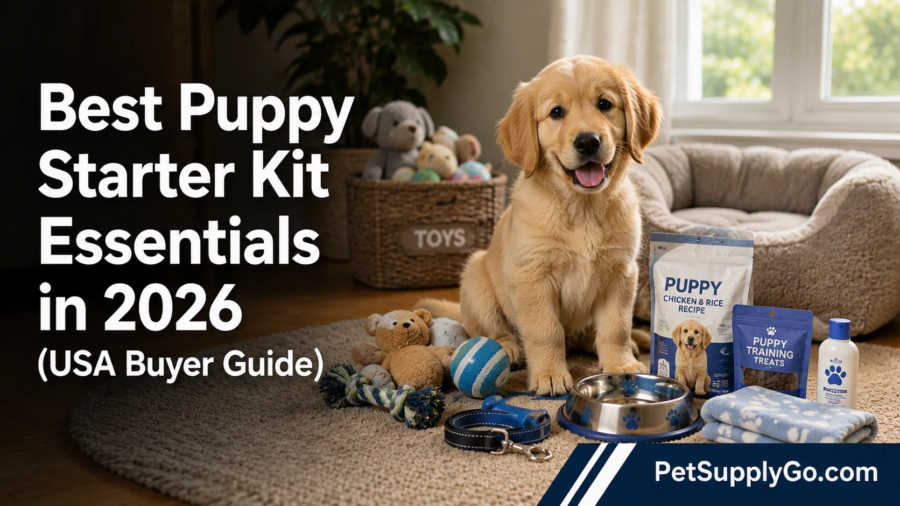
Best Puppy Starter Kit Essentials in 2026 (USA Buyer Guide)
Published on PetSupplyGo.com | Affiliate Disclosure: As an Amazon Associate we earn from qualifying purchases. This does not affect our recommendations.
Why a Thoughtful Starter Kit Makes the First Weeks Easier for Everyone
Bringing a new puppy home is one of the most exciting experiences a dog owner can have. It is also one of the most chaotic. Puppies are unpredictable, energetic, messy, and prone to chewing, biting, and eliminating in places you did not anticipate, often within the first hour of arrival. The difference between a relatively smooth first week and a stressful, exhausting one comes down largely to preparation. Having the right supplies on hand before the puppy walks through the door means you can respond to their needs in the moment rather than scrambling to order something and waiting two days for delivery while your baseboards, shoes, and rugs take the damage.
A puppy starter kit is not about buying every dog product on the market. It is about having the specific, practical items that address a puppy’s most immediate needs in their first few weeks at home. Potty training, chewing management, safe confinement, basic grooming, feeding, and early training are the core categories that matter in the first month. Everything else is secondary and can be purchased later as the puppy grows and their specific needs become clearer.
This guide covers the seven essential categories every new puppy owner needs, with specific product recommendations for each. Rather than listing dozens of individual items, we focus on the products that genuinely matter most in those critical first weeks, based on feedback from trainers, veterinarians, and thousands of verified owner reviews from people who have been through the new puppy experience recently.
Quick Answer: Best Puppy Starter Kit Essentials at a Glance
If you are short on time, here are the top product picks across each essential category:
|
Category |
Product |
Best For |
Price Range |
Our Rating |
|
Best Crate |
MidWest LifeStages Double Door Crate with Divider |
Growing puppies needing adjustable space |
$45 to $80 |
9.2/10 |
|
Best Chew Toys |
KONG Puppy Toy |
Teething puppies that need safe chewing |
$12 to $18 |
9.4/10 |
|
Best Training Treats |
Zuke’s Mini Naturals Training Treats |
Positive reinforcement training sessions |
$8 to $14 |
9.1/10 |
|
Best Food and Water Bowls |
Amazon Basics Stainless Steel Dog Bowl Set |
Durable, hygienic, affordable bowls |
$10 to $18 |
8.9/10 |
|
Best Potty Training |
Nature’s Miracle Advanced Stain and Odor Remover |
Enzyme-based accident cleanup |
$15 to $25 |
9.3/10 |
|
Best Collar and Leash |
Ruffwear Front Range Harness and Leash Set |
Comfortable, adjustable early training |
$45 to $65 |
9.0/10 |
|
Best Grooming Basics |
FURminator deShedding Tool for Puppies |
Managing early coat care and shedding |
$20 to $35 |
8.8/10 |
Keep reading for the full breakdown of each essential category, what to look for in each product type, and how to prioritize if your budget is limited.
Essential 1: A Crate with an Adjustable Divider
A crate is the single most important tool in a new puppy owner’s toolkit. It provides a safe, contained space for the puppy when you cannot directly supervise them, it accelerates potty training by leveraging the puppy’s natural reluctance to soil their sleeping area, and it gives the puppy a secure, den-like space to rest. The crate you choose for a puppy is different from the crate you would buy for an adult dog, because the puppy will grow significantly in their first six to twelve months and the crate needs to accommodate that growth without requiring multiple purchases.
The MidWest LifeStages Double Door Crate with Divider is the most practical choice for a new puppy for several reasons. The adjustable divider panel allows you to reduce the usable interior space to match the puppy’s current size, which is critical for potty training. A crate that is too large gives the puppy enough room to eliminate in one corner and sleep in another, which completely undermines the crate’s effectiveness as a potty training tool. As the puppy grows, you move the divider back to increase the usable space, avoiding the need to buy progressively larger crates. The double-door design allows flexible placement in different rooms, and the crate folds flat for storage or transport once the puppy is fully grown and house trained. The wire construction is lightweight and easy to clean, and replacement divider panels are available separately if the original is lost or damaged.
Pros:
- Adjustable divider grows with the puppy, eliminating the need to buy multiple crates during the growth period
- Double-door design offers flexible placement options in different rooms and configurations
- Affordable price at $45 to $80, with a long track record of reliability and widespread availability
Cons:
- Standard wire construction is not designed for strong adult escape attempts, so a particularly determined dog may eventually need an upgrade
- The wire floor can be noisy and uncomfortable without a crate pad or blanket, which is a separate purchase
Essential 2: Safe Chew Toys for Teething
Puppies chew. This is not a behavior that needs to be corrected or redirected in the traditional sense. Puppies explore the world with their mouths, and during the teething phase, which typically runs from about 3 to 7 months of age, chewing provides relief from the discomfort of incoming adult teeth. Without appropriate chew outlets, a puppy will find their own, which usually means your furniture, shoes, baseboards, electrical cords, and anything else within reach.
The KONG Puppy Toy is the most widely recommended chew toy for new puppies, and it has earned that reputation through decades of consistent performance. The KONG Puppy is made from a proprietary rubber formula that is softer and more forgiving than the adult KONG, which is important for young puppies whose teeth and jaws are still developing. The hollow interior can be stuffed with kibble, peanut butter, wet food, or KONG’s own Easy Treat paste, then frozen for an extended chewing challenge. Freezing a stuffed KONG turns a five-minute chewing session into a 30-minute engagement, which is invaluable during the early weeks when the puppy needs constant redirection from inappropriate chewing. The KONG Puppy is available in small, medium, and large sizes, and the rubber is durable enough to withstand months of daily chewing while still being soft enough not to damage developing teeth.
Pros:
- Soft, puppy-specific rubber formula is gentle on developing teeth while still being durable enough for daily chewing
- Hollow interior can be stuffed and frozen, providing extended mental engagement during teething and crate time
- Available in multiple sizes, so you can start with the appropriate size and size up as the puppy grows
Cons:
- The soft rubber is not indestructible, and determined chewers may eventually tear pieces off if left unsupervised
- Requires regular cleaning, particularly when stuffed with soft foods, to prevent mold and bacteria buildup inside the cavity
Essential 3: Training Treats
Positive reinforcement training is the most effective and widely recommended approach to teaching a new puppy basic manners, and training treats are the currency that makes it work. Puppies learn fastest when they are motivated by small, high-value rewards delivered immediately after the desired behavior. The right training treat is small, soft, aromatic, and something the puppy is willing to work for. Large, hard treats take too long to chew and break the training rhythm. Low-value treats like dry kibble work for some puppies in low-distraction environments but lose their motivational power quickly when distractions increase.
Zuke’s Mini Naturals Training Treats are the most practical choice for new puppy owners for several reasons. The treats are small, soft, and consistently shaped, which makes them easy to break in half for very young puppies or for extended training sessions where you want to avoid overfeeding. They come in multiple protein flavors including chicken, salmon, and peanut butter, so you can find a flavor your individual puppy finds most motivating. The ingredients list is relatively clean compared to many training treats, with real meat as the first ingredient and no artificial colors or flavors. The treats are soft enough for young puppies to chew easily but firm enough to carry in a pocket or treat pouch without crumbling into a mess.
Pros:
- Small, soft, and easy to break in half for young puppies or extended training sessions without overfeeding
- Multiple protein flavors allow you to find the specific flavor your puppy finds most motivating
- Pocket-friendly consistency that does not crumble or leave greasy residue in a treat pouch
Cons:
- Not suitable as a long-lasting chew or crate-stuffing treat, since puppies consume them in seconds
- Some puppies may lose interest in the treats over time as they become accustomed to the flavor
Essential 4: Stainless Steel Food and Water Bowls
Food and water bowls are one of the simplest items on a puppy supply list, but the material choice matters more than most new owners expect. Plastic bowls are cheap and colorful but develop scratches over time that can harbor bacteria, and some puppies develop allergic reactions or chin acne from prolonged contact with plastic surfaces. Ceramic bowls are heavier and more stable but can chip or crack if dropped, and the glaze can wear over time. Stainless steel is the most practical material for puppy bowls because it is hygienic, scratch-resistant, easy to clean, lightweight enough for a puppy to move if needed but heavy enough to resist tipping during eager eating.
The Amazon Basics Stainless Steel Dog Bowl Set provides two bowls at an affordable price, typically under $18 for a set that includes one food bowl and one water bowl. The bowls are made from standard food-grade stainless steel with a rubberized non-slip base that keeps them from sliding across the floor during enthusiastic eating. They are dishwasher safe and available in multiple sizes, so you can start with a smaller set for an 8-week-old puppy and size up as the puppy grows. The simple, no-frills design means there are no crevices or decorative elements that trap food or bacteria, making cleaning straightforward.
Pros:
- Stainless steel is the most hygienic bowl material, resisting bacterial buildup and allergic reactions
- Rubberized non-slip base keeps bowls in place during eager eating by puppies
- Dishwasher safe and available in multiple sizes to grow with the puppy
Cons:
- No lid or cover, so these are for indoor use only and are not suitable for travel or car feeding
- The rubber base can separate from the steel bowl over time with repeated dishwasher cleaning
Essential 5: Enzyme-Based Accident Cleaner
Potty accidents are a guaranteed part of bringing a puppy home. The question is not whether they will happen but how quickly and effectively you clean them. Standard household cleaners, even those marketed as pet-safe, often mask the odor of urine or feces to the human nose but leave enough residual scent for the puppy’s far more sensitive nose to detect. When a puppy can smell a previous accident location, they are significantly more likely to eliminate there again, creating a cycle of repeated accidents in the same spot. Enzyme-based cleaners break down the organic compounds in urine and feces at a molecular level, eliminating the odor completely rather than just covering it up.
Nature’s Miracle Advanced Stain and Odor Remover is the most widely used enzyme cleaner for puppy potty training, and it has maintained this position for years because it works consistently. The formula uses natural enzymes and bacteria that break down the organic compounds in urine, feces, vomit, and other biological messes. It is safe for most carpets, upholstery, and hard floors when used as directed. The product is available in multiple sizes, and buying the gallon size is more cost-effective for new puppy owners who will be using it frequently during the first few months. The key to effectiveness is allowing the enzyme solution to remain on the affected area for the recommended contact time, usually 10 to 15 minutes, before blotting or wiping. This gives the enzymes time to break down the odor compounds at a molecular level.
Pros:
- Enzyme-based formula breaks down odor compounds at a molecular level, preventing repeat accidents in the same location
- Safe for most carpets, upholstery, and hard floors when used as directed
- Available in bulk gallon sizes that are more cost-effective for the heavy use during early potty training
Cons:
- Requires proper application technique, including adequate contact time, to work effectively. Simply spraying and wiping does not give the enzymes enough time to work.
- May not remove set-in stains that have been untreated for days or weeks, though the odor elimination usually still works
Essential 6: A Harness and Leash for Early Training
A collar and leash are essential from day one, but for puppy training specifically, a harness is generally a better choice than a collar for walking. Puppies have delicate necks and developing tracheas, and pulling on a collar during early leash training can cause coughing, discomfort, and in some cases contribute to long-term tracheal damage. A harness distributes pressure across the chest and shoulders rather than concentrating it on the neck, which is safer and more comfortable for a young, untrained puppy that does not yet know how to walk on a loose leash.
The Ruffwear Front Range Harness is a well-built, adjustable harness that fits puppies as small as 10 pounds and adjusts through several size points, making it a practical choice for a growing puppy. The harness has four points of adjustment, which means you can fine-tune the fit as the puppy grows rather than replacing the entire harness every few weeks. It includes both a back clip and a front clip, with the front clip useful for discouraging pulling during early leash training by redirecting the puppy’s forward motion to the side when they pull. The construction quality is excellent, with padded straps and strong attachment points that hold up to the kind of chewing and pulling that puppies subject their gear to during the training process.
Pros:
- Four points of adjustment allow the harness to grow with the puppy over several months of use
- Front and back clip options provide flexibility for different training situations and pulling management
- Well-padded straps and strong construction that holds up to puppy chewing and pulling
Cons:
- Higher price point than basic nylon harnesses, which may feel like a significant investment for a fast-growing puppy
- Some puppies initially resist having a harness put on and may need gradual desensitization before accepting it
Essential 7: Basic Grooming Supplies
Even young puppies benefit from early grooming routines, not because they need extensive coat maintenance at 8 weeks old, but because getting them used to being brushed, handled, and examined makes veterinary visits, nail trims, and adult grooming significantly easier later. A puppy that has been handled regularly from a young age tolerates grooming, nail trims, and physical examination with far less stress than a dog that was never handled in this way during the critical socialization period.
The FURminator deShedding Tool for Puppies is specifically designed for young dogs with developing coats. Unlike the adult FURminator, which uses a more aggressive edge for removing dense undercoat, the puppy version has a gentler edge that is safe for a puppy’s thinner, more delicate coat. It still removes loose fur effectively, which reduces shedding around the house and starts building the puppy’s tolerance for being brushed. The tool is available in small and medium sizes to match the puppy’s body size. Pair it with a basic soft-bristle brush for daily gentle brushing sessions, and a pair of nail clippers designed for puppies, which have smaller, more precise cutting edges than adult clippers.
Pros:
- Gentle edge designed specifically for puppies is safe for developing coats while still removing loose fur
- Early grooming with a deshedding tool builds the puppy’s tolerance for being handled and brushed
- Reduces shedding around the house from the earliest age, establishing good grooming habits before the adult coat comes in
Cons:
- Should be used no more than once or twice per week on puppies, since overuse can irritate the skin
- Not a substitute for a soft-bristle brush for daily gentle grooming sessions during the socialization period
How to Prioritize If Your Budget Is Limited
New puppy owners can easily spend $300 or more on supplies in the first week if they buy everything at once. For owners on a tighter budget, prioritizing the essentials in order of immediate importance helps ensure the most critical items are covered first without overspending on things that can wait.
The crate is the single most important purchase. It serves as a potty training tool, a safe confinement space, and a management tool that prevents destructive behavior when you cannot supervise the puppy directly. A crate with a divider panel, like the MidWest LifeStages, costs $45 to $80 and serves the puppy from 8 weeks through adulthood. This is the one item where spending a bit more for quality pays off immediately in reduced stress and faster potty training progress.
The second priority is chew toys, specifically the KONG Puppy, because a teething puppy without appropriate chew outlets will find their own, and the cost of replacing chewed furniture, shoes, and household items quickly exceeds the cost of a $15 chew toy. The third priority is enzyme cleaner, because without it, potty accidents create lingering scent markers that cause repeated accidents in the same location, extending the potty training timeline and increasing frustration for both you and the puppy.
Training treats, bowls, a harness and leash, and grooming supplies can follow in whatever order makes the most sense for your situation. All are genuinely useful, but they are less time-sensitive than the crate, chew toys, and cleaner, which address the most urgent problems a new puppy creates in the first 48 hours of arrival.
Common Mistakes New Puppy Owners Make When Buying Supplies
- Buying a crate sized for the puppy’s current weight without a divider. A crate that fits an 8-week-old 10-pound puppy perfectly will be too small within a few weeks. Always buy for the expected adult size and use a divider to adjust the usable space as the puppy grows. This is more cost-effective and less disruptive than buying two or three progressively larger crates.
- Waiting until after the puppy arrives to order essentials. Shipping delays mean you may be without critical supplies for days, during which time the puppy is unsupervised, uncrated, or eliminating on carpets without proper cleaner to treat the area. Have the crate, chew toys, bowls, cleaner, and harness ready before the puppy comes home.
- Buying too many toys at once. A new puppy does not need twenty toys. They need two or three safe, appropriate chew toys and the supervision to redirect inappropriate chewing toward them. A pile of toys is overwhelming for a young puppy, and rotating two or three toys in and out of use keeps each one feeling novel and engaging.
- Choosing bowls, collars, or beds based on appearance rather than function. A puppy will chew a decorative collar, destroy a cute fabric bed, and knock over a lightweight ceramic bowl within the first week. Choose supplies based on durability and safety for the puppy’s current life stage, not on how they look in your home.
- Skipping the enzyme cleaner and using household products instead. Standard cleaners, even those labeled natural or pet-safe, often do not break down the organic compounds in urine at a molecular level. The puppy can still smell the accident location and will return to it. An enzyme cleaner is a non-negotiable supply for potty training, and the cost is minimal compared to the frustration of recurring accidents.
Puppy-Proofing Your Home: What the Starter Kit Does Not Cover
Having the right supplies is important, but supplies alone do not create a safe environment for a new puppy. Puppy-proofing your home before the puppy arrives is equally critical and often overlooked by first-time owners who focus entirely on shopping lists and forget about the physical environment the puppy will be exploring from the moment they arrive.
Start by getting down on your hands and knees and looking at each room from the puppy’s perspective. Everything within three feet of the floor is fair game for investigation, chewing, and elimination. Electrical cords should be covered with cord protectors or routed behind furniture. Shoes, socks, children’s toys, and any small objects that could be swallowed should be stored in closed closets or on high shelves. Trash cans should have lids or be inside cabinets. Cleaning supplies, medications, and any toxic substances should be in cabinets the puppy cannot open. Houseplants should be checked against ASPCA toxicity lists and moved out of reach if they are hazardous to dogs.
Baby gates are an invaluable tool for managing the puppy’s access to different areas of the home during the early weeks. A baby gate at the entrance to a puppy-safe room, typically a kitchen or family room with easy-to-clean floors, allows the puppy supervised freedom in a contained space while keeping them away from areas that are difficult or impossible to puppy-proof completely. As the puppy matures and learns house rules, you can gradually expand their access to additional areas of the home.
Outdoor spaces need puppy-proofing too if you have a yard. Fences should be checked for gaps or low spots a small puppy could squeeze through. Toxic plants, fertilizers, pesticides, and any standing water should be addressed before the puppy has outdoor access. Even a small amount of standing water can carry parasites or bacteria that a puppy’s immature immune system is not yet equipped to handle. A fenced yard is not a substitute for supervision during the early weeks, since puppies can find ways into trouble that adult dogs would simply ignore.
The First Week with a New Puppy: A Realistic Schedule
Understanding what the first week with a new puppy actually looks like helps set realistic expectations and reduces the frustration that comes from expecting more progress, more sleep, and more cooperation than an 8-week-old puppy is capable of providing. Puppies this young are babies. They sleep 18 to 20 hours per day, need to eat three to four times per day, need to eliminate every one to two hours while awake, and have essentially zero impulse control. Managing this schedule is the primary challenge of the first week.
A realistic first week schedule looks something like this. The puppy wakes up, goes outside immediately to eliminate, comes back in for breakfast in their bowl, has a brief play or training session, then goes back in the crate for a nap. This cycle repeats every two to three hours throughout the day. Nighttime involves at least one, often two or three, trips outside for elimination. The crate is essential during this period because it provides a safe, contained space for the puppy’s frequent naps and prevents destructive behavior or accidents during the times you cannot have eyes directly on the puppy.
Potty training progress during the first week is measured in small increments. A puppy that has three accidents on day one and two accidents by day five is making genuine progress, even though the accidents have not stopped entirely. Consistent timing for outdoor trips, immediately after waking, after eating, after playing, and before bedtime, combined with generous praise and a treat for every successful outdoor elimination, produces the fastest results. Punishing accidents does not speed up potty training and often slows it down by making the puppy afraid to eliminate in front of you, which means they hide to do it instead.
Sleep during the first week is limited for both the puppy and the owner. Puppies cry, whine, and bark during the first few nights in a new home, which is normal separation distress, not a sign that something is wrong. A crate in your bedroom, where the puppy can see and smell you, often reduces nighttime distress compared to a crate in a separate room. Some owners have success with a ticking clock wrapped in a blanket near the crate, which simulates the mother’s heartbeat, or a warm water bottle wrapped in a towel, which provides warmth. These comfort measures help some puppies settle faster, though they are not universally effective.
How We Selected These Products
Each product in this guide was selected based on four criteria, drawing on verified owner feedback from new puppy owners specifically, veterinarian recommendations for puppy-safe products, and general guidance from professional dog trainers who work with new puppy families regularly.
Safety for puppies was the primary criterion. Puppies chew, lick, and mouth everything they encounter, which means materials, construction, and size appropriateness matter more for puppies than for adult dogs. Products with small parts that could be swallowed, materials that could splinter or break into sharp pieces, or coatings that could be toxic if ingested were excluded regardless of their popularity or review count for adult dogs.
Value and longevity were the second criterion, evaluated based on how long the product remains useful as the puppy grows. A crate with a divider, for example, lasts from 8 weeks through adulthood, while a collar or harness sized for a 10-pound puppy will be outgrown within a few months. Products that grow with the puppy or that offer the longest useful window for the investment scored highest.
Practical effectiveness for the specific first-week needs was the third criterion. Products were evaluated on whether they genuinely address the most urgent problems a new puppy creates in the first days at home, including potty accidents, destructive chewing, and the need for safe confinement. Products that solve real, immediate problems scored higher than products that are nice to have but not critical during the first week.
Verified owner feedback from recent puppy owners was the fourth criterion, assessed through Amazon reviews filtered for reviews specifically mentioning use with puppies. Products with consistent, recent positive feedback from puppy owners scored higher than products with high ratings from adult dog owners but fewer reviews mentioning puppy-specific use.
Frequently Asked Questions
What do I actually need before bringing a puppy home?
At minimum, you need a crate with a divider, safe chew toys, food appropriate for the puppy’s age, a collar with an ID tag, a leash, food and water bowls, and an enzyme-based cleaner for potty accidents. These items cover the most urgent needs: safe confinement, chewing management, feeding, identification, and accident cleanup. Everything else, including beds, grooming tools, treats, and toys beyond the first two or three, can be purchased in the days and weeks after the puppy arrives.
How much does a puppy starter kit cost?
A basic starter kit covering the essentials listed in this guide costs between $100 and $200 depending on brand choices and sizes. This includes a crate ($45 to $80), chew toys ($15 to $25), training treats ($8 to $14), bowls ($10 to $18), enzyme cleaner ($15 to $25), a harness and leash ($45 to $65), and basic grooming supplies ($20 to $35). Some items can be purchased more affordably in sets or bundles, and many of these products will last well beyond the puppy stage into adulthood.
Do I need a puppy bed right away?
A dedicated puppy bed is nice to have but not a first-day essential. Most puppies will sleep in their crate for the first several weeks, and a crate pad or blanket inside the crate provides adequate comfort. A standalone bed in the living room can be added once the puppy is reliably house trained and has learned basic house rules. If you do buy a bed early, choose an inexpensive, machine-washable option, since there is a reasonable chance the puppy will have an accident on it or chew it during the early weeks.
How many toys does a new puppy need?
Two or three safe, appropriate chew toys are sufficient for a new puppy. The KONG Puppy, a soft plush toy for supervised play, and perhaps a rope toy for tug games cover the basic needs. Having too many toys available at once reduces each toy’s value and can overwhelm the puppy. Rotating two or three toys, putting some away and bringing out others every few days, keeps each one feeling new and engaging without needing a large collection.
What food should I feed my new puppy?
Start with whatever food the breeder or rescue was feeding the puppy, at least for the first week. Sudden food changes cause digestive upset in young puppies, which makes potty training harder. After the first week, if you want to switch to a different food, do so gradually over 7 to 10 days by mixing increasing proportions of the new food with decreasing proportions of the old food. Choose a food labeled specifically for puppies or “all life stages,” since puppy formulas have the higher protein, fat, and calorie levels that growing puppies need.
Should I get pet insurance for my puppy?
Pet insurance is a personal financial decision, but enrolling a puppy when they are young and healthy is generally less expensive than waiting until health issues develop. Most pet insurance plans exclude pre-existing conditions, so enrolling before any problems arise ensures broader coverage. Compare several providers, check what is and is not covered, and read the deductible and reimbursement structure carefully before committing. The cost typically ranges from $20 to $50 per month depending on the breed, coverage level, and deductible chosen.
When should I take my new puppy to the vet?
Schedule a veterinary appointment within the first few days of bringing the puppy home, even if the breeder or rescue provided recent health records. The vet will perform a comprehensive health check, verify vaccination status, discuss a vaccination and deworming schedule, and address any immediate health concerns. This initial visit also establishes a relationship with the vet before any health problems arise, which makes future visits less stressful for both you and the puppy.
Final Thoughts
A well-prepared starter kit does not guarantee a smooth first week, because puppies are inherently unpredictable. But it does mean that when the puppy has an accident at 2 AM, chews your favorite shoe, or cries in the crate for an hour, you have the tools to respond quickly and effectively rather than scrambling unprepared. The crate, the chew toys, the enzyme cleaner, and the harness are the items that matter most in those first critical days. Everything else builds on that foundation over the weeks and months that follow.
At PetSupplyGo, this guide will be updated throughout 2026 as new puppy products enter the market. Check back for updated recommendations as we continue evaluating new releases for USA puppy owners navigating the exciting, exhausting, and rewarding experience of raising a new dog.