You come home, and the evidence is on the living room floor. A shredded pillow. A table leg with fresh teeth marks. One chewed-up sandal, the other nowhere in sight. And in the middle of it, your dog, looking at you with the face of someone who has done absolutely nothing wrong.
Chewing is not bad behavior. It’s a basic dog need. Puppies chew to soothe sore gums. Adult dogs chew to relieve stress, burn energy, clean their teeth and satisfy a built-in instinct. A dog who has nothing appropriate to chew will find something inappropriate, and your couch cushion is nearly always the winner.
The solution isn’t to stop chewing. It’s to give your dog the right things to chew. And that’s harder than it looks. The pet aisle is stuffed with chews and toys that are too hard, too soft, too small, too risky or too weak for your particular dog. Some can crack teeth. Some can cause blockages. Some fall apart in five minutes. Some, like certain rawhides and antlers, are controversial among vets.
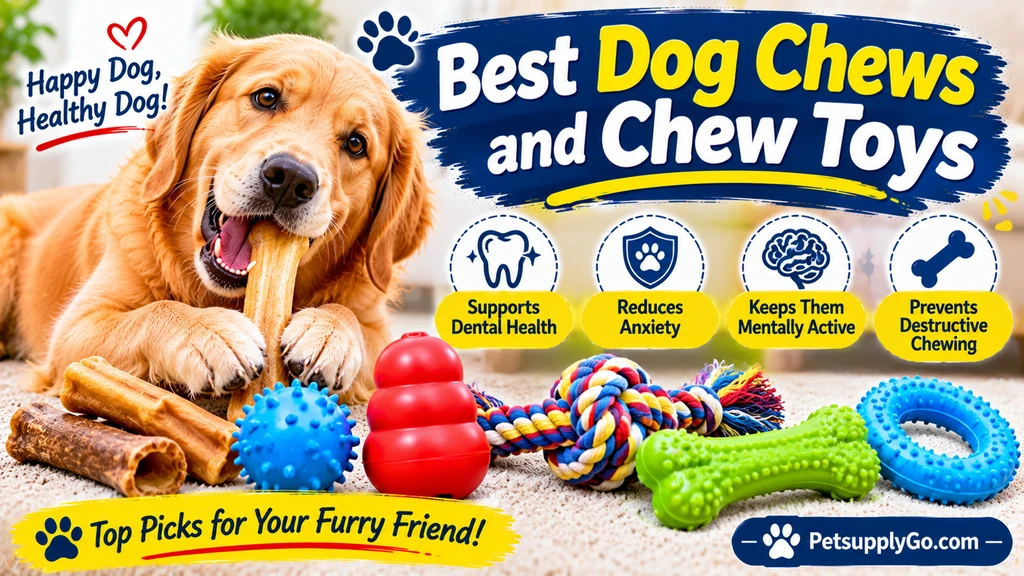
The best dog chews are the ones that match your dog’s size, age and chewing style, and that are safe for your dog. For gentle chewers, soft rubber, plush and rope toys work well. For moderate chewers, firm rubber toys and digestible edible chews are a good fit. For power chewers, very tough rubber or specially designed durable toys work best, with careful supervision. Avoid anything so hard that you can’t dent it with your thumbnail, always match the size to your dog, supervise every new chew and replace anything worn or broken.
This guide covers why dogs chew, the main types of chew toys and edible chews, which ones are safest and which carry real risks, how to match a chew to your dog’s chewing style, squeaky toy safety, puppy teething, how to introduce chews, how to stop destructive chewing, and well-known options owners trust. It ends with 30 frequently asked questions.
Quick Answer: Which Chew Should You Buy?
| Your dog | Best options | Watch out for |
| Gentle chewer | Soft rubber, plush, rope, soft edible chews | Overly hard chews they don’t need |
| Moderate chewer | Firm rubber toys, stuffable toys, digestible chews | Toys that break into pieces |
| Power chewer | Very tough rubber toys, purpose-built durable toys | Hard bones, antlers, hooves |
| Teething puppy | Soft rubber, frozen washcloth, puppy-safe chews | Hard toys, small toys |
| Senior dog | Soft, flexible chews | Chews that hurt sore teeth |
| Small dog | Small, soft or medium-firm chews sized for tiny mouths | Chews too big or hard |
| Large dog | Large, sturdy toys that can’t be swallowed | Small balls and chunks |
| Dog who swallows chews fast | Large toys, chews with holders, supervision | Small chews, cooked bones |
| Dog who loves squeaky toys | Tough squeakers, supervised play | Squeakers and stuffing that get eaten |
| Dog with allergies | Single-ingredient chews, non-edible toys | Unknown ingredients |
| Dog on a diet | Non-edible toys, low-calorie chews | Calorie-dense chews |
If you’re not sure where to start, buy one tough rubber toy sized correctly for your dog, one rope or soft toy for gentle play and one digestible chew to use under supervision. Watch how your dog treats each one, and adjust.
Why Dogs Chew
Understanding why your dog chews helps you choose the right outlet.
Instinct. Dogs descend from animals who tore, gnawed and cracked bones to eat. Chewing is built into their biology.
Teething. Puppies have 28 baby teeth, which are replaced by 42 adult teeth, usually between about three and six months of age. Chewing eases the discomfort of sore gums.
Exploration. Puppies and young dogs explore the world with their mouths.
Boredom. A dog without enough exercise or mental stimulation will make their own entertainment.
Stress and anxiety. Chewing is soothing. Dogs may chew more when they’re anxious, such as when left alone or during storms. If chewing is intense and linked to separation, check with your vet or a trainer.
Dental benefit. Gnawing can scrape plaque from teeth, though it’s not a replacement for dental care. [INTERNAL LINK: add your dog dental care guide here]
Attention. If chewing earns a reaction, such as chasing, shouting or taking the item away, some dogs will repeat it.
Hunger. Dogs who aren’t getting enough food or who are on restricted diets may chew more. Ask your vet.
Medical issues. Dental pain, gastrointestinal problems and nutritional issues can change chewing behavior. A sudden increase in chewing deserves a vet check.
Habit. Some dogs simply love to chew, and some breeds, including retrievers, terriers and many herding and working dogs, are especially enthusiastic.
Chewing is healthy when it’s directed to safe items. Your goal isn’t to stop it, but to give it a good home.
Chews vs Chew Toys vs Treats: What’s the Difference?
People use the words loosely, but the categories matter for safety.
Chew toys (non-edible). Rubber, nylon, rope, plush and other materials meant to be gnawed on but not eaten. They last longer, have no calories and don’t spoil. The risk is that dogs sometimes chew off and swallow pieces.
Edible chews. Bully sticks, collagen sticks, yak cheese chews, dental chews and similar products. Dogs can eat them, which is part of the appeal, but they add calories and can carry choking, blockage or contamination risks.
Treats. Quick rewards that are eaten in a few bites. They’re not meant to occupy a dog for a long time.
Stuffable toys. Hollow rubber toys filled with food. These sit between toys and edibles, because the dog works for food but doesn’t eat the toy. [INTERNAL LINK: add your lick mat guide here]
Which is best? Most dogs do well with a mix. Non-edible toys offer safe, long-lasting entertainment. Edible chews offer a special treat for occasional use. Treats are for training and rewards.
Types of Dog Chew Toys (Non-Edible)
1. Rubber Chew Toys
Solid or hollow rubber toys, in varying hardness. Classic examples include KONG-style toys.
Best for: Most dogs, from gentle chewers to power chewers, depending on hardness. Hollow versions can be stuffed.
Watch out for: Choose the right toughness level. Soft rubber breaks apart in power chewers. Replace toys with chunks missing.
2. Nylon Chew Bones
Hard nylon bones that last a long time. Many have bumps and ridges.
Best for: Moderate to heavy chewers who need something durable.
Watch out for: Hard nylon can wear teeth over time, and small pieces can break off and be swallowed. Check the toy regularly, and replace when worn. Choose a size that can’t be swallowed.
3. Rope Toys
Braided rope toys for chewing and tugging.
Best for: Gentle to moderate chewers, tug games, dogs who like to shred.
Watch out for: Dogs can swallow strands, which can cause serious intestinal problems. Discard frayed ropes, and supervise closely.
4. Plush Toys
Soft stuffed toys, often with squeakers.
Best for: Gentle chewers, cuddling, retrieving, puppies in supervised play.
Watch out for: Stuffing, squeakers and stitching come out fast with enthusiastic chewers. Remove and discard damaged toys.
5. Squeaky Toys
Toys with a built-in squeaker, in plush, rubber or vinyl.
Best for: Dogs who love noise and play, gentle to moderate chewers under supervision.
Watch out for: Squeakers are small and swallowable. See the squeaky toy section below.
6. Stuffable Toys
Hollow rubber toys filled with food, peanut butter, yogurt or treats.
Best for: Crate time, alone time, enrichment, slowing down eating.
Watch out for: Calories add up. Clean thoroughly. Choose the right size and toughness.
7. Puzzle Toys and Treat-Dispensing Balls
Toys that release food as the dog moves or manipulates them.
Best for: Smart, energetic dogs, mental exercise.
Watch out for: Not made for heavy chewing. Supervise.
8. Rubber Balls and Fetch Toys
Solid rubber balls and other fetch toys.
Best for: Active dogs, fetch games.
Watch out for: Choose a size that can’t fit entirely in the mouth or throat. Tennis balls can wear teeth, and small balls are choking hazards.
9. Dental Chew Toys
Rubber or nylon toys with ridges, nubs and bristles meant to scrape teeth.
Best for: Dogs who benefit from extra dental attention, as a supplement to brushing.
Watch out for: They don’t replace brushing and vet cleanings.
10. Frozen Toys and Chews
Stuffed toys frozen, or rubber toys with frozen fillers.
Best for: Teething puppies, hot days, long-lasting chewing.
Watch out for: Don’t freeze anything rock-hard that a dog could crack a tooth on. Check with your vet.
11. Durable Fabric Toys
Toys made with heavy-duty fabric, like firehose material.
Best for: Moderate chewers, fetch and tug.
Watch out for: Not indestructible. Supervise, and replace worn toys. Our guide to indestructible dog toys covers tougher options for heavy chewers.
12. Tug Toys
Toys designed for tug of war.
Best for: Interactive play, burning energy.
Watch out for: Don’t tug too hard, especially with puppies. Teach “drop it.”
Edible Chews: What’s Safe, What’s Risky
Edible chews are popular because dogs love them, but they come with more risk than most owners realize. Here’s an honest look.
| Chew | What it is | Pros | Risks and cautions |
| Bully sticks | Dried beef pizzle | Highly digestible, long lasting, single ingredient | Calorie dense, strong odor, bacterial contamination possible, end pieces can be swallowed |
| Collagen sticks | Pressed collagen | Digestible, odor-free options | Soft versions disappear quickly. Check ingredients. |
| Yak cheese chews | Hard dried cheese | Long lasting, protein rich | Very hard, so tooth fractures are possible. Not for everyone. |
| Rawhide | Dried animal hide | Long lasting, cheap | Choking and blockage risk, some contain chemicals or added flavorings, many vets advise caution |
| Pig ears | Dried pig ear | Dogs love them | High fat, contamination risk, can cause stomach upset |
| Antlers | Deer or elk antler | Long lasting, no odor | Very hard. A common cause of broken teeth. Most vets advise against them. |
| Real bones | Raw or cooked | Natural appeal | Cooked bones can splinter, raw bones carry bacteria, both can fracture teeth |
| Hooves | Cow or pig hooves | Cheap, long lasting | Hard, can splinter and fracture teeth |
| Dental chews | Shaped, digestible chews | Made to reduce plaque, some accepted by the VOHC | Calories, size must match dog |
| Jerky treats | Dried meat | Tasty | Check sourcing and ingredients. Some brands have had safety issues. |
| Tendons and trachea | Natural chews | Natural, digestible | Strong odor, variable quality |
| Fish skin chews | Dried fish skin | Lower fat, fish-based | Quality varies |
| Freeze-dried chews | Raw dried meat | High value | Raw handling risks |
What Vets Often Say About Hard Chews
Many veterinarians and veterinary dentists warn that very hard chews, including antlers, hooves, real bones, hard nylon bones and some hard yak cheese products, can fracture teeth. A broken tooth is painful and often needs extraction or a root canal. The simple guideline many vets use: if you can’t make a dent with your thumbnail, it’s probably too hard for your dog’s teeth.
What Vets Often Say About Rawhide
Rawhide is controversial. Some dogs chew it safely, but others bite off chunks and swallow them, which can cause choking or intestinal blockage. Some rawhides have been treated with chemicals or flavorings. If you choose rawhide, pick a reputable brand, supervise closely, take away small leftover pieces and talk to your vet.
Bully Sticks: Popular but Not Perfect
Bully sticks are among the most popular edible chews, and many dogs love them. They’re usually single-ingredient and digestible, which makes them better than many alternatives. But there are things to know:
- They’re high in calories, so count them in your dog’s daily food.
- They smell strongly.
- They can carry bacteria. Wash your hands after handling, and don’t let kids handle them unsupervised.
- Dogs can swallow the last small piece. Use a bully stick holder, or take the stub away when it’s small.
- Choose reputable brands that test for contaminants and are transparent about sourcing.
- Avoid giving them to dogs with sensitive stomachs or pancreatitis without your vet’s advice.
Handling and Hygiene
Edible chews made from animal products can carry bacteria such as Salmonella. Wash your hands after handling, wash bowls and surfaces, and keep chews away from small children and anyone with a weakened immune system. Avoid products with unclear sourcing. Store chews in a dry place.
Chew Safety Rules Every Owner Should Know
1. Match the size to your dog. A chew or toy should be too big to fit entirely in the mouth or be swallowed. When in doubt, go bigger.
2. Do the thumbnail test. Press a thumbnail into the chew. If it leaves a dent, it’s likely safe for your dog’s teeth. If it doesn’t, think twice.
3. Supervise. Especially with new chews. Watch how your dog chews, and take away anything that breaks into chunks.
4. Remove small leftovers. Once a chew is small enough to swallow, take it away.
5. Replace worn toys. Cracks, missing chunks, frayed ropes and exposed stuffing mean it’s time.
6. Watch for gulping. Dogs who swallow big pieces need larger, tougher or different chews.
7. Count calories. Edible chews add up. Keep treats and chews to about ten percent of your dog’s daily calories, as commonly advised by veterinarians.
8. Choose single-ingredient or simple chews. Fewer ingredients mean fewer surprises.
9. Check sourcing and quality. Reputable brands are more likely to test products.
10. Avoid cooked bones. They splinter.
11. Don’t leave toys that could be dangerous unsupervised. Ropes, plush and edibles are best used with supervision.
12. Know the signs of blockage. Vomiting, loss of appetite, lethargy, abdominal pain, constipation or diarrhea after chewing can signal a blockage, which is an emergency. Contact your vet right away.
13. Know the signs of choking. Gagging, pawing at the mouth, difficulty breathing and blue gums need immediate help.
14. Keep chews away from kids and other pets. Dogs may guard chews, and other animals may swallow them.
15. Ask your vet. Especially if your dog has dental problems, allergies, pancreatitis or a sensitive stomach.
Matching a Chew to Your Dog’s Chewing Style
Every dog chews differently. Observe yours for a few days to figure out the type.
Gentle Chewers
These dogs mouth, lick and nibble. They carry toys around and rarely destroy them.
Best options: Plush toys, rope toys, softer rubber, soft edible chews.
Tips: They may not need heavy-duty toys. Give variety, and check for wear.
Moderate Chewers
These dogs chew steadily, and toys show wear in a few weeks.
Best options: Firm rubber toys, stuffable toys, durable fabric toys, digestible edible chews.
Tips: Rotate toys, and replace when worn.
Power Chewers
These dogs destroy most toys in minutes. They crunch, tear and swallow.
Best options: Very tough rubber toys, purpose-built durable toys, large nylon chews with careful monitoring.
Tips: Supervise at all times. Avoid anything that breaks into pieces. Our indestructible toys guide covers more options.
Shredders
These dogs love tearing things apart, especially plush toys.
Best options: Tough fabric toys, rubber toys. Supervised plush play in moderation.
Tips: Take away stuffing and squeakers if swallowed.
Gulpers
These dogs try to swallow whole pieces.
Best options: Large, firm toys that can’t fit in the mouth, chews with holders, stuffable toys.
Tips: Avoid small, soft or crumbly chews. Supervise.
Lickers and Nibblers
These dogs enjoy licking and slow chewing.
Best options: Stuffable toys, lick mats, soft rubber toys.
By Life Stage and Size
Puppies: Soft rubber, frozen washcloths and puppy-safe chews. Avoid hard items that can damage developing teeth.
Adult dogs: Match to chewing style and size.
Seniors: Soft, flexible chews that don’t aggravate sore teeth or gums. Check for dental issues.
Small dogs: Smaller, softer chews. Many “tough” toys are too hard for tiny teeth.
Large dogs: Larger, tougher toys. Avoid small balls and chunks.
Flat-faced dogs: Choose toys they can hold easily. Avoid toys that block the airway.
By Special Situation
Dogs with allergies: Choose single-ingredient chews, or non-edible toys.
Dogs with sensitive stomachs: Skip rich, fatty chews. Ask your vet.
Overweight dogs: Use non-edible toys, or low-calorie chews.
Anxious dogs: Stuffable toys, lick mats and calm chews can help. Don’t rely on them alone.
Multi-dog homes: Give each dog their own chews, and supervise to prevent guarding.
Squeaky Toys: What Owners Should Know
Squeaky toys are among the most popular items for dogs, and the most debated.
Why Dogs Love Them
The squeak sounds like prey, which triggers play and hunting instincts. Squeaky toys also give feedback, since each bite makes noise.
Which Dogs Do Well With Them
- Gentle and moderate chewers
- Dogs who carry toys without destroying them
- Dogs who play fetch and retrieve
- Puppies in supervised play
Which Dogs Should Skip Them
- Dogs who tear toys apart to reach the squeaker
- Dogs who swallow stuffing and squeakers
- Dogs who become overly excited or obsessive
- Dogs with noise sensitivity
Safety Tips
- Supervise play. Squeakers, stuffing and seams are all risks.
- Check for damage. Throw away toys with holes, loose seams or exposed squeakers.
- Remove the squeaker if needed. For some toys, you can cut a small slit and remove the squeaker carefully, then stitch the seam. Do this only if you can do it safely, and watch for stuffing.
- Choose durable toys. Look for reinforced seams and tough fabrics.
- Choose the right size. A toy that’s too small can be swallowed.
- Limit the noise. Squeaking at high volume can bother some dogs, other pets and people.
- Rotate toys. It keeps interest.
- Take away toys at bedtime. Unsupervised squeaky toys are risky.
- Teach “drop it” and “trade.” It prevents guarding.
- Watch for obsession. If your dog can’t relax and keeps hunting the squeak, give a break.
Quieter Options
Some owners prefer toys with softer squeaks, crinkle fabric or no noise at all. Many dogs like these just as much.
Features That Matter When Choosing Chews and Toys
Material. Non-toxic, durable, safe if chewed. Look for clear material information. Be wary of strong chemical smells.
Hardness. Firm but with some give. Use the thumbnail test.
Size. Too big to swallow, but easy to hold.
Shape. Avoid shapes that can lodge in the mouth or throat.
Texture. Ridges and bumps can help clean teeth but shouldn’t be sharp.
Durability. Look for reputable brands with warranties or guarantees.
Ease of cleaning. Dishwasher-safe rubber toys are easy to clean.
Fillable. Hollow toys let you add food for enrichment.
Safety features. Rounded edges, no small parts, no loose attachments.
Sourcing and testing. For edible chews, choose brands that share where ingredients come from and how products are tested.
Odor. Some edibles smell strongly. Think about your home.
Price and value. A pricier toy that lasts months is often better than a cheap one that lasts minutes.
Warranty or replacement policy. Some brands replace toys that are destroyed under normal use, within limits.
Top Dog Chew and Toy Picks
Prices are approximate and change often. Check the current listing, size chart and ingredient or material details before you buy. I’ve grouped these by use rather than ranking them, since the best choice depends on your dog’s size and chewing style. Product lines change, so confirm details on the listing.
Best All-Around Rubber Toy: KONG Classic
The KONG Classic is one of the best-known dog toys in the US. It’s a hollow, bouncy rubber toy that dogs can chew, chase and stuff with food. It comes in several sizes and toughness levels, and the standard red rubber suits most moderate chewers.
Good for: Moderate chewers, crate time, enrichment, stuffing with treats.
Pros: Durable, versatile, available in many sizes, easy to find.
Cons: Not indestructible. Needs cleaning. Choose the right size and toughness.
Best for Tough Chewers: KONG Extreme
A tougher, black rubber version designed for powerful chewers. It has the same hollow shape for stuffing.
Good for: Strong chewers who destroy standard rubber toys.
Pros: Durable, stuffable, trusted brand.
Cons: Heavier and firmer. Supervise, and replace if damaged.
Best Nylon Chew: Nylabone Power Chew
Nylabone makes a range of nylon chew bones in different flavors and sizes, with a version for power chewers. They’re long lasting and affordable.
Good for: Moderate to heavy chewers who want a long-lasting chew.
Pros: Inexpensive, long lasting, many sizes.
Cons: Hard nylon can wear teeth. Small pieces can break off. Check the product and size, supervise and replace when worn.
Best Tough, Dishwasher-Safe Option: West Paw Zogoflex Toys
West Paw makes durable, flexible toys, including stuffable options, from a firm material marketed as recyclable and made in the USA. The Toppl is a popular stuffable toy that’s easy to fill and clean.
Good for: Moderate to heavy chewers, owners who want easy cleaning.
Pros: Durable, flexible, dishwasher-friendly, replacement guarantees on some products.
Cons: Higher price. Check the guarantee terms.
Best Flavored Chew Bone: Benebone
Benebone makes nylon chews flavored with real ingredients, like chicken or bacon, in shapes designed to be easy to hold. Many dogs love them.
Good for: Chewers who need extra motivation, moderate to heavy chewers with careful supervision.
Pros: Appealing flavor, designed to be gripped easily, sized by weight.
Cons: Hard chew. Apply the thumbnail test, supervise, replace when worn and avoid for dogs with dental problems. Check ingredients if your dog has allergies.
Best for Extreme Chewers: Goughnuts Chew Toys
Goughnuts makes very tough rubber chew toys, with a safety feature: an inner layer that shows color if the toy has been chewed through. Many owners of power chewers swear by them.
Good for: Power chewers, owners who are tired of replacing toys.
Pros: Very durable, safety indicator, replacement policy.
Cons: Expensive. Firm. Supervise at all times.
Best Rope Toy: Mammoth Flossy Chews
Mammoth makes cotton rope toys with knotted designs. They’re popular for tug and light chewing.
Good for: Gentle to moderate chewers, tug, teeth flossing.
Pros: Affordable, long-lasting for gentle chewers, good for interactive play.
Cons: Not for dogs who shred and swallow rope. Discard when frayed. Always supervise.
Best Squeaky Plush: Multipet Lamb Chop and Tuffy Plush Toys
Multipet’s Lamb Chop is a classic soft squeaky toy that many dogs adore. Tuffy’s makes plush toys designed with reinforced stitching for tougher play.
Good for: Gentle chewers, retrievers, puppies in supervised play, dogs who love to carry toys.
Pros: Affordable, loved by many dogs, plenty of designs.
Cons: Not for shredders. Check for loose seams and squeakers, and supervise.
Best Edible Chew: Bully Sticks From a Reputable Brand
Bully sticks are among the most popular edible chews. Choose a trusted supplier that shares sourcing and testing information, and pair them with a bully stick holder. Brands such as Redbarn and Best Bully Sticks are widely sold.
Good for: Dogs who tolerate beef, moderate chewers, supervised treat time.
Pros: Digestible, single ingredient, long lasting.
Cons: Calorie dense, strong odor, bacterial risks, choking risk with small ends. Not for every dog.
Best Long-Lasting Cheese Chew: Himalayan Yak Cheese Chews
These hard, dried cheese chews are popular as a long-lasting option.
Good for: Moderate chewers who tolerate dairy, as an occasional chew.
Pros: Long lasting, simple ingredients.
Cons: Very hard, so tooth fracture is a risk. Choose carefully, and supervise. Some versions are softened by microwaving, which can be hot, so follow the brand’s instructions.
A Note on Brands and Reviews
Chew products change often, and quality varies by batch and by dog. Read recent reviews from owners with a dog of a similar size and chewing style. Watch for comments on durability, odors, breakage and any stomach upset. Be skeptical of claims such as “indestructible” or “vet approved,” since no toy is indestructible and “vet approved” isn’t a regulated term.
How to Introduce a New Chew Safely
- Pick a quiet time and place. Avoid chaos, and keep other pets away.
- Check the size. Make sure the chew can’t be swallowed whole.
- Offer it under supervision. Stay close for the first session.
- Watch how your dog chews. Look for chunks breaking off, gulping or excessive drooling.
- Take it away if it breaks apart. Replace with a safer option.
- Limit the time. Ten to thirty minutes is plenty for edible chews.
- Remove small leftovers. Throw them away.
- Wash your hands and the area. Especially with edible chews.
- Give fresh water. Chewing makes dogs thirsty.
- Keep track of calories. Adjust meals if needed.
First-time edibles: Introduce one new chew at a time, so you can spot reactions. Watch for vomiting, diarrhea, itching or lethargy.
Puppy Teething and Chewing
Puppies chew more than any other dogs. It’s natural, and it’s important to guide it.
The Teething Timeline
- Around 2 to 4 weeks: Baby teeth begin to come in.
- Around 3 to 4 months: Baby teeth start to fall out. Chewing often intensifies.
- Around 4 to 6 months: Adult teeth erupt, and chewing peaks for many puppies.
- Around 6 to 8 months: Most adult teeth are in, and chewing may ease, although many dogs keep chewing into adolescence.
Puppies have 28 baby teeth, and dogs have 42 adult teeth. Don’t be alarmed by tiny teeth on the floor. Swallowed baby teeth are normal.
What Helps Sore Gums
- Soft rubber chew toys. Gentle on developing teeth.
- Frozen washcloths. Wet a clean washcloth, twist it and freeze it. Supervise, and take it away if your puppy shreds it.
- Frozen puppy-safe toys. Stuffable toys with a bit of frozen filler soothe gums.
- Chilled, not rock-hard, treats. Avoid anything that could injure teeth.
- A variety of textures. Rotate options.
What to Avoid for Puppies
- Hard nylon bones, antlers, hooves and real bones. They can damage developing teeth.
- Small toys that can be swallowed.
- Cooked bones.
- Rawhide, without veterinary guidance.
- Chews too big or too hard for puppy jaws.
- Rope toys left unsupervised.
- Plush toys left unsupervised.
Puppy-Proofing Matters Too
Chew toys help, but your puppy will still chew. Remove cords, shoes and anything valuable. Use baby gates and exercise pens to limit access. Supervise play. If you’re crate training, give a safe chew in the crate. [INTERNAL LINK: add your crate training guide here]
When to Call the Vet
Contact your vet if your puppy has retained baby teeth that don’t fall out by about six to seven months, bleeding gums, refusal to eat or severe pain. Our Dog Care section has more on puppy health.
Rotating Toys to Keep Dogs Interested
Dogs get bored with the same toys. A rotation keeps things fresh and extends the life of your toys.
How to rotate:
- Put out three or four toys at a time.
- Store the rest out of reach.
- Swap toys every few days or once a week.
- Mix types: one rubber, one soft, one rope, one stuffable.
- Introduce new toys occasionally, and put old ones back after a break.
Benefits:
- Reduces boredom and destructive chewing
- Makes old toys feel new
- Lets you inspect toys regularly
- Reduces clutter
Tip: Keep a few favorites available all the time, such as a trusted rubber toy, and rotate the rest.
Teaching “Drop It” and “Trade”
Chews and toys work better when your dog will give them up on request. It prevents guarding and keeps your dog safe if they pick up something dangerous.
Drop It
- Offer a toy your dog likes but doesn’t love.
- When your dog is chewing it, show a tasty treat near the nose.
- When your dog drops the toy to take the treat, say “drop it,” and give the treat.
- Give the toy back sometimes, so dropping isn’t always a loss.
- Practice daily, in short sessions.
- Gradually use less valuable treats, and add distractions.
Trade
- When your dog has something you want back, offer a more valuable item, such as a treat.
- When your dog releases the item, praise and treat.
- Return the original item if it’s safe.
Tips
- Don’t chase or pull. It turns into a game.
- Stay calm. Guarding often gets worse if you’re aggressive.
- If your dog growls or snaps over items, ask a trainer for help. Don’t punish.
- Practice with low-value items first.
Stop Destructive Chewing: Troubleshooting
| Problem | Likely cause | What to try |
| Chews furniture | Boredom, teething, lack of options | Provide appropriate chews, exercise and supervision |
| Chews shoes | Smell, texture, attention | Keep shoes out of reach, offer a similar-textured chew |
| Chews when left alone | Anxiety or boredom | Exercise first, stuffed chews, crate or pen, talk to your vet if intense |
| Destroys every toy | Power chewer, wrong toy type | Switch to tough rubber, supervise |
| Swallows pieces | Gulper | Larger, firmer toys, supervision, holders |
| Guards chews | Resource guarding | Trade, don’t punish, call a trainer |
| Chews cords and wires | Curiosity | Cover or remove cords, supervise |
| Suddenly chews more | Stress, teething, medical issue | Check with your vet |
| Ignores toys | Not interesting | Try different textures and flavors, add food, play together |
| Chews at night | Needs outlet | Evening exercise, safe chew in a crate or bed |
Prevention checklist:
- Provide daily exercise, play and training.
- Offer safe chews in a few different textures.
- Dog-proof your home, and keep valuables out of reach.
- Use bitter-tasting deterrent sprays on furniture, if safe, though effectiveness varies.
- Supervise puppies and new dogs.
- Don’t give old shoes or socks as toys. Dogs can’t tell the difference.
- Don’t punish after the fact. Dogs don’t connect it to the chewing.
- Redirect gently, and praise when they chew the right thing.
Cleaning and Replacing Chews and Toys
Rubber and nylon toys: Wash with warm soapy water, or in the dishwasher if the label allows. Scrub grooves and hollows. Dry fully.
Rope toys: Wash in the washing machine on a gentle cycle, or by hand. Dry fully to prevent mold. Throw away when frayed.
Plush toys: Machine wash, if the label allows, in a laundry bag. Air dry. Remove toys with holes or exposed stuffing.
Stuffable toys: Clean after each use. Leftover food spoils.
Edible chews: Throw away leftovers that are soft, slimy or small enough to swallow.
Replace toys when:
- They have cracks, chunks missing or sharp edges
- Ropes fray or strands come loose
- Stuffing or squeakers are exposed
- Rubber becomes brittle or sticky
- The toy is small enough to swallow
- It smells moldy and won’t wash clean
Mistakes to Avoid
Buying the wrong size. Too small is dangerous.
Choosing the hardest chew. Harder isn’t better. Broken teeth are common.
Giving chews unsupervised. Especially new ones.
Ignoring wear. Damaged toys can hurt.
Giving cooked bones. They splinter.
Giving too many edible chews. Calories add up.
Using old shoes or clothes as toys. Dogs can’t tell the difference.
Leaving ropes and plush toys out unsupervised. Swallowed strings are dangerous.
Not rotating toys. Boredom leads to destruction.
Skipping exercise. A tired dog chews less.
Assuming “indestructible” means safe. No toy is truly indestructible.
Ignoring ingredients. Check for allergens and additives.
Punishing chewing. Redirect instead.
Ignoring signs of illness. Sudden changes in chewing, appetite or behavior can signal a health problem.
How Much Should You Spend?
Basic toys (roughly $5 to $15): Plush, rope and simple rubber toys. Fine for gentle chewers.
Mid-range toys (roughly $15 to $30): Better rubber and nylon, stuffable toys, durable fabric. Good for most dogs.
Premium toys (roughly $25 to $50 and up): Very tough rubber, brands with guarantees, specialty toys for power chewers.
Edible chews (roughly $1 to $10 each or $15 to $50 per bag): Costs vary with size, type and quality.
Think about value. A toy that lasts months saves money over several cheap toys that last minutes. But a pricey toy that doesn’t suit your dog isn’t a bargain. Start with one or two, and learn what your dog likes.
Final Thoughts: Give the Chewing a Good Home
Dogs chew. It’s part of who they are, and it’s far easier to guide than to stop. Offer a few safe, well-chosen chews and toys, matched to your dog’s size, age and style. Skip the rock-hard stuff that breaks teeth. Supervise new items, watch for wear and rotate toys to keep things interesting. Add exercise, training and plenty of attention, and most destructive chewing fades.
If your dog suddenly chews more, swallows things they shouldn’t or shows signs of pain or anxiety, talk to your vet. Chewing can be a signal.
With the right chew in the right hands, or paws, you can keep your furniture intact, your dog happy and your own shoes where they belong.
Browse more helpful guides in our Dog Care section.
Chewing Habits by Breed Type
Breed doesn’t decide everything, but it gives clues. Use this as a starting point, and watch your own dog.
Retrievers (Labrador, Golden, Chesapeake Bay): Bred to carry things in their mouths, and many are enthusiastic chewers well into adulthood. Labs in particular are famous for swallowing things. Choose large, tough rubber toys and stuffable toys, and supervise. Avoid small balls.
Terriers (Jack Russell, Staffordshire, Bull Terrier): Strong jaws and high energy. Many are power chewers and shredders. Tough rubber toys and supervised play work best.
Herding breeds (Border Collie, Australian Shepherd, Heeler): Smart and energetic, they chew when bored. Puzzle toys, stuffable toys and plenty of exercise help.
Bully breeds (Pit Bull, American Bulldog, Boxer): Powerful jaws. Look for very tough toys, and avoid cheap plush and soft rubber.
Hounds (Beagle, Coonhound, Basset): Scent-driven and food-motivated. Stuffable toys and scent games are great outlets. Beagles may gulp edible chews.
Toy breeds (Chihuahua, Yorkie, Maltese): Small mouths and small teeth. Choose soft, small chews, and avoid hard nylon and antlers.
Dachshunds and long-bodied dogs: Often chew when bored or anxious. Small, soft to medium-firm chews and stuffable toys work well.
Working and guardian breeds (Rottweiler, German Shepherd, Mastiff): Powerful and strong. Choose large, sturdy toys. Giant breeds need very large sizes to avoid swallowing.
Flat-faced breeds (Pug, French Bulldog, Bulldog): May have trouble with big or oddly shaped toys. Choose lightweight, easy-to-hold toys, and watch for overheating during chewing.
Spaniels and Poodles: Moderate chewers who enjoy carrying and retrieving. Soft to medium toys suit most.
Northern breeds (Husky, Malamute): Often destructive when bored. Exercise, enrichment and tough toys are key.
Doodles and mixed breeds: Vary widely. Observe your dog’s style rather than assuming.
Matching Chews to Problems
For Boredom
Stuffable toys, puzzle toys and rotating chews keep minds busy. Add training sessions and more walks. A tired, mentally stimulated dog chews less.
For Anxiety and Stress
Chewing can soothe. Stuffable toys, lick mats and long-lasting chews give a calm outlet. They help with mild stress, but they aren’t a treatment for serious anxiety. Talk to your vet or a trainer if your dog panics when left alone.
For Teething
Soft rubber, frozen washcloths and puppy-safe chews. Avoid hard items. See the puppy section above.
For Dental Care
Dental chews with the VOHC seal and brushing are the best combination. Rubber toys with ridges may help a little, but they aren’t a substitute. [INTERNAL LINK: add your dog dental care guide here]
For Rainy Days
Stuffable toys, puzzle feeders, snuffle mats and short training games. A frozen stuffed toy can keep a dog busy for a long time.
For Car Trips and Travel
Choose durable, quiet, easy-to-clean toys. A stuffed rubber toy can keep a dog calm in a hotel or crate. Don’t let dogs chew while the car is moving unless they’re safely restrained, and watch for choking.
For Crate Time
Safe, supervised-friendly options such as stuffed rubber toys. Remove anything that could be swallowed. [INTERNAL LINK: add your crate training guide here]
For Dogs Who Chew Their Own Paws or Skin
Excessive licking and chewing of the body isn’t normal play. Allergies, parasites, anxiety, pain or boredom can be causes. See your vet.
For Dogs Who Eat Everything
Some dogs eat anything they find. Choose toys too large to swallow, and keep the environment clean. Ask your vet about pica, which can have medical or behavioral causes.
Household Items Dogs Chew: Safe and Unsafe
Many owners ask about homemade or household options. Here’s a practical guide.
Safer Options in Moderation
- Frozen carrots (large, whole, supervised). Some dogs enjoy them. Make sure pieces are too big to swallow.
- Frozen, stuffed rubber toys. Fill with plain yogurt, pumpkin or wet dog food.
- Large clean ice cubes made from broth. Check for hardness, and avoid for dogs with sensitive teeth.
- A knotted, clean towel. For gentle chewers only, supervised, and discard if frayed.
- Cardboard tubes or paper boxes. For short, supervised shredding play. Remove pieces, and avoid inks or tape.
Items to Avoid
- Old shoes, socks and clothing. Teach dogs that these are toys, and you’ll have trouble.
- Sticks and wood. Splinters can injure the mouth, throat and gut. Wood can also break teeth.
- Rocks. Dangerous to teeth and intestines.
- Plastic bottles and bags. Plastic pieces can be swallowed, and bags are a suffocation risk.
- Human toys, coins, batteries, magnets and small items. Swallowed objects can be life threatening. Button batteries and magnets are emergencies.
- Corn cobs. Common cause of blockage.
- Cooked bones. They splinter.
- Rawhide from unknown sources. See the rawhide note above.
- Chew toys made for kids. Not made for dog jaws.
- Items with toxic coatings or treatments. Many household items are chemically treated.
- Anything with xylitol. This includes some gum, candies and baked goods. It’s toxic to dogs.
Rule of thumb: If you wouldn’t want your dog to swallow it, don’t leave it within reach.
Edible Chew Quick Reference: Time, Size and Frequency
These are general guidelines. Always follow the product label, and ask your vet about your dog’s needs.
| Dog size | Typical chew size | Typical time per chew | How often |
| Toy (under 10 pounds) | Small, soft | 5 to 15 minutes | A few times a week |
| Small (10 to 25 pounds) | Small to medium | 10 to 20 minutes | A few times a week |
| Medium (25 to 50 pounds) | Medium | 15 to 30 minutes | Several times a week |
| Large (50 to 90 pounds) | Large | 20 to 40 minutes | Several times a week |
| Giant (over 90 pounds) | Extra large | 30 to 45 minutes | Several times a week |
Notes:
- Remove leftovers once the chew is small enough to swallow.
- Count calories toward your dog’s daily total.
- Skip edibles for dogs with a history of pancreatitis, food allergies or digestive trouble unless your vet approves.
- Offer plenty of fresh water.
- Rotate types, and avoid giving the same edible every day.
Toy Safety Inspection Checklist
Check your dog’s toys once a week. It takes about two minutes.
- [ ] No cracks, chunks missing or sharp edges
- [ ] No frayed ropes or loose strands
- [ ] No exposed stuffing, squeakers or stitching
- [ ] No small pieces that could fit in your dog’s throat
- [ ] Rubber isn’t brittle, sticky or crumbling
- [ ] The toy is still too big to swallow
- [ ] No strong odor or mold
- [ ] No loose parts, such as eyes, buttons or ribbons
- [ ] Stuffable toys are clean inside
- [ ] Hard toys still pass the thumbnail test
- [ ] Toys in the rotation are a good mix of types
- [ ] Any damaged toy has been thrown away
Chews in Multi-Dog Homes
Having more than one dog adds extra things to think about.
Separate for chewing. Give each dog their own space and chew, especially with edible chews. Many dogs guard valuable items.
Match toys to each dog. A toy that’s safe for a large dog may be a hazard for a small one, and vice versa. Keep small-dog toys out of reach of dogs who could swallow them.
Pick up chews when finished. Don’t leave edible chews lying around.
Watch for tension. Stiff posture, hard stares, growling or freezing are warning signs. Separate the dogs, and ask a trainer for help.
Give equal attention. Avoid favoritism that creates competition.
Duplicates help. Having two of the same toy can reduce disputes over favorites.
Supervise play with shared toys. Tug games and fetch can get rough.
Use crates or baby gates if needed. Separation during chewing is a simple way to keep peace.
Feed and chew in different spots. It reduces the chance of competition.
A Simple Daily Chew Routine
A routine helps dogs get what they need without overdoing it.
| Time | Activity |
| Morning | Walk, breakfast, then a stuffed toy while you get ready |
| Midday | Short play or training, plus a rotating chew toy |
| Afternoon | Walk or fetch, then calm time with a non-edible chew |
| Evening | Dinner, then an edible chew or stuffed toy under supervision |
| Bedtime | Calm, with a safe toy in the bed or crate, if appropriate |
Adjust it for your dog’s age, energy and health. Puppies need more naps and shorter sessions. Seniors may prefer soft chews and shorter walks.
What to Do If Your Dog Swallows Part of a Toy or Chew
It happens to many dogs. Knowing what to do can save a life.
Step 1: Stay calm. Panic doesn’t help.
Step 2: Check your dog. Is your dog breathing normally? If your dog is choking, with gagging, pawing at the mouth, blue gums or difficulty breathing, this is an emergency. Get to a vet right away, and consider calling ahead.
Step 3: Take away any remaining pieces. Prevent further swallowing.
Step 4: Figure out what was swallowed. Note the type of toy, the size of the missing piece and when it happened. Keep the packaging if you can.
Step 5: Call your vet or an animal poison hotline. Describe what was swallowed. Some items, such as batteries, magnets, fishhooks, sharp pieces or toxic materials, need immediate attention. Your vet may ask you to come in.
Step 6: Don’t induce vomiting unless told to. Some objects can cause more harm coming up, and some dogs shouldn’t vomit. Only do it under veterinary guidance.
Step 7: Watch for symptoms. Vomiting, loss of appetite, lethargy, abdominal pain or a swollen belly, straining to poop, diarrhea or no stool and restlessness can signal a blockage. These can appear hours or days later.
Step 8: Follow your vet’s advice. Your vet may recommend monitoring, X-rays, ultrasound, induced vomiting in a clinic or surgery.
Step 9: Prevent a repeat. Reassess the toy, size and supervision.
Never wait. Blockages can become life threatening quickly. When in doubt, call your vet.
Common Myths About Dog Chews
“Harder chews clean teeth better.” Not necessarily. Very hard chews can break teeth. Some soft or flexible chews with ridges help clean teeth, and brushing is still the gold standard.
“Indestructible toys exist.” No toy is truly indestructible. Some are extremely tough, but a determined dog can break almost anything.
“Natural means safe.” Many natural chews, such as bones, antlers and hooves, carry real risks.
“If a dog likes it, it must be fine.” Dogs love many things that aren’t good for them.
“Puppies can chew anything.” Puppies’ teeth are fragile and still developing.
“A dog who chews is a bad dog.” Chewing is normal. It needs direction, not punishment.
“Rawhide is digestible.” Rawhide doesn’t break down quickly, and large pieces can cause blockages.
“Dental chews replace brushing.” They help, but don’t replace brushing and vet cleanings.
“Expensive chews are always safer.” Price doesn’t guarantee safety. Fit and supervision matter more.
“Dogs know when to stop.” Many dogs will chew a toy to pieces and swallow them.
“Squeaky toys are bad for all dogs.” They’re fine for many dogs under supervision, but not for dogs who destroy them.
Quick Shopping Checklist
Before you buy any chew or toy, check the following.
- [ ] I know my dog’s chewing style: gentle, moderate or power.
- [ ] The size is too big to swallow.
- [ ] The hardness passes the thumbnail test.
- [ ] The material is non-toxic, and the brand is reputable.
- [ ] For edible chews, I’ve checked the ingredients and sourcing.
- [ ] I’ve counted the calories.
- [ ] My dog has no allergies to the ingredients.
- [ ] I plan to supervise the first use.
- [ ] I know how to clean it.
- [ ] I have a plan to replace it when it’s worn.
- [ ] I’ve checked the return or guarantee policy.
Reading Labels on Edible Chews
Edible chews can look simple, but the label tells a lot. Here’s what to look for.
Named ingredient first. “Beef pizzle” or “collagen” is clearer than “meat byproducts” or “animal derivatives.” Single-ingredient chews are easier to evaluate.
Short list. Fewer ingredients mean fewer surprises, especially for dogs with allergies.
No added sugars or sweeteners. Check for sugar, molasses, syrups and especially xylitol, which is toxic to dogs.
Preservatives and flavorings. Some chews contain artificial colors, flavors and preservatives. Dogs with sensitivities may react.
Country of origin and sourcing. Reputable brands share where ingredients come from and how products are made. Vague or missing information is a red flag.
Calories. Many labels list calories per chew. If it doesn’t, call or email the brand. High-calorie chews matter for dogs who need to lose weight.
Guaranteed analysis. Shows protein, fat, fiber and moisture. Higher fat can cause stomach trouble in sensitive dogs.
Size guidance. Look for a recommended weight range.
Best-by date and lot number. Useful for recalls and freshness.
Feeding directions. Look for supervision instructions and warnings, such as “remove when small enough to swallow.”
Company contact information. A real phone number or email suggests a company that stands behind its products.
Chews for Dogs With Health Conditions
Dogs with medical issues need extra care. These are general notes, and your vet’s advice always comes first.
Pancreatitis or fat sensitivity. Rich, fatty chews such as pig ears and some bully sticks can trigger flare-ups. Non-edible toys are safer. Ask your vet.
Kidney disease. Protein and phosphorus limits may apply to edible chews. Ask your vet.
Diabetes. Edible chews add calories and sometimes sugars. Check with your vet.
Obesity. Use non-edible toys, or count chew calories carefully.
Dental disease or sore mouths. Hard chews can hurt. Choose soft, flexible options, and get a dental exam. [INTERNAL LINK: add your dog dental care guide here]
Food allergies. Non-edible toys avoid the problem. For edibles, choose single-ingredient options that match your vet’s plan.
Arthritis. Soft toys are easier on jaws, and a comfortable bed helps joints. Our guide to dog beds for large dogs covers supportive options.
Heart disease. Avoid salty chews, and ask your vet about treats.
Digestive problems. Introduce chews slowly, or skip edibles.
Recovering from surgery. Ask your vet about chewing, since dogs may need to avoid certain activities.
Seizure disorders or special diets. Ask your vet about any new edible product.
Adolescence: The Second Chewing Phase
Many owners think chewing ends with teething. Then their dog turns eight months old, and the couch cushions start disappearing again.
What’s happening. Adolescent dogs, roughly six to eighteen months, have adult teeth and a lot of energy. They test limits, explore and sometimes get bored or anxious. Chewing often picks up again.
What helps:
- More exercise and mental stimulation
- Structured training sessions
- A good supply of tough chews and stuffable toys
- Consistent supervision
- Management, such as baby gates, closed doors and a crate or pen when you can’t watch
- Patience
What doesn’t help:
- Punishment after the fact
- Leaving a bored dog alone for hours
- Expecting your dog to know what’s off-limits
Most dogs calm down as they mature, often by two years old, though some breeds stay chewy longer. If chewing gets worse or looks compulsive, talk to your vet or a trainer.
Seasonal Chew Ideas
Summer
- Frozen stuffed toys. Fill a rubber toy with plain yogurt or wet food, and freeze. It cools your dog and lasts longer.
- Frozen broth pops. Freeze low-sodium, onion-free broth in a stuffable toy.
- Water-friendly toys. Rubber toys that float suit dogs who swim.
- Shade and water. Chewing in the heat can raise body temperature. Watch for panting.
Fall
- Rainy-day puzzle toys. Keep dogs busy indoors.
- Safe seasonal chews. Avoid acorns and some mushrooms and plants, which can be toxic.
Winter
- Indoor games. Stuffable toys and puzzle feeders when it’s too cold to stay outside long.
- Holiday cautions. Watch for chocolate, xylitol, cooked bones, ornaments and tinsel. Keep them out of reach.
- Cozy chewing. A calm chew in a warm bed helps settle dogs on cold evenings.
Spring
- New toys. Time to refresh your collection after winter.
- Outdoor chewing. Watch for sticks and garden products that can harm dogs.
Red Flags When Buying Chews Online
Online shopping is convenient, but it’s easy to buy something risky. Watch for these warning signs.
- No ingredient list or vague descriptions. Reputable products list what’s inside.
- Claims of “indestructible” or “100 percent safe.” No toy is indestructible, and no chew is completely safe.
- No brand information or contact details. Hard to hold anyone accountable.
- Strong chemical smell reported in reviews. Poor materials or coatings.
- Reviews mentioning broken teeth, blockages or illness. Take these seriously, even if there are only a few.
- Pricing that seems too good to be true. Quality and safety testing cost money.
- Imported products with unclear sourcing. Look for brands that share where products are made and tested.
- Product photos that don’t show size or scale. Check dimensions in the description.
- Weight ranges that are very broad. A chew that suits a 10-pound dog and a 90-pound dog is unlikely to be right for both.
- Fake or suspicious reviews. Look for patterns, repeated phrases or reviews that don’t mention the product.
Tip: Buy from retailers with clear return policies, and read recent reviews from dogs like yours. Start with one chew before stocking up.
Frequently Asked Questions (30 FAQs)
1. What are the best chews for dogs?
The best chews match your dog’s size, age and chewing style, and are safe for their teeth. Firm rubber toys, stuffable toys and digestible edible chews suit many dogs. Avoid anything so hard you can’t dent it with your thumbnail, and always supervise.
2. What are the safest chews for dogs?
Non-edible rubber toys of the right size and toughness are among the safest options, along with some digestible edible chews used under supervision. Safety depends on your dog. Skip cooked bones, hooves, antlers and anything that breaks into chunks.
3. What is the best chew toy for a power chewer?
Very tough, solid rubber toys designed for strong chewers, such as KONG Extreme or Goughnuts, are common choices. Even these aren’t indestructible, so supervise, and replace worn toys. Avoid hard bones and antlers, which risk broken teeth.
4. What is the best chew toy for puppies?
Soft rubber toys, frozen washcloths and puppy-specific chews are good choices for teething. Avoid hard nylon, antlers, hooves and small toys. Supervise, and keep sessions short.
5. Are bully sticks safe for dogs?
Many dogs enjoy bully sticks, and they’re digestible. But they’re high in calories, can carry bacteria and can be swallowed when they get small. Choose a reputable brand, use a holder, supervise and wash your hands after handling.
6. Is rawhide bad for dogs?
Many vets advise caution. Rawhide can cause choking and intestinal blockages if chunks are swallowed, and some products contain chemicals or flavorings. If you use rawhide, choose a reputable brand, supervise and take away small pieces. Ask your vet.
7. Are antlers safe for dogs?
Most vets advise against them. Antlers are very hard and a common cause of broken teeth. If you can’t dent a chew with your thumbnail, it’s likely too hard.
8. What is the thumbnail test?
Press your thumbnail into the chew. If you can leave a dent, it’s likely soft enough for your dog’s teeth. If it doesn’t dent, it may be too hard and could fracture a tooth.
9. Can chew toys break dogs’ teeth?
Yes. Very hard items such as antlers, hooves, real bones, hard nylon and some hard cheese chews can fracture teeth. Choose chews with some give, and ask your vet about your dog’s teeth.
10. How do I choose the right size chew?
The chew should be too large to fit entirely in your dog’s mouth or be swallowed. Check the weight range on the packaging, and size up for gulpers. When in doubt, go bigger.
11. Are squeaky toys safe for dogs?
They can be safe for gentle chewers under supervision. Risks include swallowing squeakers and stuffing. Check toys often, discard damaged ones and skip squeaky toys for dogs who shred them.
12. Why do dogs love squeaky toys?
The sound mimics prey, which triggers play and hunting instincts. The squeak also gives a satisfying response to each bite.
13. What should I do if my dog swallows a squeaker?
Contact your vet right away. A swallowed squeaker can cause a blockage or other problems. Watch for vomiting, lethargy, loss of appetite and abdominal pain.
14. How do I know if a toy is too dangerous?
Avoid toys with small parts, loose attachments, brittle plastic, strong chemical smells or a size that fits fully in your dog’s mouth. Replace toys with cracks, chunks missing or exposed stuffing.
15. How often should I replace dog chew toys?
Replace them when they show wear, such as cracks, missing pieces, frayed ropes or exposed stuffing. Heavy chewers may go through toys faster. Inspect toys regularly.
16. Can I leave my dog alone with a chew?
It’s safest to supervise, especially with new or edible chews. Some owners leave tough rubber toys for crate time, but even those carry some risk. Ask your vet or trainer about your dog.
17. How long should I let my dog chew?
For edible chews, ten to thirty minutes is common, then take the chew away. For toys, supervised play can last longer. Watch for gulping and small leftovers.
18. How many chews can my dog have?
Keep treats and edible chews to about ten percent of daily calories, as veterinarians commonly advise. Non-edible toys don’t add calories. Adjust meals if you give lots of chews.
19. What chews are good for dental health?
Some dental chews carry the Veterinary Oral Health Council seal, which means trial data showed plaque or tartar control. Chewing alone doesn’t replace brushing and vet cleanings. [INTERNAL LINK: add your dog dental care guide here]
20. What are good chews for dogs with allergies?
Non-edible toys are the simplest choice. For edible chews, choose single-ingredient products with a protein your dog tolerates, and check labels. Ask your vet to guide food-allergy decisions.
21. What are good chews for sensitive stomachs?
Non-edible toys avoid the problem. For edibles, introduce one slowly, choose simple, lower-fat options and ask your vet. Avoid rich or fatty chews if your dog is prone to stomach upset or pancreatitis.
22. What are the best chews for small dogs?
Small, soft or medium-firm chews sized for tiny mouths. Many tough toys are too hard for small teeth. Check size charts, and supervise.
23. What are the best chews for large dogs?
Large, sturdy rubber toys and appropriately sized chews that can’t be swallowed. Avoid small balls and chunks. Supervise, and check for wear.
24. Are rope toys safe?
They can be for gentle chewers under supervision, but dogs who swallow strands risk serious intestinal blockages. Discard frayed ropes, and don’t leave rope toys with unsupervised dogs.
25. Are tennis balls safe for dogs?
They’re fine for fetch if the size is right, but tennis ball fuzz can wear teeth, and small balls are a choking hazard. Choose balls too big to swallow, and don’t let your dog chew them to shreds.
26. How do I stop my dog from chewing furniture?
Provide appropriate chews, exercise, mental stimulation and supervision. Dog-proof your home, redirect to a toy and praise. Don’t punish after the fact. If chewing is intense or linked to being alone, ask your vet or a trainer.
27. Why does my dog suddenly chew everything?
Common causes include teething, boredom, stress, hunger or medical problems. A sudden change deserves a vet check. Provide more exercise, enrichment and safe chews.
28. Do stuffable toys help with boredom?
Yes. Stuffable toys give dogs a job, last longer than treats and can help with crate time and alone time. Count the calories, and clean the toys.
29. What should I do if my dog guards chews?
Don’t punish or grab. Teach “trade” with a more valuable treat, practice with low-value items first and give the dog space while chewing. If growling or snapping continues, ask a qualified trainer.
30. When should I call the vet about chewing?
Call if your dog swallows a piece of toy or chew, vomits, loses appetite, seems lethargic, has abdominal pain, breaks a tooth or suddenly changes chewing behavior. Seek emergency care for choking or suspected blockage.
Disclaimer: This guide is for general information and isn’t veterinary advice. No chew or toy is completely safe. If your dog swallows part of a toy, shows signs of choking, vomiting, abdominal pain or a broken tooth, please contact your veterinarian right away.
Add a Comment